What Is a Company Brain? Definition and Complete Guide
A Company Brain is a living record of how a business works, for people and AI. What it holds, how it differs from a wiki, RAG or search, and who needs one.

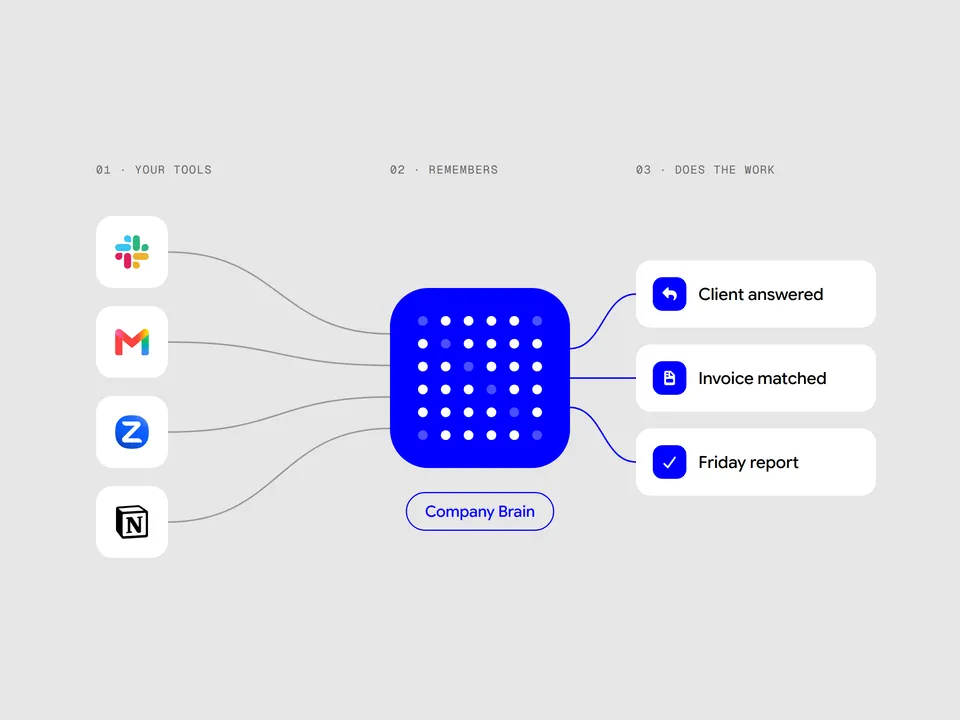
Table of Contents
- What is a Company Brain, in plain words?
- Why does a Company Brain matter now?
- What does a Company Brain contain?
- How is a Company Brain different from the tools we already have?
- Who needs a Company Brain?
- How is a Company Brain built?
- Is the Company Brain category real?
- How does Superstate build a Company Brain?
- Frequently asked questions
Every company already has this knowledge. Most of it sits in people’s heads, chat threads, inboxes and old documents. A Company Brain puts it in one place and keeps it true. This guide covers what a Company Brain holds, how it differs from the tools people confuse it with, who needs one, and how it gets built.
What is a Company Brain, in plain words?
Think of the questions a new hire asks in the first three months. “How do we bill this client?” “Who approves a discount over the usual limit?” “Why did we stop working with that supplier?” The answers exist. They are spread across people and tools, and they change over time.
A Company Brain is where those answers live. It has four jobs:
- Capture. It takes in what the company already says and writes: meetings, calls, chats, emails and documents.
- Remember. It turns that material into clear, dated pages about clients, people, rules and decisions.
- Answer. Anyone can ask it a question and get one answer, with the source it came from.
- Act. AI agents read from it, so they know the company before they do any work.
The key word is living. A document is true on the day someone writes it. A Company Brain changes when the business changes, and it tells you when two of its sources disagree.
Why does a Company Brain matter now?
AI models are strong and widely available. Every company can rent the same ones. What no model has is your context: your clients, your exceptions, your reasons. That context is the difference between an AI tool that writes generic text and one that does the work the way your company does it.
The cost of missing context shows up in the results. MIT’s NANDA initiative reported that about 95% of generative AI pilots at companies fail, and it put the cause on a “learning gap,” not on model quality. Generic tools “stall in enterprise use since they don’t learn from or adapt to workflows” (Fortune, on the MIT report). A Company Brain is the part of the system that does the learning: it holds how your workflows really run, so the AI does not start from zero each time.
We cover this failure in more depth in why AI tools don’t know your business and why AI agents give wrong answers over time.
What does a Company Brain contain?
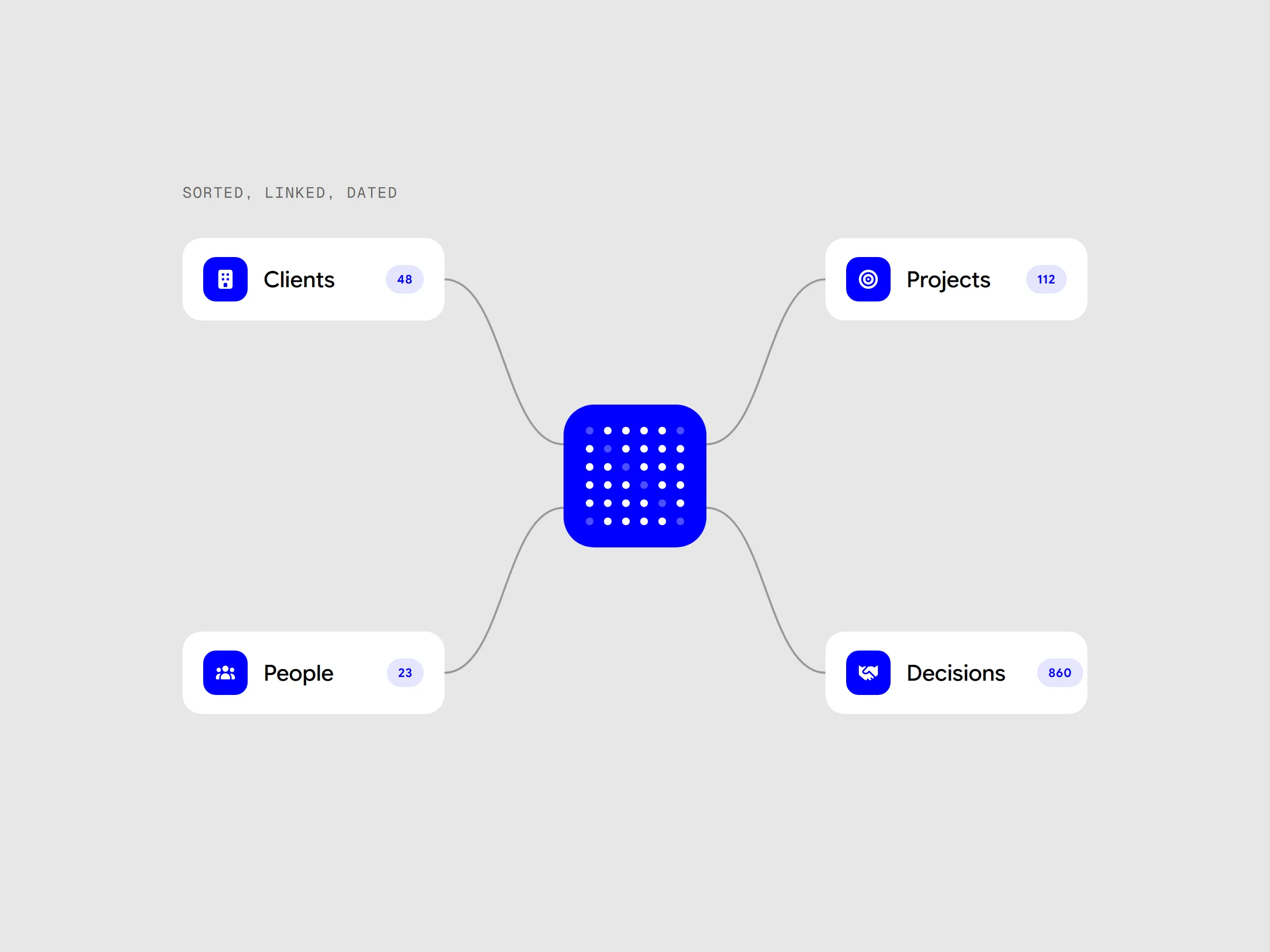
A useful Company Brain holds the knowledge that people ask each other about every week. The examples below are illustrative:
| Area | What it holds | Example |
|---|---|---|
| Clients | Terms, history, contacts, special handling | ”This client is billed quarterly, not monthly, since the last renewal” |
| Prices and offers | Price lists, discounts, who can approve exceptions | ”Partners get 10% on the first order and 5% after that” |
| Processes | How work really moves, step by step, with the exceptions | How a refund is handled for a key account |
| Decisions | What was decided, when, by whom, and why | Why the company dropped a product line |
| People and roles | Who owns what, who knows what | Who signs off on a new supplier |
| Sources | Where each fact came from, with a date | The meeting, email or document behind each page |
Two things set this apart from a pile of files. First, every fact has a source and a date, so you can check it. Second, the brain records the why behind decisions, which is the part that leaves first when people leave.
How is a Company Brain different from the tools we already have?
Most confusion about the term comes from tools that cover one part of the job. Here is how each one compares.
| Tool | What it does well | What it misses | Read more |
|---|---|---|---|
| Wiki (Confluence, Notion) | Stores pages people write | Knowledge nobody wrote down; pages go stale | Company Brain vs wiki |
| KM software with AI (Guru, Notion AI, Rovo, Copilot) | Puts AI search and answers over your docs | The AI layer is only as good as the docs under it | Company Brain vs KM software |
| RAG | Fetches relevant text for a model at question time | It is a technique, not a store of checked knowledge | Company Brain vs RAG |
| Enterprise search (Glean and others) | Finds documents across many tools | Finds where text is, not how the business works | Company Brain vs enterprise search |
| Fine-tuning | Teaches a model a style or a narrow task | Knowledge is frozen in the model on training day | Company Brain vs fine-tuning |
| Large context windows | Let a model read a lot of text at once | Hold nothing between sessions; you still choose what to feed in | Context windows vs Company Brain |
| Second brain (personal notes) | Organizes one person’s thinking | Belongs to one person and leaves with them | Company Brain vs second brain |
| Agent memory | Lets one AI agent remember its past sessions | Serves the agent, not the people who must read and check it | Agent memory vs Company Brain |
Is a wiki or a knowledge base enough?
A wiki holds what someone chose to write down, on the day they wrote it. Most operational knowledge never reaches a page, and the pages that exist drift away from reality. A wiki is good raw material for a Company Brain. It is not one.
We already pay for a KM tool with AI. Is that a Company Brain?
Usually not. Tools such as Guru, Notion AI, Atlassian Rovo and Microsoft Copilot add an AI layer over your existing documents. If the documents are thin or out of date, the AI answers from thin, out-of-date material. The gap is the knowledge, not the search box.
Is a Company Brain just RAG?
No. RAG (retrieval-augmented generation) is plumbing: it fetches text chunks and passes them to a model. A Company Brain is what that plumbing should read from. Retrieval over stale documents gives you stale answers faster.
Is it the same as enterprise search?
No. Enterprise search can show you ten files that mention “refund policy.” It cannot tell you how refunds really work for a key account when the charge is old, because that rule may not be written in any file.
Should we fine-tune a model on our data instead?
Fine-tuning changes the model’s weights. Whatever it learns is fixed on the day of training. Your prices, clients and rules change every week. A Company Brain keeps knowledge outside the model, where you can read it, correct it and update it the same day.
Will bigger context windows make this unnecessary?
A larger context window lets a model read more text in one session. It does not decide which text is current, it does not remember anything after the session, and it does not settle conflicts between sources. Someone still has to keep the knowledge true. That is the job of the brain.
How is it different from a personal second brain?
A second brain is one person’s notes. A Company Brain belongs to the organization. It stays when a person leaves, which is the moment most companies find out how much knowledge they had in one head.
Who needs a Company Brain?
You probably need one if several of these are true:
- A few people hold the know-how. When one of them is on holiday, a process slows down or stops.
- New hires take months to get productive because they must ask many people how things work.
- The same question gets different answers depending on who you ask.
- Old decisions come back because nobody remembers why the company chose what it chose.
- Your AI tools give generic answers because they do not know your clients, prices or rules.
- You want AI agents to do real work, such as answering clients or drafting offers, and they need your rules to do it safely.
These problems hit small and mid-sized companies hard, because one person often carries a whole area of the business. See does a 20–200-person company need a Company Brain and why organizational memory matters.
How is a Company Brain built?
A Company Brain is built in three phases:
- Map. Learn how the business really works from the people who do the work: how jobs move, where the exceptions are, and which knowledge sits in one head.
- Build. Build the brain on that map and connect it to the tools where work happens: email, chat, meetings, files and business systems.
- Run. Give it one owner, a source on every answer and a fast way to correct mistakes. Then keep it current for as long as you use it.
Two things decide whether it works. The first is access rights: the brain must know who may see what, and every agent must inherit those limits (the Company Brain permission gap). The second is upkeep: a brain that nobody keeps current gets worse every week.
The full guide, with what has to be true first and why most builds fail, is in how to build a Company Brain. If you want outside help, see who builds Company Brains and how to choose.
Is the Company Brain category real?
Yes, and it is young. In 2026, Y Combinator asked founders to build one in its Summer Request for Startups (UrbanGeekz), and Engram launched with $98 million to build AI that knows an organization. Garry Tan’s open-source GBrain had passed 30,000 GitHub stars by November 2026 (GitHub). Who is building what, and what the skeptics get right, is in the Company Brain market.
How does Superstate build a Company Brain?
Superstate is an AI implementation company, and a Company Brain is the base of everything it builds for a client. The work starts with a free mapping of how the company really works: a sixty-minute meeting with leadership, then an AI interview agent that talks to key people when it suits them.
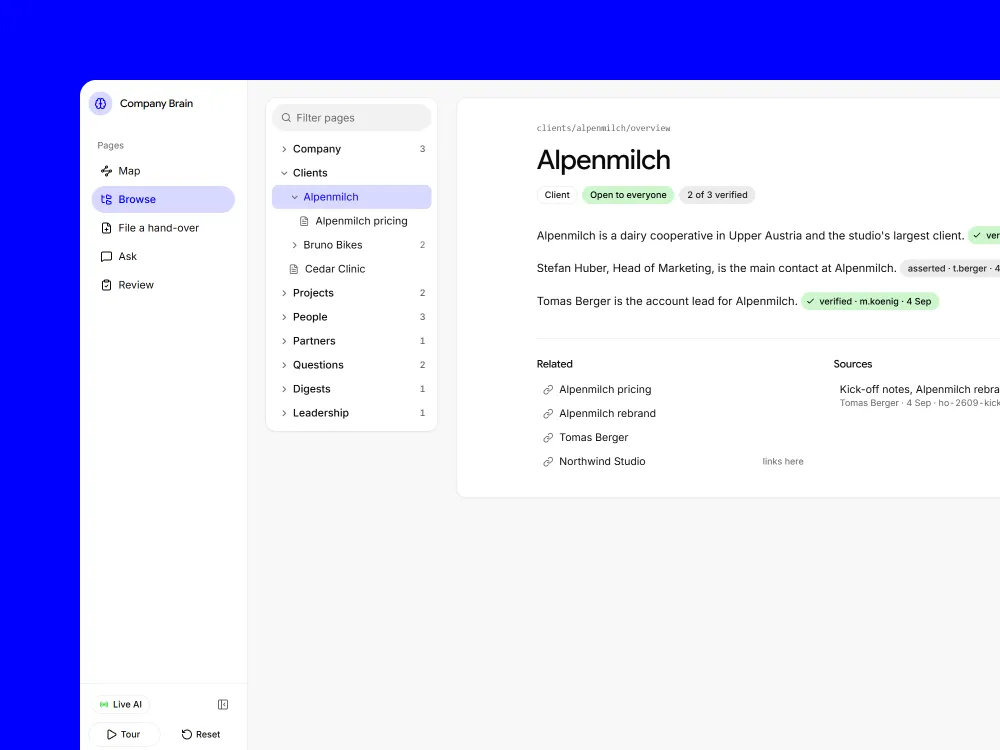
On that map, Superstate builds the client’s own Company Brain. It captures meetings, calls, chats, emails and documents the same day, with the date, and sorts them into plain pages that keep themselves up to date. Every answer shows the page it came from. If two pages disagree, the brain says so. If an answer is wrong, you correct it, and it remembers.
Each client’s brain runs on its own server and is never shared with other clients. The client decides what goes in and who sees it, and keeps everything if they leave. AI agents built on the brain then do the repeated work, and a person approves what matters.
Frequently asked questions
What is a Company Brain?
A Company Brain is a living, queryable record of how a business works: its clients, prices, rules, processes and decisions, with the reasons behind them. It stays current, it shows the source of every answer, and both people and AI tools can use it to do real work.
Is a Company Brain the same as a wiki or a knowledge base?
No. A wiki holds the pages that someone chose to write, and it goes stale when nobody updates them. A Company Brain also captures what was said in meetings, chats and emails, keeps itself current, and flags when two sources disagree. A wiki can be one of its sources.
Is a Company Brain just RAG?
No. RAG is a technique that fetches text and gives it to a model at the moment of the question. A Company Brain is the knowledge that retrieval reads from, kept current and checked. A Company Brain can use RAG, but RAG over stale documents only returns stale answers faster.
Does a small company need a Company Brain?
Often more than a large one. In a company of 20 to 200 people, much of the know-how sits with a few people, and one departure can stop a process. A Company Brain keeps that knowledge in the company and gives AI tools the context to do useful work.
How do you build a Company Brain?
You start by mapping how the business really works, from the people who do the work. Then you build the brain on that map and connect it to the tools where work happens. Then you run it: one owner, a source on every answer, and a fast way to correct it.

Want to know more about what we do? Visit the Superstate website.