The Company Brain Market: Is It Real, and Who Is Building It?
Is the Company Brain category real? A dated look at who is building it, from YC and Engram to Oracle and Anthropic, and what the skeptics get right.

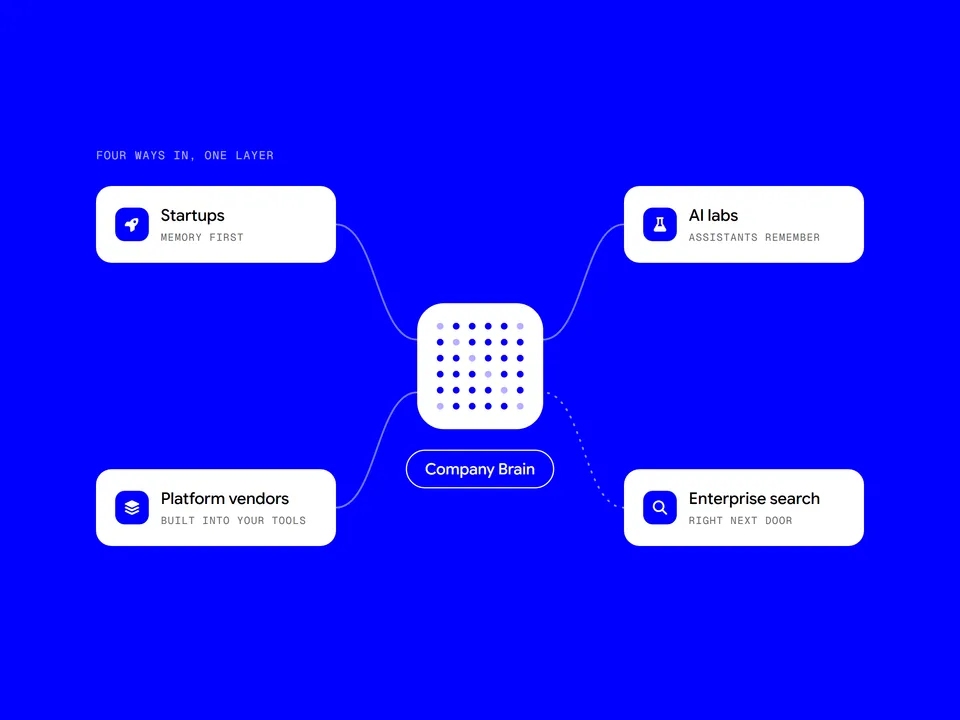
Table of Contents
A Company Brain is the living, queryable record of how a business works, kept current so people and AI tools can act on it. This article sets out who is building that layer, in what order things happened, what the critics say, and what it means for a company that has to choose.
When did the Company Brain become a category?
The current wave has a short, traceable history. Almost all of it happened between April and July 2026.
| Date | Event | Source |
|---|---|---|
| Apr 4, 2026 | Andrej Karpathy publishes the “llm-wiki” gist: an LLM that builds and maintains a markdown wiki between you and your sources | GitHub |
| Apr 5, 2026 | Garry Tan, President of Y Combinator, open-sources GBrain under the MIT license | GitHub |
| May 2026 | YC’s Summer 2026 Request for Startups includes a Company Brain entry by partner Tom Blomfield | UrbanGeekz, May 19, 2026 |
| May 19, 2026 | Databricks announces the Certified Context Engineer Associate, “the industry’s first certification for reliable AI agent systems” | Databricks |
| May 28, 2026 | Glean, the closest enterprise search vendor, reports $300 million in annual recurring revenue | Crypto Briefing |
| Jun 23, 2026 | Engram comes out of stealth with $98 million | PR Newswire |
| Jun 23, 2026 | Anthropic puts Claude Tag, a Slack teammate with persistent channel memory, into beta | TechCrunch |
| Jun 23, 2026 | ClickUp relaunches its built-in AI as Brain², which works from the whole workspace | TestingCatalog |
| Jul 15, 2026 | Oracle releases AI Agent Memory 26.6, built on Oracle AI Database | DBTA |
Two things stand out. First, the idea started as open source, not as a vendor pitch. GBrain alone had passed 30,000 GitHub stars by November 2026 (GitHub). Second, June 23 was a single day on which a startup, an AI lab and a productivity platform all moved on the same layer.
What did Y Combinator actually ask for?
YC’s Request for Startups is a public list of the companies YC wants to fund. The Summer 2026 list included a Company Brain entry by Tom Blomfield, the Monzo founder and YC group partner.
Coverage of the list describes his idea as “the missing primitive of the AI era”: a system that pulls knowledge from scattered sources, structures it, keeps it current, and turns it into “an executable file for AI agents,” a “living map of how a company actually operates” (UrbanGeekz). The entry itself asks for “the institutional memory and intelligence layer for an entire company,” with the goal of “making every employee as informed as the most knowledgeable person in the organization” (Modelence copy of the YC entry).
The detail in that entry is more useful than the slogan. It asks for a system that takes in documents, messages, meetings, code, customer conversations and financial data. It must answer with sources and confidence scores, flag contradictions and gaps, and enforce access controls. That is a fair checklist for any buyer, whoever the vendor is.
Who is building Company Brains?
The players come at the same layer from four directions. Most of them do not call their product a Company Brain. That label comes mostly from YC, analysts and commentators.
| Type of player | Example | What they shipped | Starting point |
|---|---|---|---|
| Ground-up startups | Engram | A learned memory layer for enterprise AI | Memory as its own product |
| AI labs | Anthropic | Claude Tag: one shared Claude per Slack channel that builds memory of the work | Make the assistant remember |
| Platform vendors | Oracle, Databricks, ClickUp | Agent memory in the database; a context-engineering certification; workspace-wide AI | Add memory to what customers already use |
| Enterprise search | Glean | Work AI on top of company search | Find documents, then act on them |
What is Engram, and why did its raise matter?
Engram is the loudest single data point. It raised $98 million from General Catalyst, Kleiner Perkins, Sequoia and others, with Andrej Karpathy and Pieter Abbeel among its angels (PR Newswire). Dealroom reports a $600 million post-money valuation (Dealroom). The company had 13 people at launch (Let’s Data Science).
Its early partners matter more than the number. Microsoft is testing Engram’s models inside Microsoft 365, Notion is testing them in its custom agents, and Harvey is building enterprise memory features with it (PR Newswire). These companies build AI themselves, and they still wanted a separate memory layer.
What are the large vendors doing?
The platform moves are less loud but harder to reverse. Oracle now ships agent memory inside its database, next to search and retention controls (DBTA). Databricks built a certification around context work: memory design, retrieval, and governance with access controls (Databricks). When a vendor certifies a skill, its customers start to hire for it.
Glean sits next to the category rather than inside it. It raised at a $7.2 billion valuation in June 2025 (TechCrunch) and reported $300 million in recurring revenue in May 2026 (Crypto Briefing). For the difference between search and a Company Brain, see Company Brain vs enterprise search.
Why is the context layer the prize?
The short answer: the model is getting easier to replace, and a company’s context is not.
In a November 2025 interview with Dwarkesh Patel, Microsoft CEO Satya Nadella said: “If you’re a model company, you may have a winner’s curse” (TeamDay summary). His point was that a model company can do all the hard work and still see it copied. If the smart part can be copied, the lasting value moves to what cannot: the record of how one specific business decides, prices and operates.
Research points the same way. The Agentic Context Engineering paper reports a 10.6% gain on agent benchmarks from better-managed context alone, with no change to the model.
The failure data shows what is missing today. MIT’s NANDA initiative reported a 95% failure rate for enterprise generative AI pilots and blamed a “learning gap,” not model quality: generic tools do not adapt to how a company works (Fortune). IDC research with Lenovo found that for every 33 AI proofs of concept, only four reached production (CIO.com). The AI was not stupid. It was a stranger to the business. For the full argument, see why AI tools don’t know your business.
Who should own the context layer?
This is the part vendors rarely say out loud. Once a company’s processes, decisions and exceptions live inside one platform, the cost of leaving is no longer the subscription. It is the memory itself.
That pattern is old. CRM and ERP systems became hard to leave because years of company data and configuration built up inside them. A Company Brain builds the same pull, and faster, because AI agents act on it every day. A business that lets its context pile up by default inside five vendors’ tools ends up with five partial brains, none of which it controls.
The practical test is simple. Can you read every page of your Company Brain in plain words? Can you correct it? Can you take it with you if you leave?
Is the Company Brain just marketing?
It is a fair question, and the skeptics make three serious points.
1. “It is knowledge management with a new name.” Companies have tried for decades to get knowledge out of people’s heads, with Lotus Notes, SharePoint, Confluence and Notion. Each followed the same arc: early use, slow neglect, then a wiki nobody updates and nobody trusts. A new label does not fix that.
2. “It is not a brain.” Most products sold under the label are retrieval plus a memory store. The parts that would make it more than a library are often thin or missing: deciding which source wins when two disagree, enforcing who may see and do what, and saying when an answer is uncertain.
3. “Most teams that try it give up.” Slite, a knowledge-base vendor, surveyed 149 teams in July 2026. It found that 70% had heard of a company brain, but only 19.6% said they had one that works. Of the teams that tried to build their own, 55% gave up, “almost always on maintenance” (Slite). The sample came from Slite’s own audience, so treat it as a signal, not a census.
What is the answer to each critique?
| Critique | What is true | What it misses |
|---|---|---|
| Rebranded knowledge management | The goal is the same, and so is the old failure mode | Earlier tools failed on upkeep: people had to write and update pages on top of their work. The test of a Company Brain is whether the system does the upkeep. It should capture what the company says and writes, date it, and flag conflicts |
| Not really a brain | Many products are search plus memory | The YC entry already asks for sources, confidence scores, contradiction flags and access controls. Those are the parts to demand from any vendor |
| Most builds are abandoned | The Slite data supports this | It shows where builds fail: maintenance. That is a design requirement, not proof that the need is fake |
The fair verdict: the need is real, the money is real, and the label is ahead of most products. Judge each product on upkeep, sources and permissions, not on what it calls itself.
Is the category splitting?
Yes. One group of products builds memory that makes AI agents more reliable. Another builds knowledge tools that make people faster. Most companies need both from one source of truth, and most vendors serve one side. We cover the split in agent memory vs Company Brain.
What does this mean for a business choosing now?
The market will keep moving. Labels will change, and some of today’s vendors will not last. None of that is a reason to wait, but it is a reason to keep control.
- Map before you buy. Write down where your critical knowledge lives today: which people, which threads, which spreadsheets. If the honest answer is “in a few heads,” that is the problem every vendor above is selling against.
- Use the YC checklist. Answers with sources. Conflicts flagged. Access controls that match your company’s roles. See the permission gap.
- Ask who keeps it current. If the answer is “your team, by hand,” expect it to fail the way wikis fail.
- Keep it portable. Plain pages you can read and take with you beat a store you can only query.
This is the approach Superstate takes. It maps how a company works first, then builds the Company Brain and the AI agents on top of it, and stays to run them. Each client’s brain runs on its own server and is written in plain pages that the client keeps if it leaves. For the steps in detail, read how to build a Company Brain. To compare providers, see who builds Company Brains.
Frequently asked questions
Is the Company Brain a real market or just marketing?
It is a real, funded market, but a young one. Y Combinator asked founders to build it in its Summer 2026 Request for Startups, Engram raised $98 million for an enterprise memory layer in June 2026, and Oracle, Databricks, Anthropic and ClickUp all shipped memory or context products the same year. The fair criticism is that many products under the label are still search plus memory, and that the old knowledge-management problem of upkeep is not solved by a new name.
Who is building Company Brains?
Four kinds of players. Startups such as Engram build a memory layer from the ground up. AI labs such as Anthropic add memory to their assistants, as with Claude Tag in Slack. Platform vendors such as Oracle, Databricks and ClickUp add memory and context to products companies already use. Enterprise search vendors such as Glean sit next to the category. Most of them do not use the words Company Brain for their product.
Where did the term Company Brain come from?
The current wave started in April 2026. Andrej Karpathy published his llm-wiki gist on April 4, Garry Tan open-sourced GBrain on April 5, and YC partner Tom Blomfield then put a company brain into YC’s Summer 2026 Request for Startups, described as institutional memory for an entire company.
Why are vendors racing to own the context layer?
Because models are getting easier to swap and copy, while a company’s own context is not. Satya Nadella warned in November 2025 that model companies may face a winner’s curse. Whoever holds the record of how a business works holds the part that does not commoditize, and that record is hard to move once it builds up inside one vendor’s product.
Should a small company wait until the market settles?
It does not need to wait to start, but it should own what it builds. The useful first step is not a purchase. It is a map of where the company’s knowledge lives and who keeps it current. Whatever tool comes later, the business should be able to read, correct and take its Company Brain with it.

Want to know more about what we do? Visit the Superstate website.