Who Builds Company Brains? How to Choose a Company Brain Provider
Four kinds of providers build Company Brains: your own team, software vendors, consultancies and specialist builders. How they differ and how to choose.


Table of Contents
- Why is it hard to compare Company Brain providers?
- What are the four types of Company Brain providers?
- How do the four provider types compare?
- Why do so many Company Brain builds fail on upkeep?
- Which type of provider fits your company?
- What should be on your buyer checklist?
- What questions should you ask a Company Brain provider?
- What are the red flags?
- Where does Superstate fit?
- Frequently asked questions
A Company Brain is the living, queryable record of how a business works, kept current so people and AI tools can act on it. This guide compares the four provider types, names real examples, and gives you a checklist, the questions to ask, and the red flags to watch for. For the build steps themselves, read how to build a Company Brain.
Why is it hard to compare Company Brain providers?
The label is new and loose. The current wave started in April 2026, and by mid-year startups, AI labs and platform vendors all sold memory or context products (the Company Brain market has the dated timeline). Most of them do not even use the words “Company Brain”. Others use them for a plain search tool.
So two providers can use the same words and deliver very different things. One sells you a container. Another builds a retrieval layer on your files. A third writes down how your business works and keeps it true. The useful question is not “do you build Company Brains?” It is “what exactly will we have, and who keeps it correct?”
What are the four types of Company Brain providers?
1. Do it yourself, with tools
Your team builds the brain with open-source or general tools. The best-known example is GBrain, which Garry Tan, President of Y Combinator, open-sourced under the MIT license. It is a self-hosted memory layer for AI agents that stores facts with their sources. It was built for one person’s agents, and it can be shared, but you need someone who can install it, connect it to your agents and run it. Andrej Karpathy’s “llm-wiki” gist describes a similar pattern: an AI model that builds and maintains a markdown wiki from your sources.
This route costs little in money. It costs a lot in time, and the time never stops.
2. Software vendors
A vendor sells a platform. You connect your tools, your team adds content, and AI answers questions from it. Examples you can check today:
- Guru calls itself a governed, “continuously improving source of truth” for people and AI tools, with features to verify knowledge.
- Glean is an enterprise AI platform with search over 275+ connected work apps and permission-aware access. It sits next to the Company Brain category more than inside it.
- Hyperspell calls itself “a brain for your company”: a context graph built from your tools, delivered through an API and SDK for developers who build agents.
- ClickUp Brain² adds AI that reads tasks, documents and connected apps inside the ClickUp workspace.
- Enterprise memory layers such as Engram, which launched with $98 million in funding, sell to larger organizations and product teams.
A vendor gives you good software. It does not tell you what your business knows. Your team still decides what goes in, fixes what is wrong, and owns the result.
3. Consultancies and AI agencies
A consultancy or agency runs a project for you. Often the deliverable is a retrieval system, called RAG (retrieval-augmented generation): it indexes your drives, wikis and email, and lets an AI model search them before it answers. Larger firms may also deliver a strategy or a roadmap.
RAG is a sound technique for narrow jobs, such as answering questions from a contract archive. The risk is that it retrieves whatever the documents say, current or not. If the pricing sheet in the drive is six months old, the system quotes it with confidence. For the full comparison, read Company Brain vs RAG.
The second risk is the end of the project. Many engagements end at hand-over. After that, nobody’s job is to keep the system true.
4. Specialist Company Brain builders
A specialist builder starts with the business, not the software. First it maps how the company really works, including the rules that live only in people’s heads. Then it builds the brain on that map, connects it to the tools the team already uses, and builds the AI agents that work from it. Then it keeps running and improving it as the company changes.
This type costs more attention from leadership at the start. In return, upkeep is part of the service, not a task you inherit.
How do the four provider types compare?
| Do it yourself | Software vendor | Consultancy or agency | Specialist builder | |
|---|---|---|---|---|
| What you get | Open-source or general tools you assemble | A platform your team fills | A project deliverable, often RAG on your documents | A mapped, built and running brain, plus agents |
| Who captures what is not written down | You | You | Rarely anyone | The builder, with your people |
| Who maintains it | Your team | Your team, with the vendor’s features | Usually your team, after hand-over | The builder, in an ongoing service |
| Typical fit | A technical team that already writes things down | A team with good documentation and a clear owner for the content | A narrow retrieval job on clean, current documents | A company whose knowledge lives in people’s heads and who has no time to run a system |
| Main risk | It works for a month, then nobody keeps it up | It fills with stale content, or stays empty | Confident answers from old documents; nobody owns it after delivery | Dependence on one provider, if you cannot take the content with you |
| Cost shape | Low cash, high staff time | Subscription, usually per user | Project fee | Build fee, then an ongoing fee |
For a full cost comparison of building, buying and partnering on AI, see AI build vs buy for small businesses.
Why do so many Company Brain builds fail on upkeep?
The tool is rarely the problem. Slite, a knowledge-base vendor, surveyed 149 teams in July 2026. Only 19.6% said they had a company brain that works flawlessly, and 55% of the teams that tried to build one gave up. The reason, Slite writes, “is almost never the technology. It’s the upkeep” (Slite). The sample came from Slite’s own audience, so treat it as a signal, not a census.
The pattern is old. Wikis and knowledge bases follow the same arc: a strong start, slow neglect, then pages nobody trusts. A new AI layer does not change that on its own. Somebody, or something, must capture new facts as they happen and correct old ones.
This is why “who maintains it?” is the most important row in the table above. It decides whether the brain grows in value or decays.
Which type of provider fits your company?
Start from your situation, not from the vendor list.
- Your team writes things down, and you have a technical person with time. Do it yourself, or buy a vendor platform. Name one owner for the content before you start.
- Your documents are clean and current, and the need is narrow. A RAG project from an agency can be enough. Agree in writing who keeps the source documents current.
- Your key knowledge lives in people’s heads, and nobody has time to run a system. A specialist builder fits better, because capture and upkeep are its job.
- You have tried a wiki or knowledge base before, and it went stale. Do not buy the same model again with AI on top. Pick a provider whose answer to upkeep is a person or a process, not a feature.
Size matters too. For what changes in a 20–200-person company, read Company Brains for small and medium businesses.
What should be on your buyer checklist?
Before you sign with any provider, make sure you can tick each line:
- We know which three to five jobs the brain must do first (for example, answer client questions, draft offers, onboard new hires).
- We know where that knowledge lives today: documents, tools, or people’s heads.
- The provider has shown us real output, not only a product demo.
- Every answer shows its source, so a person can check it.
- We know who adds new facts and who corrects wrong ones, by name or by role.
- Access rights follow our rules: people see only what they are allowed to see (see the permission gap).
- We know where our data is stored, which AI providers process it, and we have a data processing agreement where the law requires one.
- We can export all content in a readable format, and we keep it if we leave.
- We have a written scope and price for the first phase, and we know what the ongoing cost will be.
What questions should you ask a Company Brain provider?
1. Do you map the business before you build? If not, the brain holds only what is already written down. Ask how they capture what lives in people’s heads.
2. What does the brain contain after the first weeks? Ask to see an example from a real project, with sensitive details removed. A provider that has done this before can show one.
3. How does it stay current? Ask what happens when a price changes, a process changes or a person leaves. “Your team updates it” is an honest answer. It also means the upkeep is yours.
4. How does the brain handle two sources that disagree? A good system flags the conflict and shows both sources. A weak one picks one and hides the other.
5. Who sees what? Ask how permissions work, and test it with a user who should not see salary or client data.
6. Where does our data live, and who else can reach it? Ask whether your data is kept apart from other clients, and which AI models process it.
7. If we stop, what do we keep? Get the answer in writing: the format, the export, and the timeline.
8. Who will we work with? Ask who does the work after the sale, and whether you can speak to them before you sign.
What are the red flags?
- No discovery step. The provider quotes a price and a build plan before it has learned how your company works.
- Demo only. It shows the product but cannot show a real result or a real client you can call.
- Answers without sources. You cannot see where an answer came from, so you cannot check it.
- Upkeep left vague. The plan ends at launch, and nobody owns accuracy after that.
- No exit. Your content lives only inside its product, with no readable export.
- A big number up front. It asks for a large fixed fee before you see any working output.
- “Just connect your drive.” The pitch assumes your documents are correct and complete. Only 7% of enterprises say their data is completely ready for AI, according to Cloudera and Harvard Business Review Analytic Services.
Where does Superstate fit?
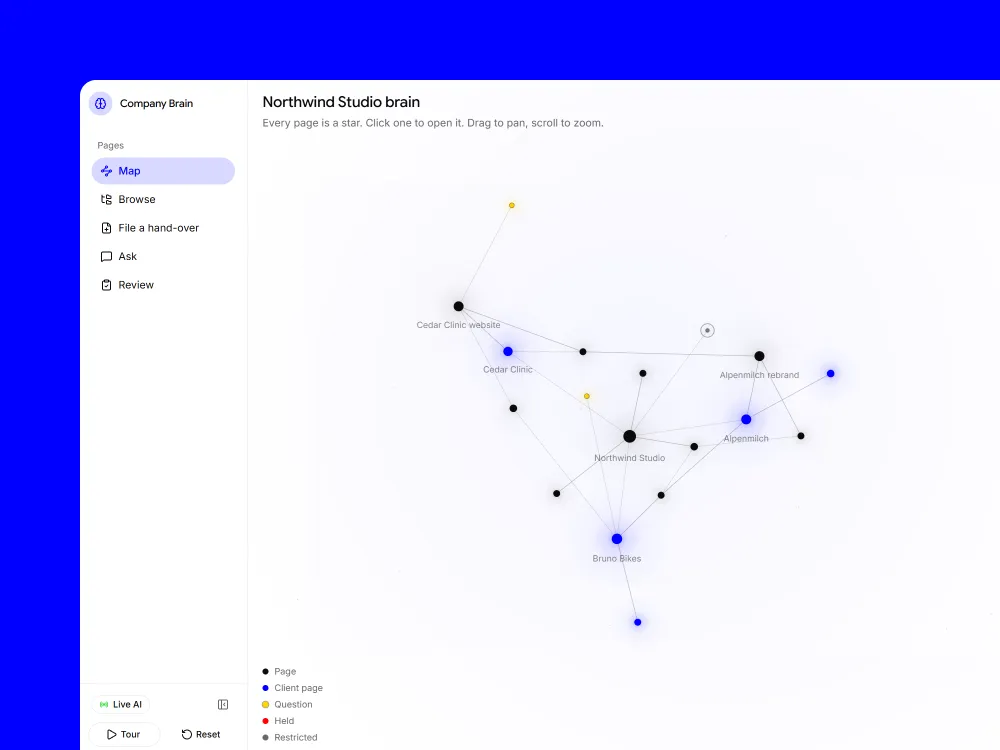
Superstate is a specialist builder, type 4 in the table above. It works in four steps: map, brain, agents, and stay.
- Map. It starts with a sixty-minute meeting with you and your leadership. Then an AI interview agent talks to your key people, each when it suits them, and the team follows a few real jobs from start to finish. You get a map of how your company runs, with the repeated tasks ranked by what they cost you. The mapping is free, you keep the map, and you pay only if you say yes to the written offer.
- Brain. The Company Brain captures meetings, calls, chats, emails and documents the same day, with the date. It sorts them into plain pages that keep themselves up to date. Every answer shows the page it came from, and you can correct it.
- Agents. AI agents work from the brain on the tasks your team repeats most, such as drafting offers or chasing invoices. What matters goes to a person first.
- Stay. The team keeps watching, fixing and adding as your company changes, for as long as you want.
Each client’s brain runs on its own server and is never shared with other clients. If you leave, you keep everything, in pages your people can read.
It is not the right fit for everyone. Superstate is a six-person team, and you work with the founders. It does not sell a self-serve tool. If you want software your own team will run, a vendor or the do-it-yourself route fits better. If you have one narrow retrieval job on clean documents, an agency project may be enough. Superstate fits companies whose knowledge lives in people’s heads and who want one partner to build the brain and keep it running.
Whichever provider you pick, the same rule applies: choose the one with the clearest answer to who keeps the brain true next year.
Frequently asked questions
Who builds Company Brains for businesses?
Four kinds of providers. Your own team can build one with open-source or off-the-shelf tools. Software vendors sell a knowledge or memory platform that your team fills and runs. Consultancies and AI agencies build a project, often a retrieval system on your documents, and hand it over. Specialist builders map how the business works, build the brain on that map, and keep running it with you. The right one depends on where your knowledge lives and who will keep it current.
How much does a Company Brain cost?
It depends on the provider type. Do-it-yourself tools cost little in money and a lot in your team’s time. Software vendors charge a subscription, usually per user. Consultancies and agencies charge a project fee. Specialist builders usually charge for the build and then for the ongoing work. Ask every provider for a written scope and price before you commit, and count the cost of upkeep, not only the cost of the first version.
What is the difference between a Company Brain builder and a RAG integrator?
A RAG integrator builds a retrieval system on documents you already have. It finds and quotes those documents, so if they are out of date, its answers are out of date too. A Company Brain builder also captures what is not written down, keeps the pages current as the business changes, and shows the source of every answer. RAG is a technique a Company Brain can use. It is not the whole system.
Should we build a Company Brain ourselves or hire a provider?
Build it yourselves if your team already writes things down, has someone technical with time to run the system, and will own its upkeep for years. Hire a provider if the important knowledge lives in people’s heads, if nobody has time to maintain it, or if you have tried a wiki or knowledge base before and it went stale. Many teams that build their own give up, and upkeep is the usual reason.
What should we own if we stop working with a provider?
You should keep all of the content, in a format your people can open and read without the provider’s software, plus a full export of the sources it came from. Ask for this in writing before you sign. If the brain lives only inside a vendor’s product, you rent it. If you can take it with you, you own it.

Want to know more about what we do? Visit the Superstate website.