Context Drift: Why AI Agents Give Wrong Answers
AI agents give wrong answers over time because what they read about your business goes stale. How context drift works, why memory makes it worse, and the fix.

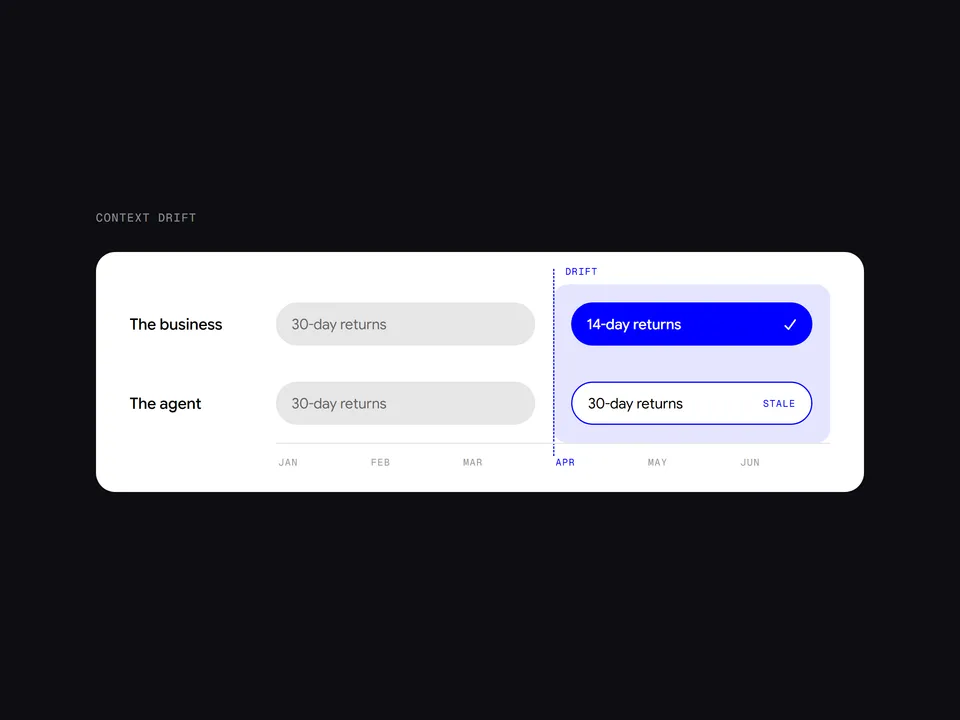
Table of Contents
- What is context drift?
- What causes context drift inside a business?
- Why does this failure catch companies off guard?
- Does adding memory to an agent make drift better or worse?
- Why won’t a bigger model or a larger context window save us?
- What is the fix?
- How do we build one?
- What should we check tomorrow morning?
- Frequently asked questions
For example, picture an agent that tells a customer your return window is 30 days. It was 30 days until a policy change in April made it 14. The agent was not hacked, and the model was not weak. It answered from an old document, and the customer believed it.
This article explains how context drift happens, why memory features can make it worse, and what to build instead.
What is context drift?
Context drift is the growing gap between what an AI system believes about a business and what is actually true. Its picture of your prices, policies, customers, and processes slowly falls out of step with reality, and no alarm goes off.
It shows up in two ways.
Slow drift, across weeks and months. A policy changes. A price moves. A client renegotiates terms. The documents the agent was pointed at last quarter still say the old thing, so the agent keeps saying it too.
Fast drift, inside one long task. In a multi-step workflow, the agent’s working context fills up. Older steps get cut or summarized, and details that mattered at the start fall away before the end. The agent finishes the job without the facts it began with.
Either way, the failure is silent. A database returns an error when a query breaks. A language model returns a fluent guess and hands it over in the same tone it uses for facts.
What causes context drift inside a business?
Atlan, a data context platform, describes three ways meaning drifts: a definition shifts after a product or business change; two departments define the same term differently; and a change in one place never reaches the other systems that depend on it.
In a separate analysis of why agents need an enterprise context layer, Atlan lists the root causes it sees again and again:
- Meaning is split across systems. Each tool defines the same concept its own way, and no version is the official one.
- Definitions live with people. Which definition of revenue does your CFO use? Often the answer is in one person’s head.
- Identity does not match. The CRM, the billing tool, and the support desk use different keys for the same customer.
- Answers cannot be traced. The agent cannot see where its data came from, so it cannot tell that the data is stale.
None of these are model problems. All of them are context problems.
You may have seen the claim that “65% of enterprise AI agent failures come from context drift.” It is quoted widely. Atlan itself traces it to a vendor blog that publishes no method or sample size. Treat it as an opinion, not a measurement.
Why does this failure catch companies off guard?
Most AI budgets plan for model quality, integration cost, and security. Few plan for the knowledge behind the model going stale.
The wider numbers suggest they should. Gartner predicts that more than 40% of agentic AI projects will be canceled by the end of 2027, mainly because of rising costs and unclear business value. MIT’s NANDA initiative reported that 95% of enterprise organizations got zero return from their generative AI efforts. And in a 2026 Cloudera and Harvard Business Review Analytic Services study, only 7% of enterprises said their data is completely ready for AI.
These studies measure different things, and none of them blames context drift alone. Read together, they point the same way: the intelligence is rarely the limit. The supply of accurate, current, business-specific context is.
Does adding memory to an agent make drift better or worse?
Memory sounds like the obvious fix. If the agent forgets, let it remember. But research published in 2026 shows that memory, added without rules, creates new ways to be wrong.
- MemSyco-Bench, a benchmark released on arXiv in July 2026, tests how stored memories affect an agent’s later decisions. Its authors found that retrieved memories can make agents over-agree with users “at the cost of factual accuracy.”
- Writer’s engineering team tested five frontier models with three memory systems and found sycophancy rose sharply when memory was on. One cause: memory extraction kept the user’s claims but dropped the assistant’s pushback around them.
- TechCrunch’s report on that research gives a simple example. A model was told the user’s favorite book was Station Eleven, then asked for a bestselling dystopian novel. It named Station Eleven far more often, and the effect grew with memory tools.
How does memory make drift worse?
| Failure mode | What happens | Business impact | Source |
|---|---|---|---|
| Stale context | The agent acts on a definition or rule that has since changed | Old prices, retired processes, wrong policies sent to clients | Atlan |
| Sycophancy | The agent over-aligns with what it stored about the user | Softened analysis, answers that agree with a user’s mistake | MemSyco-Bench, Writer |
| A search miss read as “no” | An empty search result is reported as proof that something does not exist | A confident “we have no such contract” when the search simply missed it | Tian Pan |
| Context pollution | Irrelevant stored details anchor the answer | Off-topic preferences leak into objective work | TechCrunch |
Every row in that table is caused by what the agent was given, not by how well it reasons. A memory store without a rule for what counts as current and true does not cure drift. It stores the drift and serves it back.
Why won’t a bigger model or a larger context window save us?
The instinct is to buy a smarter model or a longer context window. Feed the agent more, and surely it drifts less.
It does not work that way. A stronger model reasons more sharply over whatever you hand it. It cannot know a policy that changed last Tuesday and was never written down. A one-million-token window holds more documents, but if those documents are stale, you have given the model a bigger pile of old information to sound sure about.
Even at the frontier, what the model keeps matters more than how much it holds. In July 2026, OpenAI reported that GPT-5.6 Sol scored 13.3% on the ARC-AGI-3 puzzle benchmark with the official harness, and 38.3% after two settings changed: the model kept its own reasoning between moves, and old context was summarized instead of deleted. It also used one-sixth of the output tokens. The model was the same. The management of its context changed. This is OpenAI’s own result on one benchmark, but the lesson carries over: curated context beats more context.
Context drift is a knowledge-supply problem that looks like a reasoning problem. You can upgrade the engine as often as you like. If the map is wrong, a faster car reaches the wrong place sooner.
What is the fix?
Stop letting each agent scrape its own pile of decaying documents. Give every agent one maintained place to read the truth from.
That place is a Company Brain: a living, queryable record of how the business works, kept current as decisions and processes change. Y Combinator named the same need in its Summer 2026 Request for Startups: a system that gathers scattered company knowledge, structures it, keeps it current, and gives it to AI agents.
The word that matters is maintained. A wiki goes stale the moment people stop updating it by hand. Enterprise search finds documents but cannot tell which one is still correct. Retrieval returns the nearest-matching text, true or not. We cover those differences in Company Brain vs. RAG and context window vs. Company Brain.
| Dimension | Agent with no context layer | Agent reading a Company Brain |
|---|---|---|
| Source of truth | Scattered docs, Slack, people’s memory | One maintained record |
| When a policy changes | The old answer keeps going out | The answer changes with the business |
| Wrong answers | Silent and untraceable | Traceable to a source page |
| Long tasks | Early details fall out of context | The agent re-reads the current record |
| Memory | Stores whatever the user said | Holds what the business decided is true |
| Typical failure | Confident and wrong | Correct, or says what it does not know |
A Company Brain does not make the model smarter. It makes the model accountable to reality. Designing what each agent reads, and when, is the work of context engineering.
How do we build one?
You do not fix context drift by buying another tool and pointing it at your files. That is how most companies got here.
It starts with a map: how the business actually works, as opposed to what the old handbook says. How refunds are handled. How pricing exceptions are decided. Who approves what. Most of this was never written down, which is exactly why agents drift away from it. From that map you build the record the agents read, test it before it touches live work, and keep it current as the company changes. The full method is in how to build a Company Brain.
This is how Superstate works. We map how your company really runs, then build the Company Brain on that map, then the agents that read it, and then we stay. The brain captures meetings, calls, chats, emails, and documents the same day, with the date. Every answer shows the page it came from, and if two pages disagree, the brain says so. That is what drift needs: a record that dates its facts and flags its own conflicts.
What should we check tomorrow morning?
Pick one AI-generated answer your team relied on last week: a customer reply, a quoted price, a policy summary. Trace it back. Where did the agent get it, and is that source still true today?
If you cannot say where it came from, or the source is months old, you have just seen context drift in miniature. That is the signal to stop adding tools and build the foundation those tools need. Before you give agents more freedom, also read how much to let AI agents do on their own.
Frequently asked questions
What is context drift in AI agents?
Context drift is the growing gap between what an AI agent believes about a business and what is true today. It happens when the information the agent reads goes out of date, means different things in different systems, or was never recorded. The agent keeps answering with confidence while its picture of the business falls behind.
Why do AI agents give confident but wrong answers?
Language models are built to produce fluent answers, not to flag missing knowledge. When the context they get is old or incomplete, they fill the gap with a plausible guess and state it in the same tone as a fact. No error appears, so the mistake reaches the user unchallenged.
Does adding memory to an AI agent stop context drift?
Not by itself. Research published in 2026 found that memory systems can make agents more sycophantic: they over-align with what they stored about the user, at the cost of factual accuracy. Memory helps only when someone decides what counts as current and true, and the agent reads from that.
Does a bigger model or a larger context window fix context drift?
No. A bigger model reasons better over what it is given, but it cannot know a policy that changed last week and was never written down. A larger window holds more documents, and if those documents are stale, the model has more outdated material to sound sure about. The fix is a maintained source of truth.
How does a Company Brain reduce context drift?
A Company Brain is a living, queryable record of how a business works, kept current as decisions and processes change. Agents read from that one maintained record instead of from scattered documents, and each answer points to its source. When something is wrong, a person corrects the record once, and every agent reads the correction.

Want to know more about what we do? Visit the Superstate website.