AI Agent Autonomy: How Much Should SMBs Hand Over?
AI agent autonomy is the level of independent action you grant an AI system. Here's how SMBs decide how much control to hand over - without getting burned.

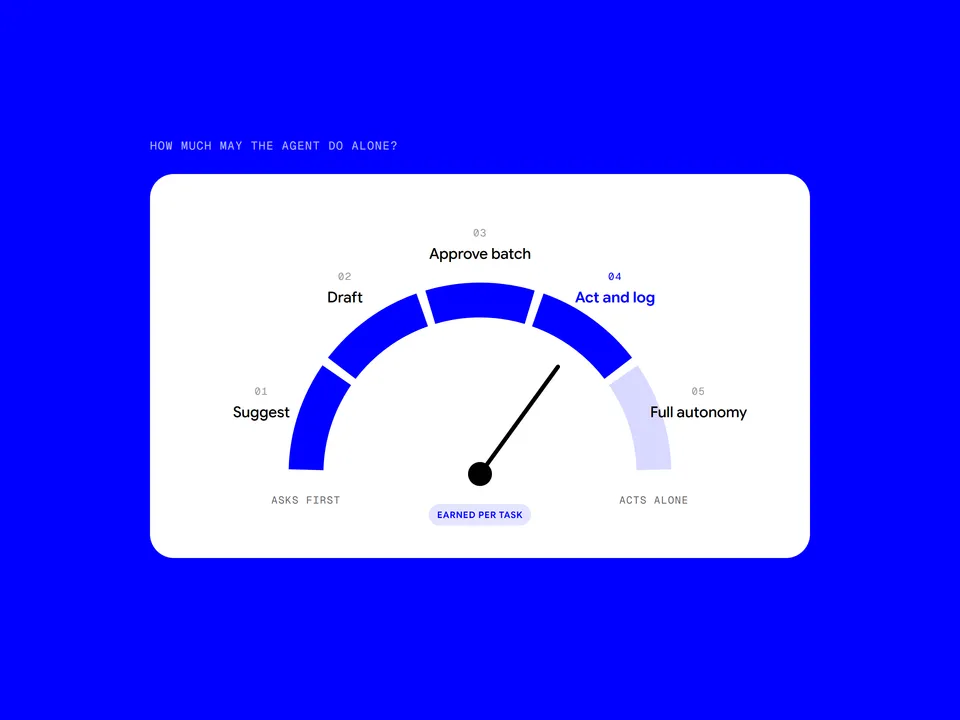
Table of Contents
For example, picture a 60-person logistics firm that lets a new agent reschedule deliveries on its own. For three weeks it saves dispatchers hours every day. In week four it rebooks 200 shipments to a carrier that went offline, and nobody notices for two days because no human reviews the agent’s decisions and nothing is logged. This is an illustration, not a real case. It shows why AI agent autonomy, the amount of independent action you hand an AI system, is the setting that decides whether agents save you time or cost you money.
What is AI agent autonomy?
AI agent autonomy is the degree to which an AI system can perceive a situation, decide what to do, and execute the action - without a human approving each step. It is not a single on/off switch. It runs on a spectrum, from an assistant that only suggests, to a co-pilot that drafts and waits, all the way to a fully independent agent that acts first and reports afterward.
Researchers have started formalizing this. A 2025 paper, Levels of Autonomy for AI Agents, defines five levels by the role the user takes: operator, collaborator, consultant, approver, or observer. The useful takeaway for a business owner is simpler: autonomy is a dial, not a switch. The job is knowing how far to turn it, and for which task.
Why does agent autonomy matter now?
Agents are moving into everyday business software. Gartner forecasts that 40% of enterprise applications will include task-specific AI agents by the end of 2026, up from less than 5% in 2025. The question has moved from “are agents real” to “which part of my company gets handed over first.”
Control is not keeping up. In a Gravitee survey of over 900 executives and technical practitioners, on average only 47.1% of an organization’s AI agents were actively monitored or secured. Only 14.4% said all their agents went live with full security and IT approval. Gravitee sells API management, so read the figures as one vendor’s survey, not a market census.
Gartner also expects trouble. It predicts that over 40% of agentic AI projects will be canceled by the end of 2027, mainly because of rising costs and unclear business value.
Handing an agent the keys is the easy half. Building the guardrails, the logging, and the review loop decides the outcome.
What are the five levels of agent autonomy?

The ladder below is our own working model, not an industry standard. The mistake most SMBs make is treating autonomy as all-or-nothing - either a human approves everything (and the agent saves nothing) or the agent runs wild (and one bad call costs a client). The way out is to think in rungs. Each task gets placed on a ladder, and it climbs only after it earns the next rung.
| Rung | What the agent does | Human role | Best for | Risk if mis-set |
|---|---|---|---|---|
| 1. Suggest | Recommends, never acts | Decides and executes | New, high-stakes, or unproven tasks | Almost none - slow but safe |
| 2. Draft | Prepares the action, waits | Reviews and approves each one | Customer emails, proposals, reports | Low - bottleneck if volume is high |
| 3. Approve-batch | Acts after one bulk sign-off | Reviews a queue, then releases | Invoicing, scheduling, data entry | Medium - errors ship in batches |
| 4. Act-and-log | Acts immediately, records everything | Audits the log, sets limits | Reversible, repeatable, proven tasks | Medium - needs real monitoring |
| 5. Full autonomy | Acts and self-corrects | Spot-checks outcomes only | Narrow, low-stakes, reversible loops | High if scope creeps |
Two rules make the ladder work.
First, autonomy is earned per task, not granted per agent. The same agent might sit at Rung 2 for customer refunds and Rung 4 for sorting support tickets. The firm in the example made the mistake of granting Rung 4 to an action, rebooking carriers, that was neither well-proven nor easily reversible.
Second, the gate between rungs is evidence, not time. A task climbs when it has a measured error rate low enough to justify less review. “It’s been running two weeks” is not evidence. “It made 0 errors in 400 logged actions” is.
How do you decide where a task starts?
When deciding where a task starts on the ladder, the first question is not “how smart is the agent.” It is “what happens if it’s wrong, and can I undo it.”
Gartner made a similar point in May 2026. It warned that applying uniform governance across all AI agents will lead to failure: blanket rules slow down simple agents and under-protect more autonomous ones. Gartner proposes four levels (observe, advise, act with approval, act autonomously), each with its own controls. Risk has to be assessed task by task.
A simple sort works:
- Reversible and low-stakes - drafting copy, summarizing documents, tagging tickets, internal lookups. Start high on the ladder. A wrong summary costs a re-read.
- Reversible but visible - sending a customer email, posting to a channel, updating a record. Start in the middle. A wrong email is recoverable but it touches a relationship.
- Hard to reverse or high-stakes - moving money, signing contracts, changing prices, deleting data, committing to a vendor. Keep these at Rung 1 or 2 until the track record is undeniable, and even then, cap the size of any single action.
An agent that saves hours a day is worth nothing if one un-reviewed action in an irreversible category costs a five-figure client.
How does autonomy connect to the rest of your AI build?
Autonomy is a property of the whole system, not a feature you add at the end.
Process decides where the agent can act at all. You cannot set a sane level on a workflow you have never mapped. If the steps, owners, and failure points of “reschedule a delivery” were never written down, there is no safe rung for it. Which processes to automate first helps you choose.
Data decides whether the agent acts on truth. An agent at Rung 4 on top of stale or fragmented data scales mistakes. Autonomy amplifies whatever data quality you already have.
Impact decides the starting rung. The closer an action sits to revenue and reputation, the lower it starts.
Governance covers the rest: permissions, logging, and a named reviewer. See AI governance for SMBs for the policy side, and how AI agents change your team structure for who does the reviewing.
What should you do tomorrow morning?
Pull up every place an AI agent currently acts - or where you’re about to switch one on. For each one, write three things on a single line: what action it takes, whether that action is reversible, and who reads the log when it goes wrong. If the third column is blank, the agent is at the wrong rung. Drop it to Rung 2 - draft and approve - until logging and a named reviewer exist.
Then pick exactly one task to deliberately promote up the ladder this month. Measure its error rate over real volume, not calendar days. That single disciplined climb teaches your team more about safe autonomy than any vendor demo - because the goal was never to hand over everything. It was to know, action by action, exactly how much you’ve handed over and exactly what catches it when it’s wrong.
The companies that do well with agents will not be the ones that turned the dial the furthest. They will be the ones who knew which number it was on.
Superstate builds agents this way. Each agent has one clear job and clear limits, and what matters goes to a person first. We start with the one or two agents that save the most time, and add more as the evidence comes in.
Frequently asked questions
What is AI agent autonomy?
AI agent autonomy is the degree to which an AI system can take actions on its own, by perceiving, deciding, and executing, without a human approving each step. It runs on a spectrum from suggestion-only assistants to fully independent agents that act first and report later.
How much autonomy should a small business give an AI agent?
Set autonomy per task, based on how reversible and how high-stakes the action is. Low-risk, easily reversible tasks like drafting and summarizing can run with little oversight. Actions that move money, touch customers, or write to core systems should keep a human in the loop until error rates are proven low.
What is human-in-the-loop AI?
Human-in-the-loop AI is a setup where an agent proposes or drafts an action, but a person reviews and approves it before it executes. It preserves accountability while still saving time on the preparation step.
Is it safe to let AI agents act without human approval?
It can be, but only for narrow, low-risk, reversible tasks that are logged and capped. Failures usually come from granting broad autonomy before an agent has a proven track record, and from having no audit trail when something goes wrong.

Want to know more about what we do? Visit the Superstate website.