AI Governance for SMBs: Your Policy Playbook
AI governance for SMBs is now a compliance issue, not a nice-to-have. A practical 2026 playbook to build an AI policy before regulators or leaks force it.

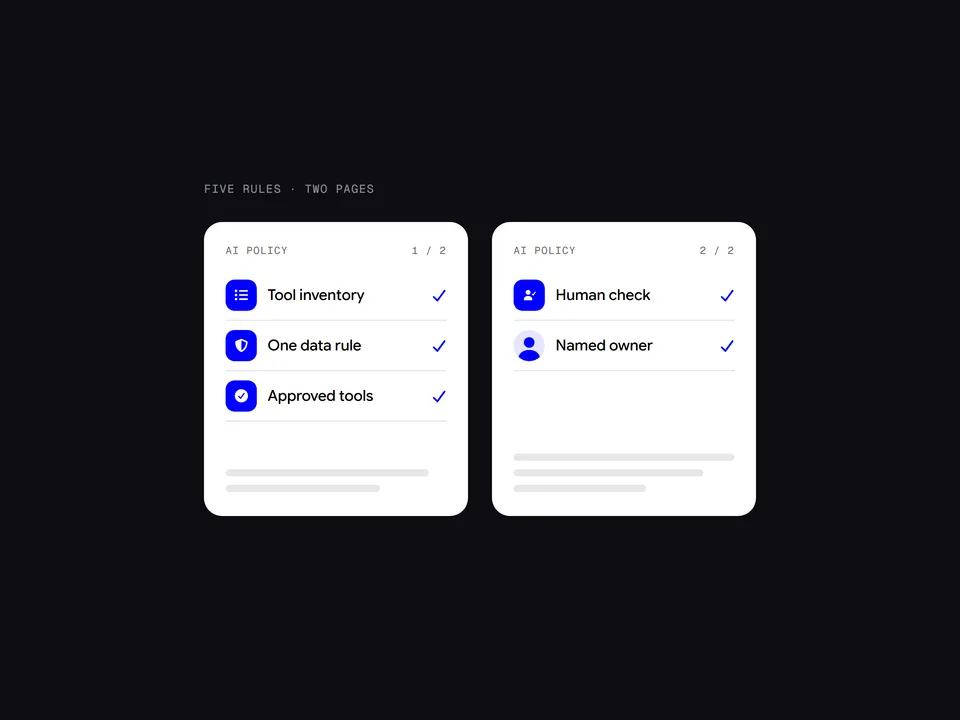
Table of Contents
What is AI governance for SMBs?
AI governance is the set of policies, approval steps, and accountability structures that control how a company chooses, uses, and monitors AI. It answers four questions: what tools are allowed, what data can go into them, who checks the output, and who is responsible when something goes wrong.
For a small business, governance is not a 40-page manual. It is a short, enforced set of decisions that keeps AI useful without exposing the company to legal, financial, or reputational damage. Think of it as the difference between everyone driving as they like and a few clear traffic rules.
Why did AI governance become urgent in 2026?
Three things moved it up the list.
Do small businesses have AI policies?
Mostly not. HR Partner surveyed HR professionals at small and mid-sized businesses (20-500 employees) in the UK, US, and Australia. It reported that 80% of respondents use AI in their daily work, but only 23% of businesses have a formal policy to guide AI use. The survey covers HR staff, so treat it as a signal, not a census of all small firms. The tools moved faster than the rules.
How much unapproved AI use is there?
A lot. A survey by BlackFog and Sapio Research (2,000 respondents in the US and UK, at organizations with more than 500 employees, fieldwork in November 2025) found that 49% of respondents use AI tools their employer has not sanctioned. The risk is the same in smaller firms: client contracts, pricing, and other data pasted into tools the company does not control. Governance turns that invisible use into something a leader can see and shape. For how to find it and handle it, read what is shadow AI and how to handle it.
Does the EU AI Act apply to your business?
Probably, if your AI output reaches people in the EU. Regulation (EU) 2024/1689, the AI Act, covers AI systems placed on the EU market and systems whose output is used in the EU, so a US business can fall inside it. The transparency duties of Article 50 require, among other things, that people are told when they interact with an AI system and that deepfakes and some AI-generated content are disclosed. Those duties began to apply on August 2, 2026, and the 2026 Digital Omnibus left that date in place. Law firms report a grace period to December 2, 2026 for marking AI-generated content in systems already on the market. Dates for the high-risk rules were moved, so check the current timetable. This is general information, not legal advice.
What are the EU AI Act risk tiers, in plain English?

The Act sorts AI systems by potential harm and attaches duties to each tier. Most SMB use falls into the lower tiers, but knowing the map prevents surprises.
| Risk tier | What it covers | Obligation | Maximum fine |
|---|---|---|---|
| Prohibited | Social scoring, manipulative systems, untargeted biometric scraping | Banned outright | EUR 35M or 7% of worldwide turnover |
| High-risk | AI in hiring, credit scoring, critical infrastructure | Documentation, human oversight, registration | EUR 15M or 3% |
| Limited risk | Chatbots, AI-generated content, deepfakes | Transparency and disclosure (Article 50) | EUR 15M or 3% |
| Minimal risk | Spam filters, AI in productivity tools | No specific obligation | None |
Fines come from Article 99. A separate cap of EUR 7.5M or 1% applies to giving incorrect or misleading information to authorities. For SMEs, including start-ups, the lower of the two figures applies instead of the higher. That is still a heavy fine for a company with thin margins.
Most SMBs sit in the limited and minimal tiers. The trap is the high-risk tier. A tool that screens job applicants or scores loan applications carries documentation and oversight duties many owners never realized they took on.
What is a 5-step AI governance plan for SMBs?
Governance fails when it is too heavy to follow. This plan is built to be drafted in a week and to fit on two pages.
Step 1: Inventory what’s already in use
Ask every team which AI tools they touch, including the free ones. Most leaders are surprised by the answer. You cannot govern what you cannot see, and the inventory usually reveals the same tool being paid for three times across departments - the tool-sprawl problem in miniature (see AI tool sprawl).
Step 2: Set one data rule everyone remembers
Forget the legal essay. State one rule: “Never put client data, financials, or anything you wouldn’t email to a competitor into an AI tool that isn’t on the approved list.” Simple rules get followed. Complex ones get ignored.
Step 3: Publish an approved-tool list
Name the specific tools that are allowed and the data each one may handle. Enterprise-tier tools with data-protection agreements go on the list. Consumer free tiers, in most cases, do not. The list removes the guesswork that pushes people toward whatever is fastest.
Step 4: Require a human checkpoint for anything customer-facing
AI output that reaches a client - a proposal, a contract summary, a published article - passes through one human review first. This single step prevents the hallucinated figure and the fabricated citation from becoming a public mistake or an Article 50 transparency problem.
Step 5: Name one accountable owner
Assign one person responsibility for AI decisions: approving new tools, reviewing the policy quarterly, and being the point of contact when something breaks. If your team runs AI agents, also set how much each agent may do on its own: see AI agent autonomy. Governance without an owner is a document nobody maintains.
Where do SMBs get AI governance wrong?
Three failure patterns repeat across companies that try and stall.
The first is the photocopied template. A generic AI policy downloaded from the internet and pasted onto the intranet changes nothing, because it maps to no real workflow and names no real owner. It exists to be pointed at, not followed.
The second is governance by prohibition. Banning AI outright drives usage underground - the exact shadow AI behavior the policy was meant to prevent. People often use unsanctioned tools because the sanctioned path is slower, not because they are reckless.
The third is the one-time document. AI tools and regulations shift monthly. A policy written in January and never revisited is obsolete by spring. Governance is a quarterly habit, not a launch event.
A generic template or a slide deck from an outside firm has the same weakness: it maps to no real workflow and has no owner after delivery. A policy lasts when it is built on how your team actually works and someone keeps it current.
What should you do tomorrow morning?
Start with the inventory. Send one message to every team lead asking which AI tools their people use, free ones included. Give it a day. The list you get back is the most honest picture of your AI exposure you will ever have, and it costs nothing to gather.
Then write the one data rule from Step 2 and name the owner from Step 5. Those three moves - inventory, one rule, one owner - take less than a week and remove the largest share of your risk. The rest of the plan can follow over the next few weeks. The point is to start before the choice is made for you.
The EU AI Act’s transparency duties already apply. An employee pasting a contract into a chatbot may already be happening. AI governance for SMBs stopped being a question of whether and became a question of how fast - and whether you set the rules, or inherit them from a regulator, a breach, or a client who found out the hard way.
Frequently asked questions
What is AI governance for a small business?
AI governance for a small business is the set of policies, approval processes, and accountability structures that control how AI tools are chosen, used, and monitored. It defines what data can enter AI systems, who approves new tools, and how outputs are checked before reaching customers.
Does the EU AI Act apply to small businesses?
Yes, if you place an AI system on the EU market or the output of your AI system is used in the EU, whatever your size or location. Small and mid-sized companies get simplified documentation and the lower of the two possible fine amounts, but the core obligations still apply.
What should an AI policy for an SMB include?
An effective SMB AI policy lists approved tools, defines which data must never enter AI systems, sets a human review step for customer-facing output, and names one accountable owner. It should fit on two pages and be reviewed quarterly.
What are the fines for breaking the EU AI Act?
Fines reach up to EUR 35 million or 7% of worldwide annual turnover for prohibited practices, and up to EUR 15 million or 3% for most other obligations, including high-risk duties and Article 50 transparency. For SMEs the lower of the two amounts applies.
How long does it take to set up AI governance?
A basic version, with an inventory, one data rule, an approved-tool list, and a named owner, can be drafted in about a week. Getting people to follow it consistently takes longer and needs a quarterly review.

Want to know more about what we do? Visit the Superstate website.