AI Agents Are Reshaping the Org Chart, Not Flattening It
How do AI agents change your team structure? Routine work shrinks, the experienced middle shifts to overseeing agents. What it means for SMBs.

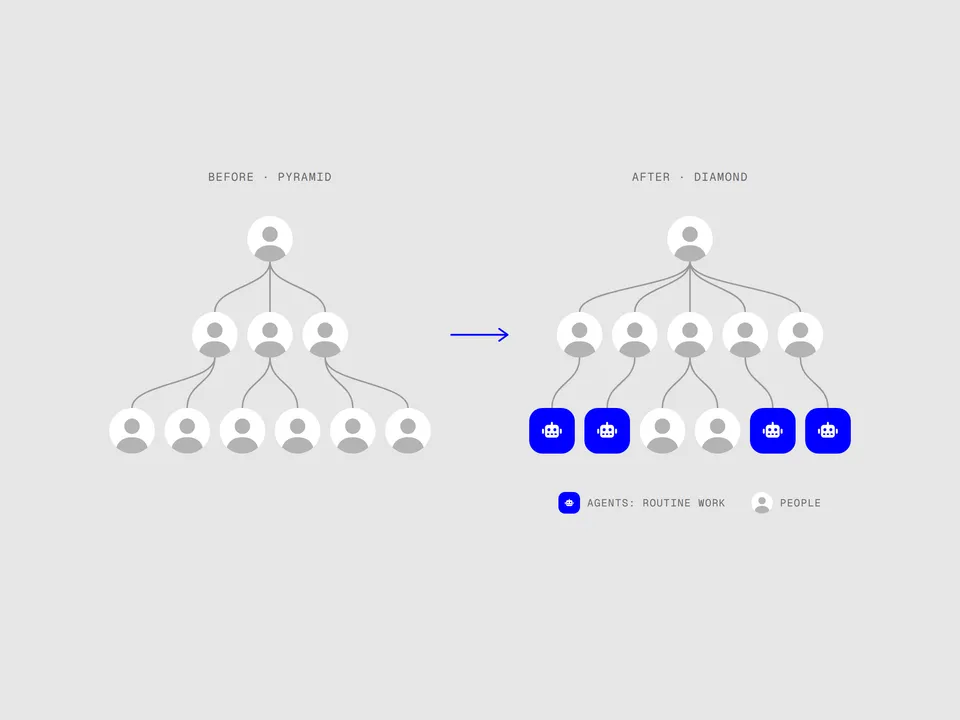
Table of Contents
- What is an AI agent, and how is it different from a chatbot?
- Will AI agents flatten the org chart?
- Pyramid or diamond: how does the structure change?
- Are companies ready to govern agents?
- What does this mean for a small business?
- Expert insight
- What are five steps to redesign your team for AI agents?
- Frequently asked questions
Gartner forecasts that 40% of enterprise applications will include task-specific AI agents by the end of 2026, up from less than 5% in 2025. Agents are arriving inside the software your team already uses. The question for every leader is what happens to the people who did that work.
What is an AI agent, and how is it different from a chatbot?
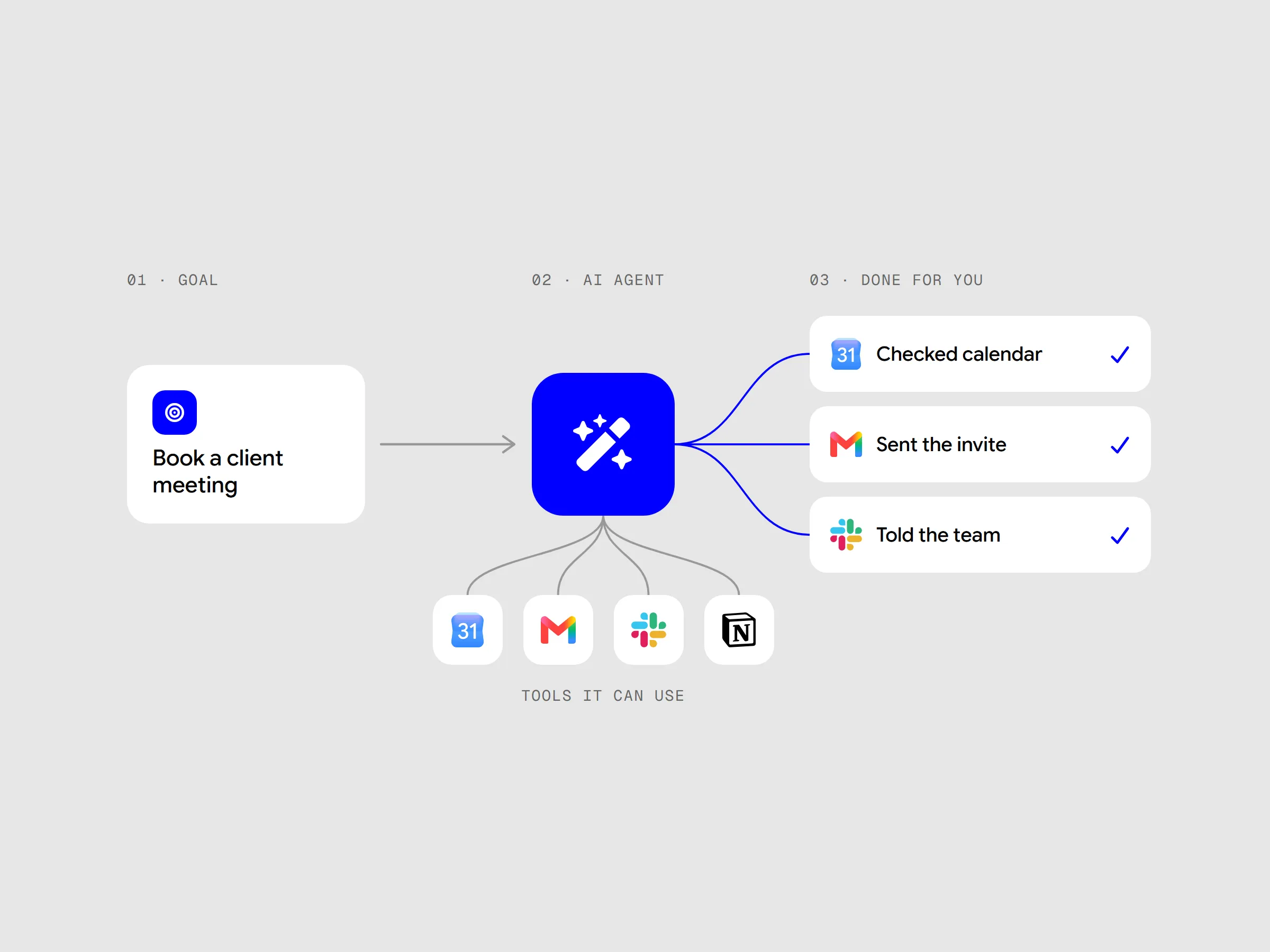
An AI agent is software that pursues a goal across multiple steps without constant human direction. A chatbot answers one question at a time. An agent reads a customer email, checks inventory, drafts a response, flags exceptions, and logs the interaction, in sequence. That matters because agents absorb workflows, not just tasks.
Leaders expect this to spread fast. In Deloitte’s 2026 State of AI in the Enterprise survey of 3,235 IT and business leaders in 24 countries, 74% expect their companies to use AI agents at least moderately by 2027.
Will AI agents flatten the org chart?
Not in the way people expect. The traditional org chart is a pyramid: a wide base of junior staff doing execution work, a narrower band of managers who coordinate, and a thin layer of executives.
Agents hit the base first. Data entry, report generation, lead qualification, invoice processing, and first-level support are tasks agents do well. But task automation is not the same as job loss. BCG estimates that 50% to 55% of US jobs will be reshaped by AI over the next two to three years, while 10% to 15% could be eliminated within five years or more. BCG’s own summary: “Task automation doesn’t equal job loss. Most roles will remain, but will change substantially.”
One view of where this leads is a diamond: a small leadership team, a strong middle, and a narrow base of new talent. PwC Australia describes this shape as one that can suit many companies. PwC’s US analysis, No more pyramids, asks leaders to choose a shape on purpose, and notes alternatives such as an hourglass. Treat the diamond as one plausible outcome, not a settled law.
Why might the middle grow?
Three forces push in that direction. These are our reading of the evidence, not measured results.
-
Agent oversight requires judgment. Someone must review outputs, catch errors, handle edge cases, and decide when to override. That takes domain expertise, which mid-career professionals have.
-
Workflow design becomes a core skill. Deciding which tasks agents handle, how they hand off to humans, and where quality gates sit is design work. Juniors lack the process knowledge. Executives lack the operational detail.
-
Every employee manages some agent work. Microsoft’s 2026 Work Trend Index says the most effective AI users redefine their value around what only humans can do: setting clear intent, defining the outcome and quality bar, and designing how work gets done across humans and AI. That is management work, whatever the title.
Pyramid or diamond: how does the structure change?
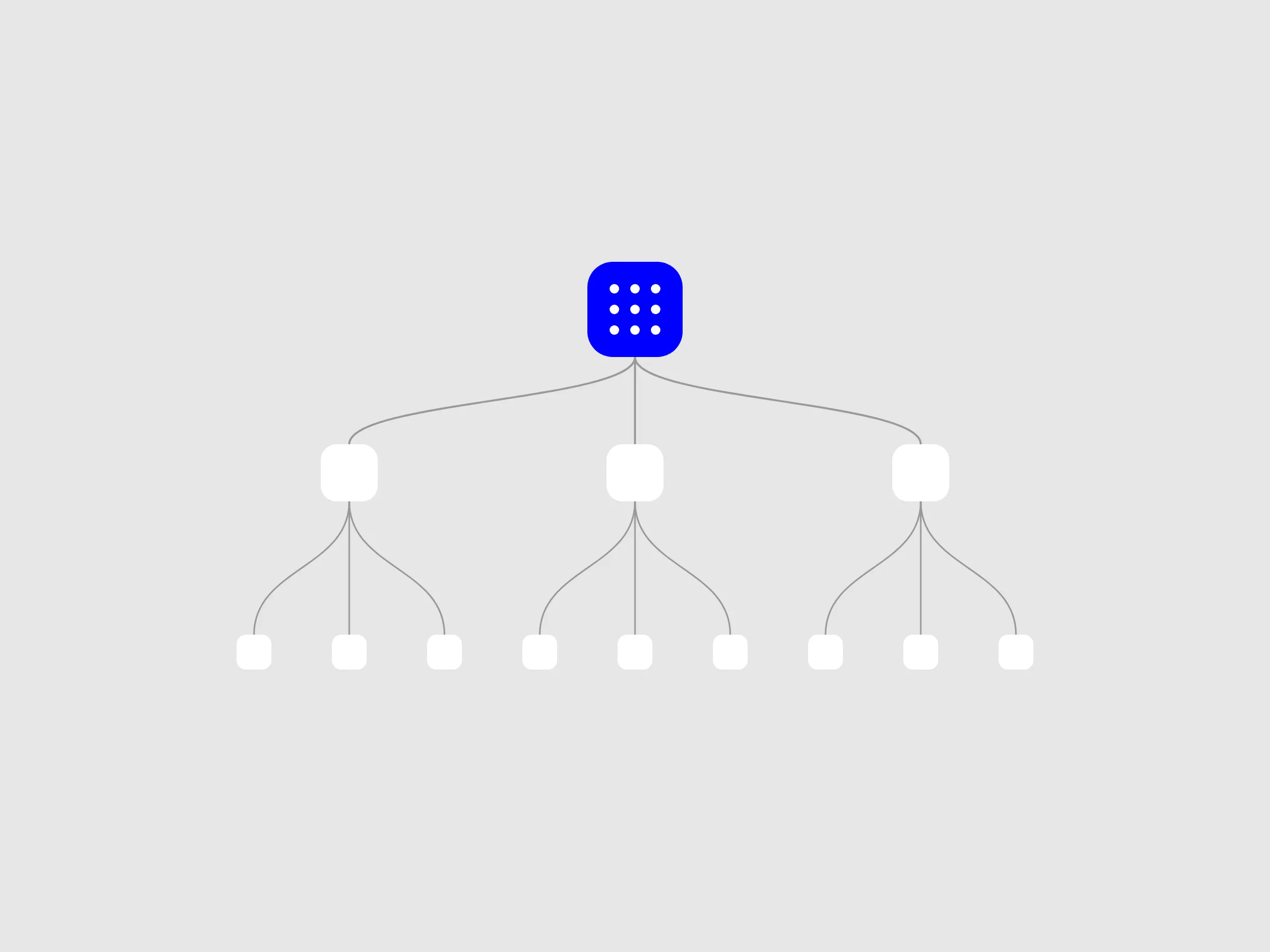
| Dimension | Traditional pyramid | AI-augmented diamond |
|---|---|---|
| Base layer | Large pool of junior execution roles | Narrower, because agents handle routine execution |
| Middle layer | Coordinators, reporters, information relays | Agent operators, workflow designers, quality reviewers |
| Top layer | Strategic direction | Lean, better informed by agent-generated insight |
| Key middle skill | Status tracking, delegation | Agent oversight, workflow design, exception handling |
| Hiring focus | Volume at entry level | Experience and judgment at mid-level |
| Cost structure | Heavy payroll at the base | Agent costs replace some base payroll; mid-level pay rises |
The risk of treating agents as cheaper labor is that you lose the people who know how the work should go. Agents without skilled human oversight can produce confident, wrong output at scale. Redeploying experienced people as agent operators keeps that knowledge in the loop.
Are companies ready to govern agents?
Mostly not yet. In the same Deloitte survey, only 21% of respondents say their organizations have a mature governance model for agentic AI. Gartner predicts that over 40% of agentic AI projects will be canceled by the end of 2027, mainly because of rising costs and unclear business value.
The gap between deploying agents and governing them creates three risks:
- Quality drift. Without human review loops, agent outputs degrade as edge cases pile up.
- Accountability gaps. When an agent makes a decision that costs money or reputation, who owns the outcome? Most companies have not answered this.
- Shadow agents. Employees spin up their own agents without IT oversight. It is the same pattern as shadow AI, with autonomous action added.
Setting limits per task is the practical answer. See how much autonomy to give an AI agent and AI governance for SMBs.
What does this mean for a small business?
A large enterprise can create a role like “Head of Agentic Operations.” A 40-person company cannot. But the shift can hit small firms hard, because they have less slack to absorb a bad change.
For an SMB, the diamond is not about adding management layers. It is about making sure the experienced people already on the team spend their time on oversight and decisions, not on execution that agents do faster. Three rules help:
- Map every workflow before you deploy an agent. Companies that skip this step automate broken processes and scale the problem. Which processes to automate first shows how to pick.
- Check your data. Agents are only as good as the data they read. Unified, clean data makes them useful instead of dangerous.
- Embed agents in what you sell, not only in how you operate. A consulting firm whose deliverables include agent-generated analysis changes its offer.
Expert insight
“The biggest mistake I see in operations leadership right now is treating AI agents like a headcount reduction tool,” says Vladimir Gerov, Operations & Growth at Superstate. “The math looks obvious on a spreadsheet - replace five junior roles with an agent, save on payroll. But within three months, you’re drowning in quality issues, customer complaints, and compliance gaps. The companies winning with agents are the ones investing in their mid-level people to become agent operators. That’s where the real leverage sits.”
What are five steps to redesign your team for AI agents?
Before you approve another agent deployment or another headcount cut, do this.
-
Audit your workflows end to end. Map every handoff, decision point, and quality gate. You cannot redesign what you have not documented.
-
Identify the judgment layer. For each workflow, mark where human judgment, context, or relationships matter. Those are the boundaries where agents hand off to people.
-
Redeploy, do not only reduce. Give experienced people freed from execution tasks the job of overseeing agents, with clear escalation paths and review cadences.
-
Set governance before you scale. Name an agent owner. Set output quality standards. Build review loops.
-
Measure ROI by workflow, not by headcount. Track cycle time, error rate, and customer satisfaction per workflow. The return shows up in throughput and quality, not only in salary savings. What ROI to expect in 90 days explains how to measure it.
Superstate follows the same order for clients: we map how your company works first, then build the agents on that map, each with one clear job and clear limits.
Frequently asked questions
Will AI agents replace middle managers?
The evidence points to transformation more than elimination. BCG estimates that 50% to 55% of US jobs will be reshaped by AI in the next two to three years, with 10% to 15% possibly eliminated over five years or more. Managers shift from information relay and status tracking toward agent oversight, workflow design, and decisions.
What is the diamond org structure in AI-driven companies?
The diamond is an organization shape with a small leadership team, a strong middle layer, and a narrow base of entry-level roles. PwC Australia describes it as a structure that can suit many companies once agents handle routine execution. It is one possible outcome, and PwC also discusses other shapes.
How many enterprises will use AI agents?
Gartner forecasts that 40% of enterprise applications will include task-specific AI agents by the end of 2026, up from less than 5% in 2025. In Deloitte’s 2026 survey, 74% of respondents expect their companies to use AI agents at least moderately by 2027.
What skills do managers need to lead AI agent work?
Managers need workflow design skills, the ability to judge the quality of agent output, and good judgment on when to escalate to a person. Microsoft’s 2026 Work Trend Index points to setting clear intent, defining the outcome and quality bar, and designing how work flows across humans and AI. These skills sit on top of normal people management.

Want to know more about what we do? Visit the Superstate website.