Bigger Context Windows Won't Replace a Company Brain
A 10M-token context window is short-term memory, not company memory. Why bigger context windows can't replace a Company Brain.

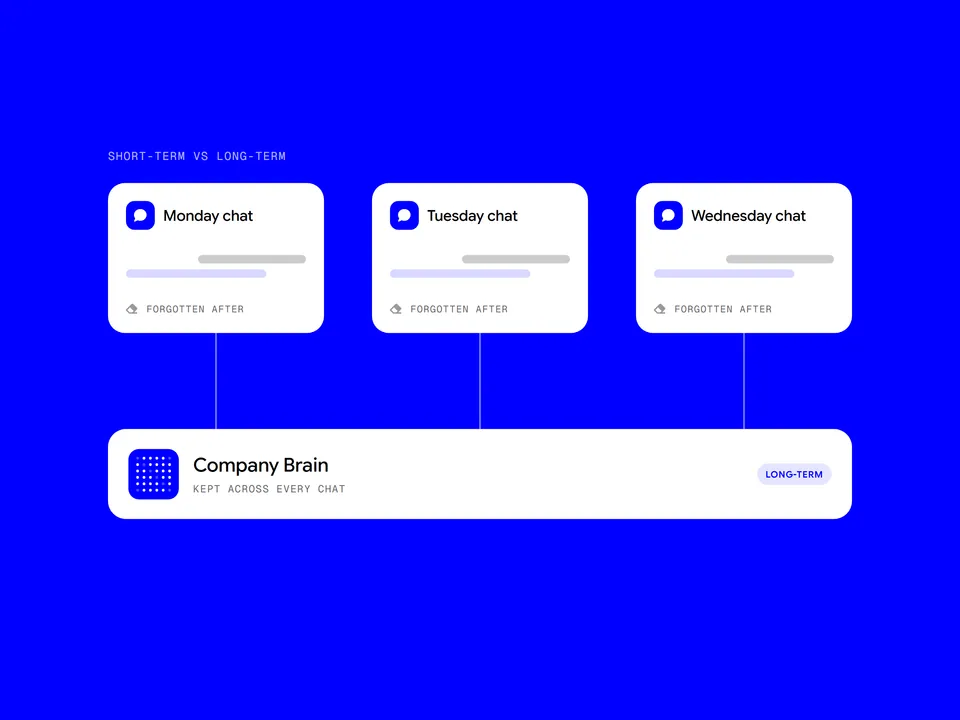
Table of Contents
- What a Context Window Actually Is
- The Lost-in-the-Middle Problem Gets Worse, Not Better
- A Context Window and a Company Brain Do Different Jobs
- ”Just Paste Everything In” Fails on Economics and on Truth
- Why is a bigger context window the wrong fix?
- What Bigger Windows Do Change
- What to Do Tomorrow Morning
- Frequently asked questions
Windows have grown fast. Meta’s Llama 4 Scout offers up to 10 million tokens, and most frontier models now ship with 1 million as standard (Codingscape). So the obvious question follows: if a model can read a whole document library in one prompt, why would a company need a separate system to hold its knowledge?
What a Context Window Actually Is
A context window is the amount of text a large language model can hold in its attention at one time - the prompt, the documents pasted in, and the conversation so far. When the session ends, that memory is gone. Ask the same model the same question tomorrow, in a fresh chat, and it knows nothing about what it read today.
A Company Brain is a living, queryable record of how a business works. It persists, it is shared across every employee and every tool, and it survives the conversation, the quarter, and the people who leave.
Those are different categories of thing. One is a scratchpad. The other is an institution’s memory. Confusing them is the core mistake behind a lot of AI spending in 2026.
The Lost-in-the-Middle Problem Gets Worse, Not Better
Here is the part the arms-race headlines skip: a bigger window does not mean a more accurate answer.
Researchers first documented the “lost in the middle” effect in 2023 (Liu et al., arXiv). They found that models retrieve information best from the beginning and end of a long context, and that performance degrades significantly when the relevant fact sits in the middle, even in models built for long contexts. The curve is U-shaped: strong at the edges, weak in the middle.
The advertised limit is therefore not the same as reliable working memory. A window that says one million tokens does not promise one million tokens of equally good reading.
Paste your entire company into a prompt and the fact that saves the deal might be sitting on page 4,000, in the exact dead zone where the model reads worst. The window swallowed it. It did not understand it.
A Context Window and a Company Brain Do Different Jobs
The two are easy to conflate because both involve feeding a model knowledge. What they do with that knowledge is where they split.
| Dimension | Bigger Context Window | Company Brain |
|---|---|---|
| Memory type | Temporary - one session, then gone | Persistent - survives conversations, quarters, employees |
| Scope | Whatever you paste this time | The whole business, always available |
| Accuracy at scale | Degrades in the middle of long inputs | Serves the relevant fact, not the whole pile |
| Handles contradictions | Inherits every conflict in the raw docs | Curated to one current answer |
| Cost per use | Pay to refill the window every query | Maintained once, queried cheaply |
| Who benefits | The one person in that chat | Every employee and every AI tool |
| Freshness | As stale as the files you happened to paste | Kept current as the business changes |
A bigger window is a raw capability. A Company Brain is what turns that capability into something a business can rely on.
”Just Paste Everything In” Fails on Economics and on Truth
Even if accuracy held perfectly, the paste-it-all approach breaks on two fronts.
The first is cost. Filling a large window is not free, and the price depends on the model. Multiply that by every employee asking every question all day. Reloading the company’s entire knowledge base on every query is the most expensive possible way to answer “what is our refund policy?”
The second front is truth, and it is the one that actually sinks projects. A company’s raw documents are full of contradictions: three different pricing sheets, an onboarding doc nobody updated since 2024, a Slack thread that overrules a wiki page that overrules a PDF. Pour all of that into one window and the model inherits every conflict at once. It has no way to know which version is current. So it picks one - confidently - and sometimes it picks wrong.
This is not hypothetical. In a June 2026 VentureBeat survey of 101 enterprises, 57% had traced a confidently wrong AI answer to missing or inconsistent business context, and 31% said it had happened more than once (VentureBeat). The sample is small, and the survey blames missing context, not the model. One common form of missing context is stale facts, which we cover in why AI agents give wrong answers over time.
A giant context window does nothing about any of this. It faithfully reads the mess. A Company Brain exists precisely to resolve the mess into one current, trustworthy answer before the AI ever touches it.
Why is a bigger context window the wrong fix?
There is a blind spot here. Leaders try to make an existing process faster with AI instead of rethinking how the work is done. Bigger context windows are the purest example. The instinct is: our knowledge is scattered and messy, so let’s buy a model big enough to hold all the mess at once.
That optimizes the spoon. It does not question whether the spoon should exist. The car did not make horses faster - it changed how movement worked. A Company Brain is the equivalent move: instead of shoveling raw knowledge into a model on every query and hoping it sorts things out, the business maintains one live record of how it actually works, and every AI tool reads from that.
The technical world has been circling the same conclusion. The lineage runs from Andrej Karpathy’s LLM-maintained wiki pattern (April 2026), to Garry Tan open-sourcing a version of it, to Y Combinator’s Summer 2026 requests for startups, which reportedly named the company brain as a category (see the Company Brain market for what we could and could not confirm). A Company Brain is also not the same thing as retrieval over documents; see Company Brain vs RAG.
What Bigger Windows Do Change
None of this makes large context windows useless - they are a genuine leap. They make a single reasoning task richer. They let a model hold a long contract, a full codebase file, or an entire meeting transcript in view at once. For one-off, deep, single-session work, more room is real power.
The distinction is about the job. A big window helps a model think hard about what is in front of it right now. A Company Brain decides what should be in front of it in the first place, keeps that knowledge current, and makes it available to everyone tomorrow, not just to whoever ran the prompt today.
The two are complementary. The Brain curates; the window reasons. Betting that a large enough window removes the need for the Brain is betting that a big enough desk removes the need for a filing system. The desk gets cluttered faster.
What to Do Tomorrow Morning
Run one test. Open your best AI tool, in a fresh chat, and ask it a question only your business can answer correctly - how a specific client likes invoices formatted, why a process changed last spring, what your actual return policy is for a specific edge case. Watch what it does. It will either admit it doesn’t know, or it will invent something confident and wrong.
That gap is not a model problem, and no context window closes it. It is a memory problem. The fix is to give the business a memory that persists - one current record of how the company works that every tool and every hire can draw on.
That starts with a map: a single session to lay out how the business actually runs - its decisions, processes, and context - and build the first version of that Brain, before wiring any AI on top of it. The companies that do this stop paying, over and over, to re-explain themselves to a machine that forgets by morning.
This is how Superstate starts: a free mapping of how your company really works, which begins with a sixty-minute meeting, then a brain built on that map. For the full picture of the topic, read what a Company Brain is.
Frequently asked questions
Can a bigger context window replace a Company Brain?
No. A context window is temporary memory a model holds for one conversation and forgets afterward. A Company Brain is a persistent, queryable record of how a business works, so knowledge survives across every conversation, employee, and AI tool. A larger window makes one session longer; it does not give a company a memory.
What is the lost-in-the-middle problem?
It describes how large language models retrieve information well from the start and end of a long context but poorly from the middle. The 2023 paper that named the effect found that performance degrades significantly when the relevant fact sits in the middle of a long context, so a bigger window does not reliably mean a more accurate answer.
Why do AI tools give confidently wrong answers about a business?
Most tools guess around a business instead of reading a maintained record of it. In a June 2026 VentureBeat survey of 101 enterprises, 57% traced a confidently wrong AI answer to missing or inconsistent business context. Without a curated Company Brain, the model fills gaps with plausible fiction.
Is a Company Brain just pasting all our documents into a prompt?
No. Dumping raw documents into a long prompt reproduces the same contradictions, stale files, and duplicate answers that already live in a company. A Company Brain is a curated, current record of decisions, processes, and context, so an AI reads one reliable source instead of sifting a pile of conflicting ones.

Want to know more about what we do? Visit the Superstate website.