Company Brain vs Wiki: Why Documentation Isn't Memory
Company Brain vs wiki: why Confluence and Notion pages go stale, a 5-point test to tell which gap you have, and what a living memory layer adds.

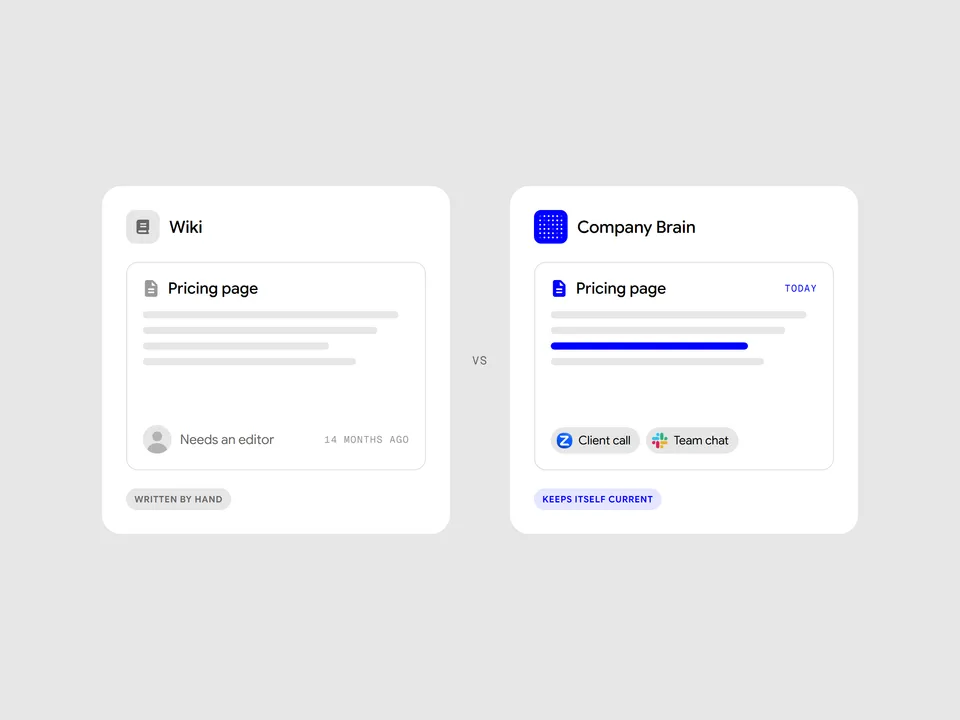
Table of Contents
- What does a wiki actually do?
- Why do wikis go stale, and why does that kill trust?
- What is the core difference between a Company Brain and a wiki?
- How can you tell if you need a Company Brain or better documentation?
- Why did this gap become urgent with AI?
- What does a Company Brain do that a wiki can’t?
- How do you check your own wiki today?
- Frequently asked questions
Every growing company builds a wiki at some point. About a year later, someone searches it, finds a page last edited fourteen months ago, and goes back to asking Dave in accounting. The wiki is still there. Nobody trusts it.
This is the gap between documentation and memory. A Company Brain is a living, queryable record of a company’s decisions, processes and context, built for both people and AI. This article compares the two, gives you a five-point test to tell which gap you have, and shows what a memory layer adds to the wiki you already pay for.
What does a wiki actually do?
A wiki (Confluence, Notion, an internal SharePoint, a folder of Google Docs) is a store of pages that people write and people maintain. Someone writes a page. Someone is supposed to update it. Other people are supposed to find it and trust it.
That model has three dependencies, and all three leak.
- Someone has to write the page. Most operational knowledge never gets written down. It lives in the head of the person who has done the task forty times.
- Someone has to update the page when reality changes. A price changes, a process changes, a policy changes, and the page keeps saying the old thing.
- Someone has to find and trust the page later. The moment a reader hits one outdated page, every other page becomes suspect.
A wiki, in other words, is a snapshot. It is accurate on the day it is written and decays from there. Documentation captures what someone knew at one moment. Memory stays current as the business moves.
Why do wikis go stale, and why does that kill trust?
Staleness is not a discipline problem you can fix with a reminder at the all-hands. It is built into the model.
Look at what a company asks its people to search through. IDC has estimated that a knowledge worker spends about 2.5 hours a day, roughly 30% of the workday, searching for information. A wiki was supposed to fix that. Mostly, it moved the problem into a search bar that returns forty results, three of them contradictory.
Then trust erodes, and erosion runs one way. An employee searches once, lands on an outdated procedure or a wrong phone number, and stops using the wiki. One bad page does not cost you one page of trust. It costs you the reader.
This is how most company wikis die. Not by deletion, by abandonment. The pages stay up. The knowledge inside them slowly stops matching the business. People route around it, back to the tribal knowledge problem the wiki was built to solve: the same question answered five different ways in five different Slack threads.
The usual response is to make the wiki faster or prettier: a better search bar, a nicer template, a quarterly review cycle. That treats the symptom. Documentation and memory are different things, and a better filing cabinet is still a filing cabinet.
What is the core difference between a Company Brain and a wiki?
A wiki is written for people to read. A Company Brain is built for people and AI to use.
That word, use, is the whole difference. A wiki is passive. It waits to be opened. A Company Brain is the context layer an AI tool reads from to do the work: answer the customer, draft the quote, route the ticket, explain why a process exists. The wiki holds documents. The Company Brain holds the operating logic of the business in a form that people and machines can act on.
| Dimension | Wiki (Confluence, Notion, SharePoint) | Company Brain |
|---|---|---|
| What it is | A store of human-written pages | A living, queryable record of how the business works |
| Who it is for | People, reading | People and AI, acting |
| What it holds | Whatever got written down | Decisions, processes, exceptions, and the reasons behind them |
| Covers the “why” | Rarely: records outcomes, not reasoning | Yes: decisions carry the context that explains them |
| Stays current by | Someone remembering to edit | Capturing changes as the business makes them |
| When it is wrong | Silently: nothing flags an old page | Built to show gaps and conflicts, not hide them |
| AI reads it and gets | Confident answers from stale text | Answers grounded in how things work now |
| Failure mode | Abandonment: people route around it | Kept alive as a working asset |
The row that does the most damage is when it is wrong. A wiki fails silently. No alarm goes off when a page goes out of date. The page sits there looking authoritative. That was survivable when only people read the wiki and could sense that a page felt old. It stops being survivable when an AI tool reads the same page and repeats it to a customer with full confidence.
How can you tell if you need a Company Brain or better documentation?
The answer does not depend on how many pages you have or how good they are. It depends on which kind of failure keeps happening.
A Company Brain is the right fix when:
- AI tools give generic or wrong answers even with access to your docs. If the model can find the relevant page but still gets business-specific questions wrong, the missing piece is context that the documentation does not hold. More pages will not close this gap.
- New hires spend months asking ten people how things actually work. If onboarding still runs on informal questions despite thorough written guides, what is missing is not more guides. It is the reasoning and the exceptions that only exist in conversations.
- The same decision gets made more than once. If teams keep reopening settled decisions, the reasoning behind the first decision was not kept anywhere findable. “We already tried that” keeps coming up because the context for the first attempt is gone.
- Knowledge leaves when people leave. If losing one key person creates a gap the docs cannot cover, the docs are not capturing what matters most. (More on this in what you lose when employees leave.)
- Exceptions outnumber the rule. If the way work really happens looks little like the written version, the written version is decorative, not operational.
Better documentation is the right fix when the team does not write things down at all, or writes them where nobody can find them. That is a real problem with a different cause. It needs cleaner structure, clear ownership and steady writing habits before anything else.
The two problems can coexist, and most companies have both. The question is which one is holding you back right now.
Why did this gap become urgent with AI?
For most of their history, stale wikis were an annoyance. AI turned them into a liability.
When you connect a model to your knowledge, you no longer rely on a person to judge whether a page looks current. You ask a machine to treat it as ground truth. When MIT’s NANDA initiative studied enterprise generative AI, it found that for 95% of companies in its dataset, implementation was falling short. The researchers pointed to a learning gap in tools and organizations, not to model quality. The foundation under the model is the usual problem, and a recent Cloudera and Harvard Business Review Analytic Services survey found that only 7% of enterprises say their data is completely ready for AI.
Investors now name this layer too. Y Combinator’s Summer 2026 Request for Startups included a Company Brain category, written up by partner Tom Blomfield. It describes a system that gathers knowledge scattered across Slack threads, old emails, support tickets and people’s memories, keeps it current, and turns it into something AI agents can execute: how refunds are handled, how pricing exceptions are decided, how engineers respond to incidents. Search finds pages. A chatbot summarizes them. Neither is memory.
The model has become the cheap part. Any company can rent a frontier model by the token. No company can rent its own context: how it prices exceptions, why a policy exists, how the best rep handles a churn call. That context is the scarce asset, and a wiki was never designed to hold it in a usable form. (For why AI tools sound generic without it, see why AI tools don’t know your business.)
What does a Company Brain do that a wiki can’t?
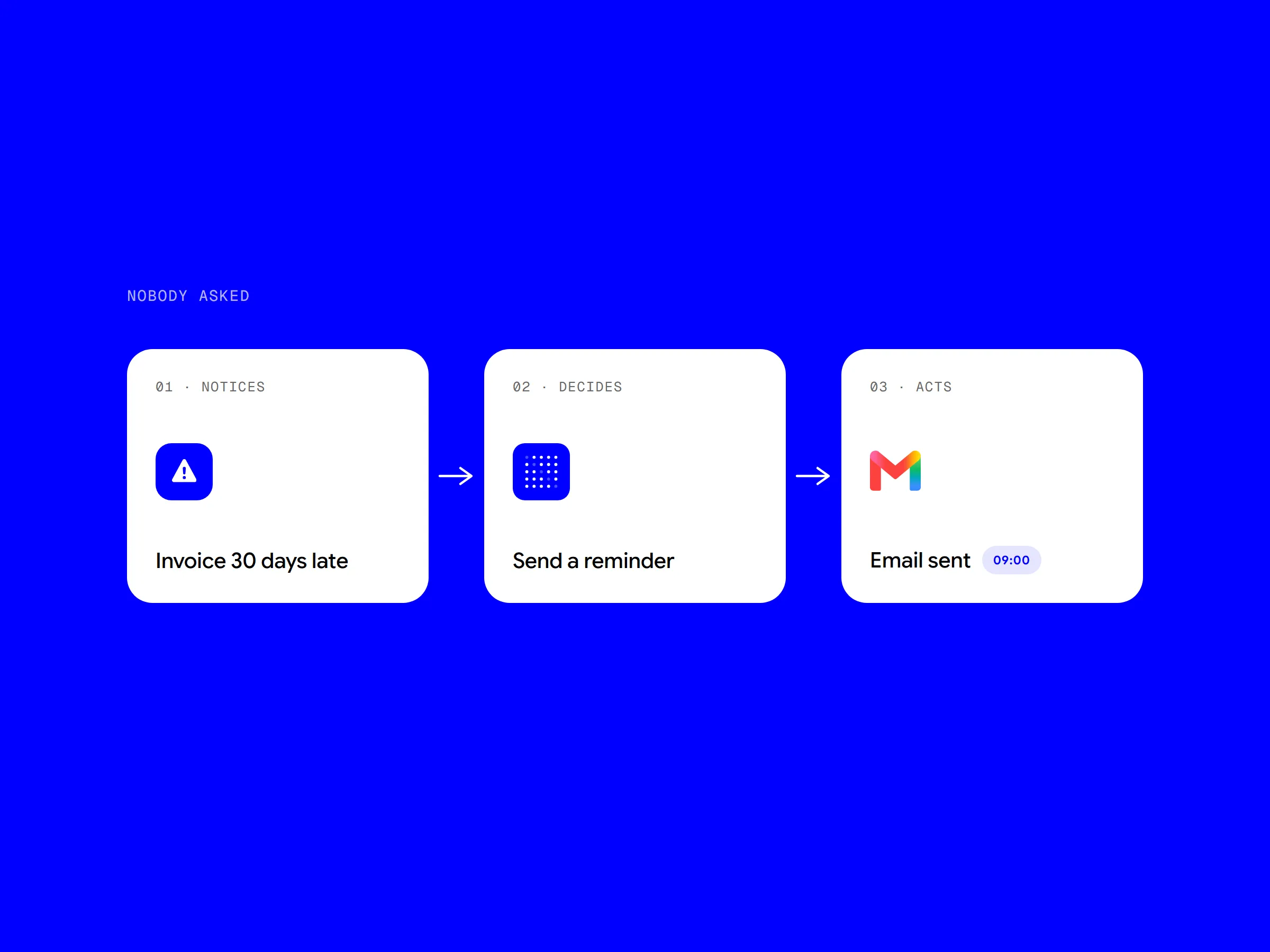
Three things separate a memory layer from a page store.
It captures the undocumented. A wiki can only hold what someone typed. A Company Brain is built by first mapping how the business actually runs, including the knowledge that exists only in people’s heads, and turning it into something you can query.
It stays in sync instead of decaying. A wiki drifts the moment reality changes. A Company Brain tracks how the business works over time, so the answer reflects how things are done now, not how they were done a year ago.
It makes AI useful instead of generic. Point a general model at your business and it writes confident filler, because it does not know your product, your tone or your rules. Grounded in a Company Brain, the same model works more like a colleague who has been at the company for years.
None of this means throwing the wiki away. Your wiki is good raw material and a head start on the mapping. It is just not, on its own, the thing.
If you already pay for a knowledge tool that added AI search on top of your pages, read Company Brain vs knowledge management software. It covers why AI over the same pages does not close this gap.
How do you check your own wiki today?
Open your wiki and check the “last edited” date on the five pages a new hire needs most in week one. If most of them are older than your last major process change, a better template will not help. You have a gap where a Company Brain should be.
Then run the AI test. Ask an assistant with access to the wiki about one real exception, such as how a specific client is billed. If it finds nothing, fix the documentation. If it finds the policy page and still gets the exception wrong, the knowledge was never written down.
The first step after that is not another tool. It is a map of how the business runs today and where the knowledge really lives. That is how Superstate starts with every client: a sixty-minute meeting with leadership, then talks with the people who do the work. The brain built on that map captures what the company already says and writes, keeps its pages up to date, and shows the page behind every answer. For the full method, read how to build a Company Brain.
The question is not whether your knowledge should be written down. It is whether it stays alive after it is, or rots in a filing cabinet while your AI tools read from it and repeat it to your customers.
Frequently asked questions
Is a Company Brain just a wiki?
No. A wiki is a store of pages that a person has to write and keep up to date, and it goes stale when the business changes. A Company Brain is a living, queryable record of how the business actually works. It stays current, it holds the decisions and exceptions that no page records, and AI tools can use it to do work.
Do we need a Company Brain if we already have Confluence or Notion?
Often, yes. A good wiki covers the documented layer: policies, process steps, reference guides. Most companies with a mature wiki still lose knowledge to undocumented exceptions, decisions made on calls, and people who leave. If your AI tools can find the right page but still give the wrong answer, the wiki is not the missing piece.
How do I know if my problem is documentation or a Company Brain gap?
Ask an AI assistant with access to your wiki a question about a real exception, such as how a specific client is billed. If it cannot find any relevant page, you have a documentation problem. If it finds the policy page but still gets the exception wrong, you have a Company Brain gap: the context was never written down.
Why do company wikis always go out of date?
A wiki depends on a person remembering to update a page every time a price, process or policy changes. That update rarely happens, so pages drift away from how the business really works. After someone finds one wrong page, they stop trusting the whole wiki and go back to asking a colleague.
Can we turn our existing wiki into a Company Brain?
Your wiki is useful raw material, but it is not a Company Brain on its own. It holds only what someone chose to write down. Building a Company Brain starts by mapping how the business actually runs, including the knowledge in people’s heads and chat threads, and then keeping that record current.

Want to know more about what we do? Visit the Superstate website.