Agent Memory for Companies: The Company Brain Split
Agent memory and a Company Brain are two layers, not one. Learn what each does, where the market is splitting, and which your business needs first.

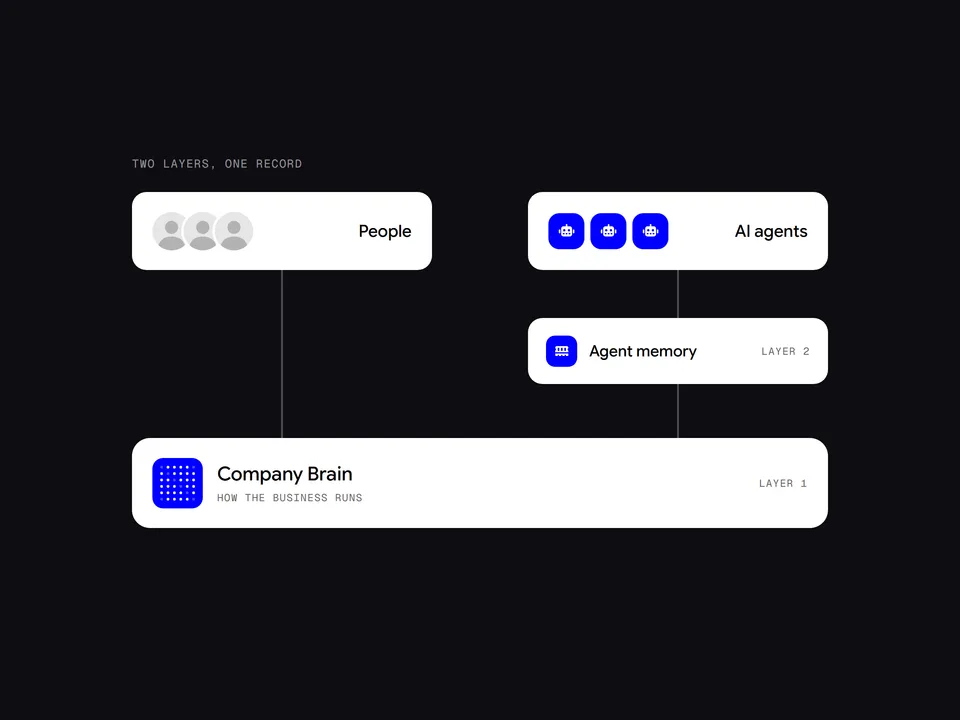
Table of Contents
On June 23, 2026, Engram came out of stealth with $98 million in funding from General Catalyst, Kleiner Perkins, Sequoia Capital, and others, to build what it calls the learned memory layer for AI. The same press release describes the problem: the AI employees use every day “knows next to nothing” about their organization. Two months later, on September 2, Meta Engineering described how it built an AI agent that acts as an organization’s “second brain” for expert knowledge. Both tackle the same core problem, and they approach it from different sides.
A Company Brain is a living, queryable record of how a business works, structured so that people and AI agents can both use it (the pillar post defines it in full). The market is quietly splitting on who the reader is, and agent memory for companies sits on that fault line.
What Is the Agent Memory Split?
Our reading of the market is that vendors fall into two camps. This is our own classification, not an industry standard.
The agent-first camp builds context layers that AI systems consume through an API or a connector. Humans curate and approve, and agents consume continuously. Engram is the best-funded example we can point to.
The human-first camp builds searchable knowledge systems where a person is the main reader: wikis, knowledge bases, and the knowledge-management tools that now use the “company brain” label. AI assists the human inside their workflow, not the other way around. For the difference between these tools and a Company Brain, see Company Brain vs Wiki.
| Agent-first memory | Human-first knowledge system | |
|---|---|---|
| Primary reader | AI agents via API or connector | People via search or chat |
| Design priority | Structured, machine-parseable context | Human-readable, browsable documentation |
| Update mechanism | Continuous, event-driven | Often manual, periodic review |
| Failure mode | Agents act on incomplete decision context | Knowledge silos form; onboarding stays slow |
| What it misses | The human reasoning behind the data | The growing AI workload on the same business |
A Company Brain aims at both columns: one maintained source, readable by a person browsing and by an agent querying.
Why Do Agents Need More Than Stored Documents?
Every agent needs context to perform. Without it, agents retrieve stale data or return confidently wrong answers about a company’s own operations. The slow gap between what the AI was told and what is currently true is called context drift. We explain it in Context Drift in AI Agents.
The shape of the context matters, too. LangChain’s Harrison Chase wrote in June 2026 that agent memory is still early, with little to no standards, and that one emerging pattern is wiki memory: an agent turns raw source data into a compact, persistent, agent-readable knowledge layer. A 2025 research paper on Agentic Context Engineering reports gains of 10.6% on agent benchmarks by evolving the context an agent works from, without changing model weights. Agents do better when the context is structured and maintained.
The human side has a matching problem. Tribal knowledge did not disappear when agents arrived. An NBER working paper reports that 89% of executives say AI has had no productivity impact so far (see also The Register’s coverage). The cause is not always model quality. A model that does not know how the business makes decisions, handles exceptions, or prices its services cannot use that knowledge. We look at the pattern in Why AI Tools Don’t Know Your Business.
What Happens When You Build Only Half a Company Brain?
The agent-only failure. An agent with perfect access to structured company data still fails when the reasoning behind a decision was never captured. For example, picture a pricing agent with access to every historical contract in a CRM. It cannot know why certain clients received non-standard rates, because that was a judgment call by a sales director who has since left. The data is there. The institutional reasoning is not. An agent that retrieves without understanding fails with the same assertiveness it would show if the context were complete.
The human-only failure. A knowledge system written for human readers will not serve a growing agent workload well. Agents work best with explicit fields, clear metadata, and stated decision context, and they struggle with documents written only for narrative reading. A system built only for people gets bypassed as the agent layer grows.
Agent memory that humans cannot inspect, update, or challenge becomes brittle. A knowledge system only humans can use becomes irrelevant to the AI work. Neither half is wrong about the problem, and this split does not resolve by one side winning, because both kinds of reader are here to stay.
Can One Brain Serve Both Humans and Agents?
Meta’s September 2026 post, “An Organizational Second Brain: Building an AI That Learns From Experts,” gives one worked example. The team built an agent for a compliance domain, where the same questions come up across many product reviews and experts spend days on manual research. The design separates what the agent knows from how it reasons. A structured, auditable knowledge architecture holds the first. A self-improvement loop turns expert corrections into verified, tested updates, without retraining the model.
Meta describes the result as turning one-off expert corrections into compounding institutional memory, and says the pattern is designed to generalize to other domains. We read two lessons into it. Knowledge lives outside the model, where people can inspect and correct it. And expert judgment gets captured as part of normal work, not as a separate documentation project.
The same shape works for a small company. What a new hire asks in their first week and what an agent checks before sending a proposal should draw on one source of truth, kept current by one process, under one set of permissions. For the broader market picture, see The Company Brain Market.
How Do You Tell Which Half a Vendor Is Selling?
The design decisions that reveal a vendor’s camp are usually visible in the first hour of conversation.
Signs of an agent-first build:
- The primary interface is an API, connector, or agent SDK, not a human-facing application
- Onboarding focuses on data pipelines and integrations before anything else
- Search, chat, and browsing feel secondary or sit on the roadmap
- Pricing tracks API calls or agent queries, not users
Signs of a human-first build:
- The primary interface is a search bar, chat box, or wiki-style editor
- Onboarding leads with documentation migration and team training
- Agent support is a plugin, a beta, or a planned release
- Pricing is per seat
Signs of a unified build:
- Both interfaces are first-class from day one
- The same fact, such as a pricing exception or a client history, is readable by a person and by an agent without transformation
- Permissions apply at the knowledge level, not only at the interface
- The setup covers how people make decisions, not just which data sources exist
The practical starting point is a mapping session: what knowledge exists in the business, where it lives (in systems or in people’s heads), and which sources your agents and your people actually draw from. That map shows which half is missing.
Which Layer Does Your Business Need First?
Start with the record of how the business works, then let agents read from it. Giving agents memory before the business has a reliable record means giving them a faster way to retrieve the same gaps.
At Superstate, the Company Brain is built on a map of how your company runs, and the agents we build for repeated tasks read the brain, so they know the company from day one. Every answer shows the page it came from. The first step is a free sixty-minute meeting. For the build path, see How to Build a Company Brain.
Frequently asked questions
What is agent memory for companies?
Agent memory for companies is the context layer that gives AI agents access to how a business operates, including its decisions, processes, pricing logic, and exception handling, rather than only stored documents. Without it, agents retrieve facts but miss the reasoning that makes those facts usable. A Company Brain is the maintained record that agent memory should draw from.
How is agent memory different from a company wiki or documentation?
Agent memory is structured for machines: explicit fields, metadata, and decision context that an AI system can query mid-task. A company wiki is written for people to browse and read. They can work together, but most wiki content needs transformation before an agent can use it reliably. A Company Brain keeps one maintained source that both people and agents can query.
Why do AI agents fail without a Company Brain?
Agents can retrieve documents but cannot infer the reasoning behind a company’s decisions. An agent handling a pricing exception cannot know why the exception exists unless that decision context was captured. Over time the stored context also drifts away from how the business works today. A Company Brain closes the gap by holding decision logic alongside raw data and keeping it current.
Should a Company Brain serve AI agents or human employees?
Both. People and agents should read from the same underlying knowledge. A tool built for only one kind of reader leaves gaps that show up when the other kind grows. Meta’s engineering team describes a design that keeps knowledge outside the model, where experts can inspect and correct it, as one example of this approach.

Want to know more about what we do? Visit the Superstate website.