How to Build a Company Brain: A Practical Guide
How to build a Company Brain in three phases (Map, Build, Run), what it must hold, what has to be true first, and why most builds fail.

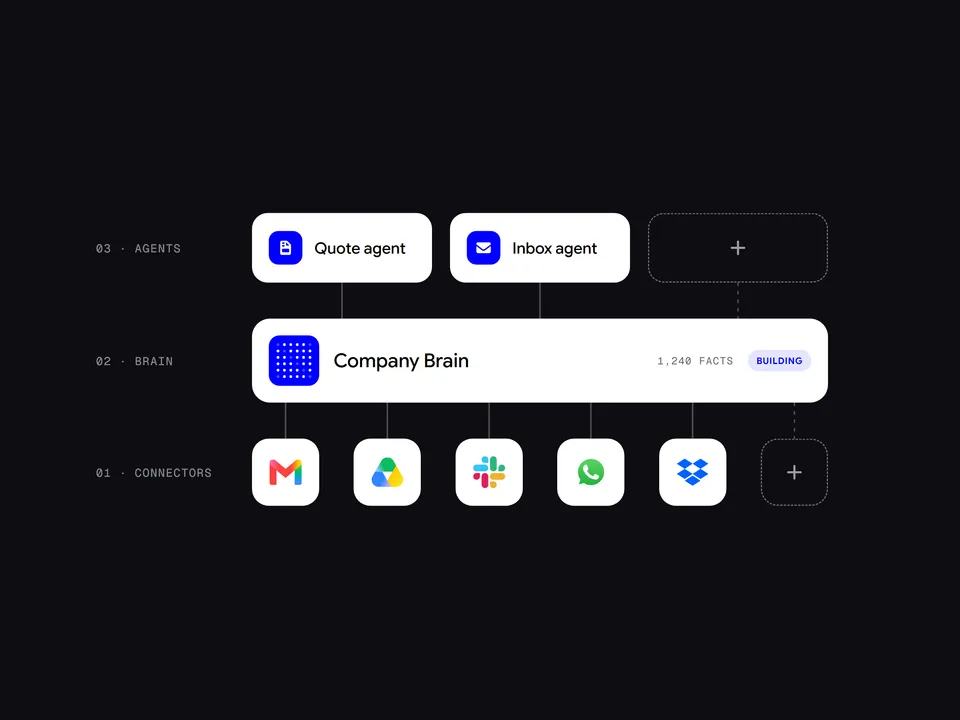
Table of Contents
- Why build a Company Brain at all?
- What should a Company Brain hold?
- What has to be true before you start?
- How do we build a Company Brain, step by step?
- Why do most Company Brain builds fail?
- What three questions should we ask before we start?
- How is a Company Brain different from a wiki, search or RAG?
- How does Superstate build a Company Brain?
- Where should we start?
- Frequently asked questions
Most failed builds skip the first phase or the last one. This guide covers what a Company Brain should hold, what has to be true before you start, each phase in turn, why most builds fail, and the questions to ask before you begin.
A Company Brain is the living, queryable record of how a business works, kept current so that people and AI tools can act on it.
Why build a Company Brain at all?
Because AI tools that do not know your business give generic answers. A model can write a fine proposal in general. It cannot know your pricing exceptions, your largest client’s history, or why the team changed its refund rule last spring. We explain this gap in why AI tools don’t know your business.
The data problem is real and common. In a study by Cloudera and Harvard Business Review Analytic Services, only 7% of respondents said their organization’s data is completely ready for AI (Cloudera, March 5, 2026). MIT’s NANDA initiative reported a 95% failure rate for enterprise generative AI pilots and blamed a “learning gap”: generic tools do not adapt to how a company works (Fortune).
When the brain exists, the result can be large. Stripe built an internal AI platform called Kai, and more than 10,000 Stripe employees use it every week (How I AI, Lenny’s Newsletter). Stripe’s team describes how it structured its data so agents can query it safely, and how it uses projects as a way to govern who sees what. Few companies are Stripe. The lesson still holds: the context comes first, and the model sits on top.
What should a Company Brain hold?
A Company Brain holds the operating knowledge of the business. Six kinds of knowledge matter most:
| Kind of knowledge | What it covers | Why documents usually miss it |
|---|---|---|
| Processes | How work actually gets done | The manual describes how it was meant to work |
| Decisions | What was decided, when, by whom, and why | The reasons stay in a meeting or a chat thread |
| Rules and exceptions | Pricing exceptions, refund logic, edge cases | Exceptions are handled case by case and never written up |
| People | Who owns what, who knows what | Org charts show reporting lines, not knowledge |
| Clients and partners | History, terms, preferences, open issues | Spread across email, CRM notes and memory |
| Open questions | What the business does not know yet | Nobody documents what is unresolved |
Each item should carry a date and a source. “Partners get 10% on the first order” is not enough. The brain should also say who approved it, when, and where it was said. Without that, nobody can tell a current rule from an old one.
What has to be true before you start?
Three conditions decide whether a build can work. Check them first.
Someone can say how the business works. If the answer to “how do we handle pricing exceptions?” is “it depends on who you ask,” the Map phase will surface that. But there must be a real answer somewhere. If each person invents the process each time, the company must agree on the process before a brain can hold it.
The tools can connect. A brain that cannot read email, chat, documents and client records cannot capture work as it happens. Very old systems with no way to export or connect may need attention first. For a deeper check, see is our data ready for AI.
There is a human owner. A brain without a keeper decays. Someone must settle conflicts, approve rule changes, and make sure corrections happen. In a small company this is usually the CEO or COO. For what this looks like in a 20 to 200-person company, see Company Brain for small and medium businesses.
How do we build a Company Brain, step by step?
Phase 1: Map how the business really works
The Map phase captures how the business operates before any tool is set up. It is the phase teams most often skip, and the one that decides most outcomes.
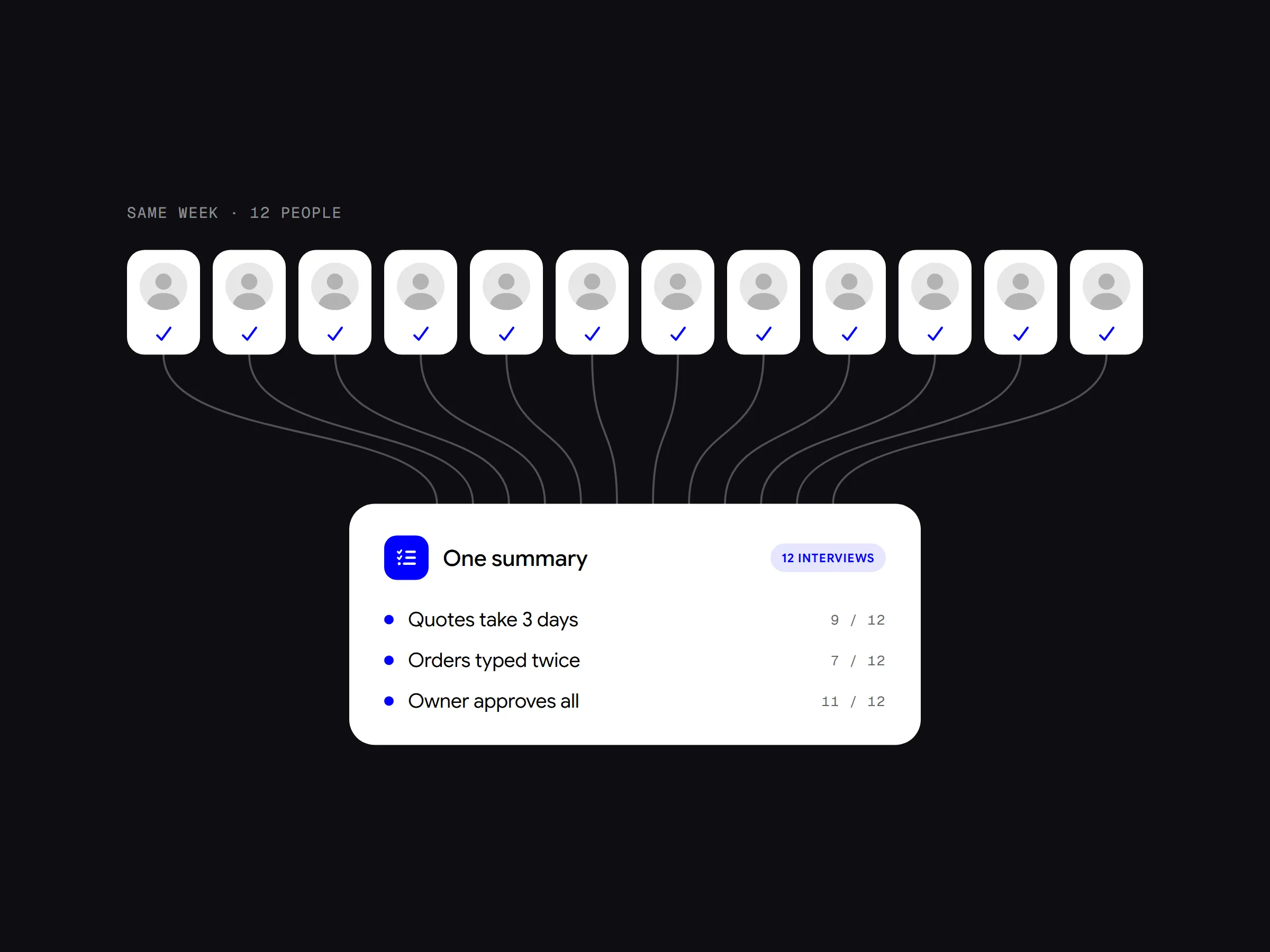
Most companies assume their processes live in their documents. They rarely do. Mapping gets the knowledge from the people who hold it:
- Start with leadership. One structured meeting covers how work moves, where time and money go, and what is missing.
- Interview the people who do the work. They know the exceptions that leadership does not see.
- Look at the tools already in use. Note where each kind of knowledge lives today.
- Follow a few real jobs from start to finish. A real order, a real invoice, a real client question. This shows the gap between the manual and the work.
- Rank what you find. List the tasks that repeat, and order them by what they cost the business.
The output is not better documentation. It is a first version of the brain: how the company runs, at enough detail that a new hire or an AI agent could act on it. It is also a ranked list of where AI will save the most.
Phase 2: Build the brain and connect it
The Build phase makes the brain part of daily work. Four properties separate a brain that stays useful from one that rots.
It captures as work happens. Meetings, calls, chats, emails and documents flow in the same day, with the date. Nobody waits six months and then “does the documentation.”
It shows its source. Every answer points to the page it came from, and every page points to where it was said. The YC Summer 2026 Company Brain entry asks for the same: answers with sources and confidence scores, plus flags for contradictions and gaps.
It respects access rights. A sales assistant should not read payroll. The brain must know who may see what, and every agent must inherit those limits. This is harder than it looks. We cover it in the Company Brain permission gap. Databricks lists governance, PII handling and access controls among the core skills in its context engineering certification.
It can be corrected. When an answer is wrong, a person fixes it once and the brain keeps the fix. New or changed rules go to the owner for approval. This is the quality gate that keeps the brain trusted, not a bottleneck.
The craft of deciding what each AI tool sees, and when, has a name: context engineering. The Build phase is where it happens. The brain supplies the right context to the right tool at the right moment. Nobody has to paste background into every prompt.
Phase 3: Run it
A Company Brain is never finished. The business changes every week, so the brain must change with it.
Running a brain means three things. The owner checks what changed and settles conflicts. The brain flags pages that disagree or have not been confirmed in a long time. And the team adds new needs as they come up: a new client type, a new process, a new agent.
This is where most builds die. Slite, a knowledge-base vendor, surveyed 149 teams in July 2026. Of the teams that tried to build a company brain themselves, 55% gave up, “almost always on maintenance” (Slite). The sample came from Slite’s own audience, so treat it as a signal. It still matches what the history of company wikis shows.
Why do most Company Brain builds fail?
Most failures come from six causes. All of them can be prevented before setup starts.
- Dirty input. A brain built on scattered pages, old policies and broken documents gives answers that sound sure and are six months out of date. Nobody sees the problem until someone acts on a wrong answer.
- Skipping the Map phase. Teams pick a platform, import their documents, and assume the documents describe today’s business. They often do not. Importing documents is not the same as capturing knowledge from the people who hold it.
- Treating it as a project. A project has a launch date and an end. A Company Brain has neither. It is either current or getting worse. Teams that launch and walk away end up with a system that answers from last year’s reality.
- Stale context at scale. AI tools do not know when a fact is out of date. One person who reads a stale wiki makes one mistake. Fifty agents that read the same stale fact make fifty mistakes, fast, with no sign that anything is wrong. We cover this in context drift in AI agents.
- Built for one audience. A brain built only for agents gives people nothing to read or check, so nobody maintains it. A brain built only for people often lacks the structure and permissions agents need to act safely. Most businesses need both from one source. See agent memory vs Company Brain.
- No governance. If any tool can write anything, and any agent can read everything, the brain cannot be trusted. It needs a record of what is known, from where, confirmed by whom, and who may act on it.
What three questions should we ask before we start?
Whether you build in-house, buy a product, or hire a partner, three questions show whether the result will be trusted.
Who owns it? A brain with no named owner goes stale within weeks. The answer should be a person’s name, not a job title. That person settles disputes and approves rule changes.
How is an answer verified? Every answer should show where it came from. When an answer is wrong, there must be a clear way to fix it, and the fix must stick. When the business changes, the brain must flag what is now out of date. If you cannot check an answer, you cannot trust it.
Who may see what? The brain holds sensitive knowledge: prices, salaries, client terms. Access must follow your company’s roles, and every agent must inherit the rights of the person it works for.
None of these questions has a software-only answer. Each needs a decision by the business, made during the Map phase. To compare who can build a brain for you, see who builds Company Brains.
How is a Company Brain different from a wiki, search or RAG?
| Approach | What it holds | How it stays current | Can AI act on it? |
|---|---|---|---|
| Company Brain | Decisions, processes, rules and reasons, with sources | Captures as work happens; a person approves changes | Yes, built for it |
| Wiki or Notion | Pages people wrote | Only when someone updates them | Risky: no way to tell stale pages |
| Enterprise search | An index of documents | Automatic, but surface only | Finds files, does not answer |
| RAG pipeline | Text chunks fetched at query time | As fresh as the sources | Partly: retrieves, does not reconcile |
| Fine-tuning | Knowledge baked into the model | A new training run for each change | No: cannot follow daily change |
The last column matters most. An AI that queries a wiki finds documents. An AI that queries a Company Brain finds answers, with the reason and the source behind each one.
How does Superstate build a Company Brain?
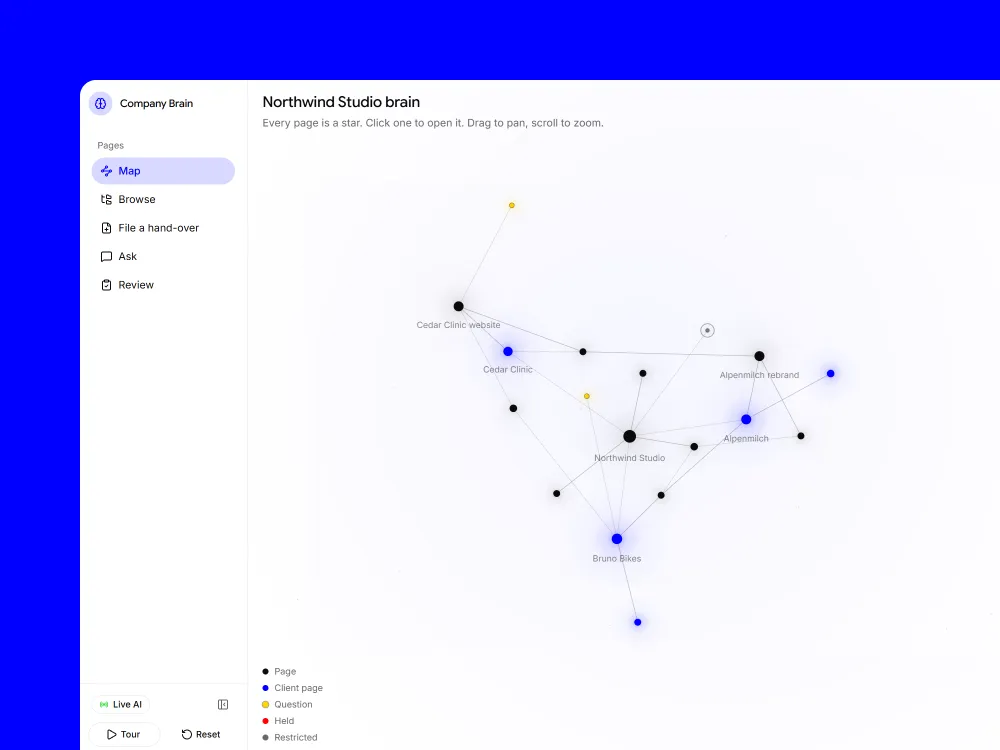
Superstate follows the same three phases, with a fourth step: it stays.
- Map. It starts with a sixty-minute meeting with leadership. Then it talks to the people who do the work, looks at the tools already in use, and follows a few real jobs from start to finish. The client gets the map: how the company runs, where hours leak, and which tasks repeat, ranked by what they cost. The mapping is free.
- Brain. The Company Brain captures meetings, calls, chats, emails and documents the same day, with the date. It sorts them into plain pages that keep themselves up to date. Every answer shows the page it came from. If something is wrong, you correct it, and the brain remembers.
- Agents. AI agents read the brain, so they know the company from day one. Each has one clear job and clear limits, and what matters goes to a person first. Superstate starts with the one or two agents that save the most time.
- Stay. Superstate watches how the agents work, fixes what goes wrong, and adds to the brain as the company changes.
Each client’s brain runs on its own server and is never shared with other clients. The client decides what goes in and who sees it. If the client leaves, it keeps the brain, written in pages its people can open and read.
Where should we start?
Start with one question: if the three people who know most about how your business works left tomorrow, how much of that knowledge would leave with them? For most companies, the honest answer is “most of it.”
Then take the first step of the Map phase. Put the people who know how the business works in a room for an hour, and write down where the critical knowledge lives today. That list tells you what the brain must hold first and which AI agents will pay off soonest.
Frequently asked questions
How long does it take to build a Company Brain?
The first version comes from the Map phase, which starts with one meeting with leadership and continues with short interviews with the people who do the work. Connecting the brain to your tools takes days to weeks, depending on how many tools there are. The Run phase never ends: a Company Brain that stops being kept current gets worse quickly.
Do we need a lot of existing documentation to build a Company Brain?
No. Many companies start with very little written down, and that is expected. The Map phase gets the knowledge directly from the people who hold it. Old documents help, but they are checked against how the company works today, not imported as truth.
Who should own the Company Brain inside our company?
One named person who is accountable for its accuracy. In a small company that is often the CEO or COO. The owner does not write every page. They decide which source wins when two disagree, approve changes to rules, and make sure corrections happen.
How do we know if a Company Brain is working?
Three signs. AI tools give answers specific to how your company works, with a source for each. New hires find what they need without asking five people. And the same why-do-we-do-it-this-way questions stop coming up in meetings.
What is the biggest mistake when building a Company Brain?
Skipping the Map phase. Teams pick a platform, import their old documents, and find out months later that the brain answers confidently from information nobody knew was out of date. Mapping how the business works today, before any tool is set up, is what separates a useful Company Brain from a search engine over stale files.

Want to know more about what we do? Visit the Superstate website.