Why Your Data Is Killing Your AI Projects
Is your data ready for AI? Four tests, a four-step plan, and why only 7% of enterprises say their data is completely ready. A practical guide for SMBs.

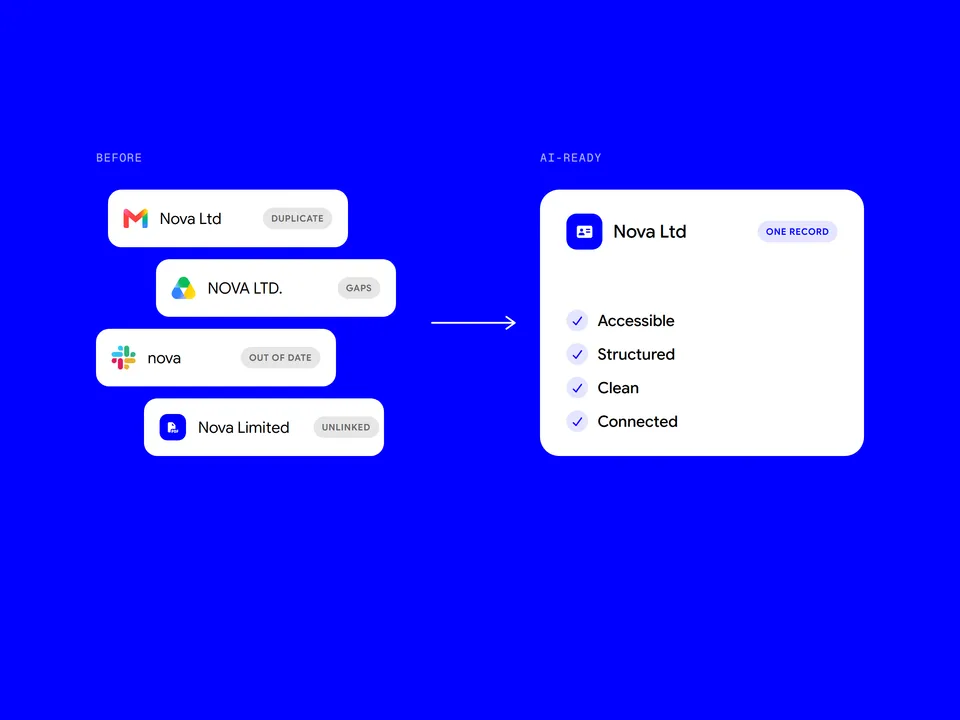
Table of Contents
Gartner predicts that 60% of AI projects lacking AI-ready data will be abandoned by 2026 (reported by Freevacy from Gartner’s February 2025 press release). For small businesses, with tighter budgets and fewer second chances, the gap between ambition and data reality is a major threat to AI return. For the wider picture on failure, read why AI projects fail.
Why does data sink AI projects?
For example, picture a 45-person logistics company that buys an AI demand-forecasting tool. The model is solid and the vendor is reputable. But sales data lives in three systems with different formats, inventory records are full of errors, and two years of supplier data exist only in email attachments. The project stalls, and the budget is spent.
The pattern is common. Qlik research found that 81% of AI professionals say their company still has significant data quality issues. Companies often buy the AI tool first and discover the data problem second. By then the budget is gone and the team is discouraged.
Leaders tend to imagine AI as a layer they can drape over existing operations, reading their spreadsheets and understanding their processes. AI needs a specific kind of input to produce useful output. “Garbage in, garbage out” was true for databases in 1995. It is more true for AI.
What makes data AI-ready?
AI-ready data meets four criteria that much small-business data fails.
| Criteria | What it means | Typical SMB situation |
|---|---|---|
| Accessible | All data reachable through APIs or unified storage | Scattered across many SaaS tools, local drives, and email |
| Structured | Consistent formats, labeled fields, machine-readable | A mix of CSVs, PDFs, screenshots, and verbal agreements |
| Clean | No duplicates, no gaps, no contradictions | Duplicate and incomplete customer and transaction records |
| Connected | Data sources linked by common identifiers | Customer in CRM is not the same record as in billing or support |
The right-hand column is our general observation, not survey data. A large share of business information is unstructured: documents, emails, images, chat messages, call recordings. That data is not useless. It is just unusable in its current state. The gap between “data that exists” and “data AI can use” is where many AI projects die.
What does bad data cost an AI project?
The damage goes beyond the failed project. An abandoned project still burns planning, vendor selection, and partial implementation costs. For a small business, a failed project also kills appetite for AI. A $50,000 project that fails because the data was not ready costs more than $50,000: it can delay the next attempt for a year, while competitors who prepared their data pull ahead. That last point is our judgment, not a measured figure.
Fixing data is also the part of AI work that lasts. A clean, connected data set serves the first use case and every one after it. A company that builds its Company Brain starts from the same place: its data in one reachable place.
What are the four steps to make your data AI-ready?

Step 1: Audit every data source
Before fixing anything, map what exists: every SaaS tool, spreadsheet, shared drive, and email chain with business-critical information. For each source, answer three questions:
- What data lives here? Customer records, transactions, communications, documents.
- How current is it? Real-time, daily, monthly, stale.
- Who owns it? Which team, which person, and what happens when they leave.
Most companies find more data sources than they expected. A common surprise is business-critical information held only in a former employee’s personal files.
Step 2: Consolidate and kill the silos
Identify which sources hold overlapping data and which hold unique information. The goal is fewer systems with better data, connected through common identifiers. This does not mean ripping out every tool. It means one source of truth for each data category:
- Customer data: one CRM, one record per customer, linked across billing, support, and sales.
- Financial data: one accounting system feeding all reports.
- Operational data: one project management or ERP source.
Where consolidation is not possible because switching tools mid-operation is too disruptive, build integrations that sync data between systems automatically.
Step 3: Clean the foundation
With data consolidated, fix what is broken:
- Deduplication. Merge duplicate customer records, transaction entries, and contact lists.
- Standardization. Use consistent date formats, address formats, and naming conventions.
- Gap-filling. Find missing fields and decide whether they can be recovered or must be collected from now on.
- Validation rules. Set up automated checks that catch errors at the point of entry, not six months later.
Step 4: Build a data hygiene routine
Cleaning data once is a project. Keeping it clean is a system, and it is the step most often skipped. A hygiene routine includes:
- Automated ingestion rules that format new data on entry.
- Scheduled quality checks that flag anomalies weekly.
- Clear ownership, with one person or team accountable for each data domain.
- Documentation that any new team member can follow.
Which data should you fix first?

The biggest mistake in data readiness is to boil the ocean. Companies that try to clean all their data before launching any AI initiative rarely launch at all.
The smarter approach: pick one high-value AI use case, such as automating invoice processing, predicting customer churn, or building an internal knowledge base. Then prepare only the data that use case needs. AI use case prioritization shows how to pick.
For example, picture a software company that makes its support-ticket data AI-ready first: it cleans past tickets, standardizes category tags, and links tickets to customer accounts in its CRM. The result is visible and fast, and it makes the case for the next data sprint.
Where do off-the-shelf tools fall short?
Standard SaaS tools promise AI features built on your existing data. The pitch is convenient: flip on the AI toggle. But those features only work when the underlying data is already clean, structured, and complete. A CRM’s built-in AI forecasting produces nonsense if many deal records lack close dates or revenue figures. An email tool writes embarrassing messages when the contact database is full of duplicates and outdated titles.
A report that lists everything wrong with your data is useful for understanding the problem and not for fixing it. The missing step is building the pipelines, cleaning the records, and keeping the system running. Superstate starts with a free map of how your company really works, including where its data lives, and then builds on that map. You keep the map and pay only if you say yes to the offer. For who should do the work, read build, buy or partner.
Expert perspective
“Data readiness decides most of the outcome before a single model is trained,” says Ivan Ivanov, Software Engineer at Superstate. “Most SMBs think their data problem is about volume. They have plenty of data. The problem is that it’s scattered, inconsistent, and locked in formats that AI systems can’t parse. A four-to-eight-week focused data sprint — not a six-month overhaul — is the right first step.”
What should you do tomorrow morning?
Pull up every system your company uses to store customer, financial, or operational data. Count them. If the number is higher than five, you likely have a consolidation problem. If you cannot export clean data from any of them in under 10 minutes, you have an accessibility problem. If the same customer appears differently in two or more systems, you have a consistency problem. These are rules of thumb, not benchmarks.
Any one of these can kill an AI project. Start with the system that feeds your highest-value business decision, and make that data AI-ready first.
Frequently asked questions
What is AI-ready data?
AI-ready data is information that is clean, structured, accessible, and labeled so AI systems can use it for analysis or automation. For most small businesses, this means consolidating scattered sources, standardizing formats, and filling gaps in historical records.
How many companies have AI-ready data?
Few. A Cloudera and Harvard Business Review Analytic Services report found that only 7% of enterprises say their data is completely ready for AI. A Qlik survey found that 81% of AI professionals say their company still has significant data quality issues.
What percentage of AI projects fail because of data?
Gartner predicts that 60% of AI projects lacking AI-ready data will be abandoned by 2026. Separately, RAND reports that by some estimates more than 80 percent of AI projects fail, twice the rate of IT projects without AI.
How long does it take to make business data AI-ready?
It depends on the number of disconnected systems and the state of the records. A focused sprint on the data for one use case can take weeks, not months. Cleaning all company data at once usually takes far longer and often never finishes.
Should small businesses fix their data before starting AI projects?
Yes, but it does not need to be perfect first. Pick one high-value AI use case, prepare only the data it needs, and expand from there. Companies that try to clean all their data before launching any AI initiative rarely launch at all.

Want to know more about what we do? Visit the Superstate website.