AI Use Case Prioritization: Pick the Right First Project
AI use case prioritization helps SMBs pick the first AI project that pays off — a value-vs-feasibility framework to rank ideas and skip dead-end pilots.

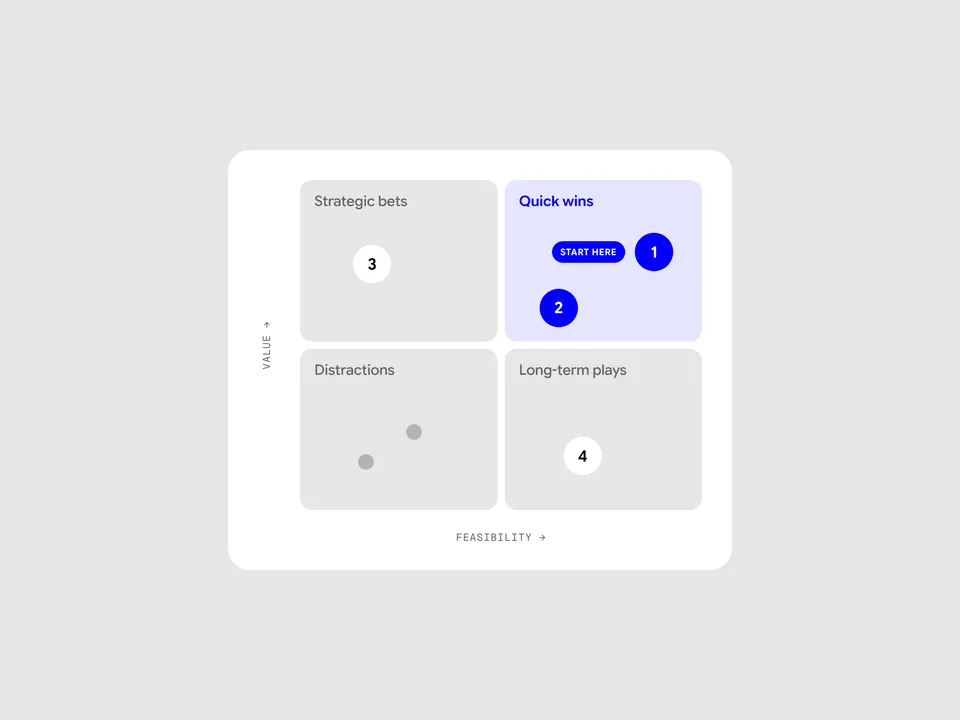
Table of Contents
- Why AI Use Case Prioritization Decides Whether a Project Pays Off
- Why Most SMBs Pick the Wrong First AI Project
- What Is the Value-vs-Feasibility Matrix for AI Use Cases?
- How to Run an AI Use Case Prioritization Exercise in 5 Steps
- What Separates a Ranked Roadmap From a Pile of AI Tools
- What to Do Tomorrow Morning
- Frequently asked questions
For example, picture a mid-sized logistics company that spends nine months on an AI demand-forecasting engine. It works, but it sits unused because the data arrives too late to change any shipping decision. Meanwhile a two-week project that drafts customer-service replies quietly saves hours every week, and nobody ranked it as worth doing. AI use case prioritization closes that gap. It is the process of evaluating each candidate AI project against the same criteria (business value, technical feasibility, data readiness, and time to value) and ranking them so resources go to the highest payoff and lowest risk first. This post is part of our guide to the AI maturity model.
Why AI Use Case Prioritization Decides Whether a Project Pays Off
The numbers explain the stakes. RAND Corporation reports that by some estimates more than 80% of AI projects fail, twice the rate of IT projects without AI. A Gartner survey of 782 infrastructure and operations leaders in April 2026 found that only 28% of AI use cases fully succeed and meet ROI expectations.
One upstream decision plausibly explains part of this: which use case to build first. Companies often choose by enthusiasm, not by evidence. A summary of BCG’s 2025 study reports that 60% of companies generate no material value from AI, while a small group of “future-built” firms, about 5%, create substantial value at scale. Choosing the right problems to point AI at, in the right order, is one thing within a company’s control.
A common error is to ask AI to make an existing process faster instead of asking which process is worth rebuilding. Leaders fund the work that is easy to picture (a faster report, a smarter inbox) and overlook work that would move the business. Prioritization forces value to be named, scored, and compared before effort is spent.
Why Most SMBs Pick the Wrong First AI Project
Three biases quietly corrupt the first choice.
The shiny-object bias
The most technically exciting project is rarely the most valuable one. Predictive maintenance, computer vision, autonomous agents - they demo beautifully and then stall in production because the data infrastructure underneath them is not ready. The wow factor of a use case has almost no correlation with its return.
The competitor-mirror bias
“Our rival launched a chatbot, so we need one.” Copying a use case ignores whether it fits your data, your margins, or your customers’ real friction points. A competitor’s quick win can be your six-month distraction if the underlying conditions differ.
The boil-the-ocean bias
Some teams try to transform ten workflows at once. Spreading a small team across ten projects guarantees that none reach the finish line. McKinsey’s data shows 88% of companies use AI in at least one function, yet only 39% see any impact on EBIT, most often less than 5%. Wide adoption, thin results. Focus is the missing variable.
What Is the Value-vs-Feasibility Matrix for AI Use Cases?

The most reliable way to rank candidates is a scoring matrix that plots each one on two axes: how much value it creates and how feasible it is to build with what exists today. An impact-feasibility matrix sorts every idea into four quadrants:
- Quick wins - high value, high feasibility. Build these first.
- Strategic bets - high value, lower feasibility. Plan and fund deliberately.
- Long-term plays - promising but blocked by missing data or skills. Park with a review date.
- Distractions - low value, low feasibility. Cut without guilt.
Quick wins come first - not because they deliver the largest absolute value, but because a result delivered in 60 to 90 days funds and de-risks everything that follows it.
To make the matrix concrete, score each candidate from 1 to 5 on the dimensions below. The scores in this table are illustrative, not benchmarks.
| Candidate use case | Business value (1-5) | Feasibility (1-5) | Data readiness (1-5) | Time to value | Priority |
|---|---|---|---|---|---|
| AI customer-reply drafting | 4 | 5 | 5 | 2-4 weeks | Build first (quick win) |
| Automated invoice processing | 4 | 4 | 4 | 6-8 weeks | Build second |
| Predictive demand forecasting | 5 | 2 | 2 | 9-12 months | Strategic bet (defer) |
| AI sales-lead scoring | 3 | 3 | 3 | 8-10 weeks | Reassess after first win |
The highest single score does not win. Predictive forecasting scores a 5 on value and still ranks last, because the data is not ready and the payback sits a year out. The reply-drafting tool wins because it is feasible now and returns value in weeks. This is where the data readiness column earns its place. A use case can be brilliant on paper and unbuildable in practice if the data underneath it is weak. See AI-ready data for SMBs.
The best first AI project is the one that proves value fast enough to fund the second. Sequence beats ambition.
How to Run an AI Use Case Prioritization Exercise in 5 Steps
A prioritization session takes an afternoon and saves quarters of wasted effort. Run it like this.
- Inventory the candidates. Pull every AI idea floating around the company - the ones in Slack threads, board decks, and hallway conversations. Write each as a one-line problem statement, not a tool name. “Cut invoice processing time” beats “use AI.”
- Score each on four dimensions. Rate business value, feasibility, data readiness, and time to value from 1 to 5. Score collaboratively with the people who own the workflow, so feasibility estimates stay honest.
- Plot them on the value-vs-feasibility matrix. Sort each candidate into quick wins, strategic bets, long-term plays, or distractions. The visual stack-rank exposes which “obvious” projects are actually distractions.
- Sequence, don’t just select. Choose the top quick win as the first build, then order the rest. Prioritization produces a roadmap, not a single pick.
- Set a 90-day proof gate. Commit to a measurable result within a quarter. If the first project cannot show value that fast, it was scored too generously - send it back to the matrix.
The strongest first projects sit where a high-value process meets data you already control, which is why workflow automation so often ranks above flashier, data-hungry use cases. See which business processes to automate first.
What Separates a Ranked Roadmap From a Pile of AI Tools
A scored roadmap and a stack of AI subscriptions look similar on a budget line. They behave very differently in production.
Off-the-shelf tools each solve one isolated task and force the business to adapt its process to the tool. Buy five and you get five dashboards that do not talk to each other. A prioritization deck with no one to build it ages on a shared drive. Prioritization is only valuable when something gets built on the other side of it. For who should build, read build, buy or partner.
At Superstate we map how a company really works first, rank what AI can do for it by what each item is worth, and then build the top items. The mapping is free, and you pay only if you say yes.
What to Do Tomorrow Morning
List every AI idea circulating in the company. Score each one from 1 to 5 on business value, feasibility, and data readiness, and estimate its time to value in weeks. The candidate with the highest combined score and the shortest payback is the first build. Everything else gets a quadrant and a date - strategic bets get a plan, long-term plays get a review trigger, distractions get cut today.
The habit that helps most is simple: rank AI projects before building any of them, then build in order. Ask whether the first project on your list is the one a scoring model would choose, or the one that sounded most impressive in a meeting.
Frequently asked questions
What is AI use case prioritization?
It is the process of scoring every candidate AI project against consistent criteria (business value, feasibility, data readiness, and time to value) and ranking them so resources go to the highest-payoff, lowest-risk projects first. It decides which problem AI is pointed at before any code is written.
How do you prioritize AI use cases?
Inventory every candidate, score each from 1 to 5 on business value, feasibility, data readiness, and time to value, then plot them on a value-vs-feasibility matrix. Build the high-value, high-feasibility quick wins first, because a result delivered in 60 to 90 days funds and de-risks the projects that follow.
What is the best first AI project for a small business?
The best first project is the highest-scoring quick win: usually a task with plenty of existing data, a clear time cost, and a payback measured in weeks, such as drafting customer replies or automating invoice processing. Projects like predictive forecasting score high on value but stall when the data is not ready, so they belong later.
Why do so many AI projects fail?
RAND reports that by some estimates more than 80 percent of AI projects fail, twice the rate of IT projects without AI. Choosing impressive demos over objectively scored candidates is one common way to waste a budget.
How long should a first AI project take?
A well-chosen first AI project should show measurable results within 60 to 90 days. Anything that needs more than a quarter to prove value belongs in the strategic-bet category: worth funding deliberately, but not the place to start.

Want to know more about what we do? Visit the Superstate website.