The AI Maturity Model: 5 Stages for SMBs
A 5-stage AI maturity model for small and mid-sized businesses: what each stage looks like, what blocks it, a quick self-check, and the next step.

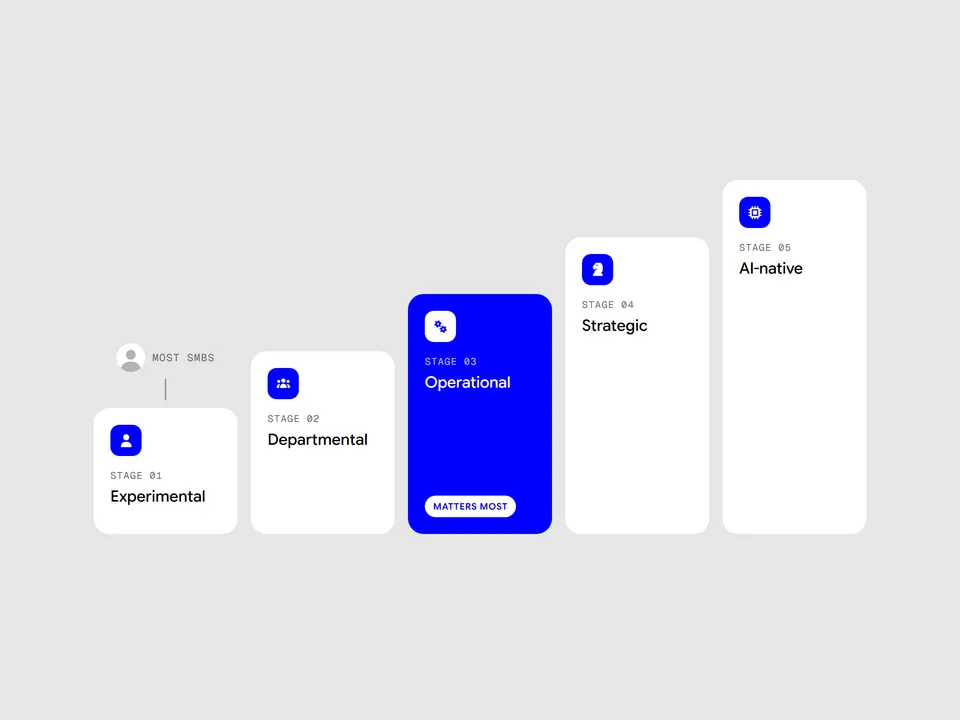
Table of Contents
This guide sets out the five stages, what blocks each one, a short self-check, and for each stage the post that helps most with the next step.
What is an AI maturity model?
An AI maturity model is a staged framework that shows how deeply a business uses AI in its work, its data and its decisions. It does not count tools. It asks a harder question: how much of the business would stop if you switched the AI off tomorrow?
At low maturity, nothing stops, because AI sits on the surface of the work. At high maturity, AI carries part of the load, and the process was designed around it.
Research groups publish their own versions. MIT CISR’s Enterprise AI Maturity Model, built on a survey of 721 companies, uses four stages. It found that financial performance improves with each stage: companies in the first two stages performed below their industry average, and companies in the last two performed well above it. Models like that are written for large enterprises with data teams and AI budgets. The five stages below are for companies of 20 to 200 people, where one owner decides and one rebuilt workflow can change the whole business.
Why does using AI not mean you are good at it?
Because buying a tool and changing the work are two different steps, and most companies take only the first.
The gap shows up in the large surveys. McKinsey’s State of AI finds that 88% of organizations regularly use AI in at least one business function. Only about 6% are “high performers” that attribute more than 5% of EBIT to AI. The same research finds that high performers are 2.8 times more likely to have fundamentally redesigned their workflows (55% against 20% of others).
For small businesses, the base is lower still. The Census Bureau data in our adoption post shows that about one in four US businesses uses AI in a business function at all. So the real question for most SMBs is not “are we using AI?” It is “has AI changed how any part of our work is done?”
What are the 5 stages of AI maturity?
| Stage | What it looks like | Typical blocker | Next step |
|---|---|---|---|
| 1. Experimental | People use ChatGPT or similar tools on their own. No shared account, no policy, no measurement. | Nobody owns AI, and nobody knows where it would pay. | List the tasks that repeat every week and pick one. |
| 2. Departmental | One team uses one AI tool for one task: a support chatbot, a meeting notetaker, invoice capture. | The tool sees only its own data and does not connect to the rest of the business. | Choose the one workflow worth rebuilding end to end. |
| 3. Operational | One or more workflows are rebuilt around AI. Data flows between systems, and a person checks what matters. | Data lives in many places, and the company’s knowledge is in people’s heads. | Connect the data and knowledge behind your core workflows. |
| 4. Strategic | AI changes what you sell and how you decide: new services, pricing, forecasts. | Leaders still treat AI as a cost project, not a product question. | Ask which client offer could only exist because of AI. |
| 5. AI-native | The business model depends on AI. Without it, the company cannot deliver what it sells. | Dependence on one vendor, governance, and keeping the system current. | Keep the data and the process yours, and keep improving. |
The jump between stages is rarely about a better model or a newer tool. It is about how much of the work underneath gets rebuilt.
Stage 1: Experimental
People use AI on their own initiative. A marketer drafts copy, a founder summarizes calls, an analyst writes spreadsheet formulas with an assistant. The value is real but invisible, because nobody measures it and nobody shares what works.
The risk at this stage is not that AI does too little. It is that company data goes into tools nobody approved. Before you go further, check whether your business is ready for AI transformation, and use AI use case prioritization to pick a first task on purpose instead of by accident.
Stage 2: Departmental
One team picks one task and automates part of it. Support runs a chatbot, finance uses invoice capture, sales uses an AI email assistant. The win is local, and you can measure it.
The limit is that each tool knows only its own slice of the business. A second and a third team then buy their own tools, and the company now has several AI products that do not talk to each other. This is the stage where the build, buy or partner decision matters most. If you decide to bring in outside help, see how to choose an AI transformation partner.
Stage 3: Operational
This is the stage that matters most for an SMB. A workflow is rebuilt end to end, and data moves between the systems it touches. AI does not just draft the proposal: it pulls the client’s history, applies your pricing rules, flags the risk, and sends it to the right person for approval.
The blocker here is almost always data. Only 7% of enterprises say their data is completely ready for AI, and in smaller firms much of the knowledge was never written down. Read whether your data is ready for AI before you build. Many companies solve this with a Company Brain: one place that holds the company’s clients, documents, rules and decisions, which every AI agent can read. Stage 3 is also where most projects stall, so why AI projects fail is worth reading first.
Stage 4: Strategic
AI reaches the core offer and the decisions that run the company. For example, picture a logistics firm that quotes prices from live capacity data, or an accounting firm that sells monthly advisory built on continuous bookkeeping instead of a year-end report. The offer changes because the AI exists, so new revenue starts to show up, not only saved cost.
The blocker is a mindset that still sees AI as a cheaper way to do the old work. AI transformation vs digital transformation explains why the two need different thinking.
Stage 5: AI-native
The business model depends on AI. Remove it and the company cannot deliver what it sells. Few SMBs need to reach this stage, and that is fine. The ones that do can often work at a cost and speed that competitors built on older processes cannot match.
At this stage, the main risks are dependence on one vendor and systems that drift out of date. Keep your data and your process knowledge in a form you own, so you can change models and vendors without starting over.
Where are we? A 5-minute self-assessment
Answer yes or no to each question. Your stage is the highest one where you can answer yes to every question at that stage and at every stage below it.
Stage 1 (Experimental)
- Do at least some of your people use AI tools in their work each week?
Stage 2 (Departmental)
- Does at least one team use an approved AI tool for a defined task?
- Can you name what that tool saves, in hours or money?
- Do you have a written rule on what company data may go into AI tools?
Stage 3 (Operational)
- Is at least one workflow redesigned end to end, not just sped up?
- Does the AI in that workflow read data from more than one system?
- Can a new employee or an AI agent find your prices, rules and past decisions without asking a colleague?
- Does a named person own each AI workflow and check its results?
Stage 4 (Strategic)
- Do you sell at least one service or product that depends on AI?
- Do leaders use AI-produced reports or forecasts in regular decisions?
Stage 5 (AI-native)
- Would your company be unable to deliver its core offer without AI?
Most companies find a “no” earlier than they expect. The question about prices, rules and past decisions is the one most SMBs fail. It is also the one that blocks Stage 3, because no AI workflow can be better than the knowledge it reads.
What holds a company back at its stage?
Look at five areas: ownership, process, data, people and governance. A company that is strong in one area and weak in the others will plateau. Your real stage is set by the weakest area, not by the average.
| Area | What a “no” looks like | Where to read more |
|---|---|---|
| Ownership | Nobody is responsible for AI results | Are we ready for AI transformation? |
| Process | Tools are added to old processes, which stay the same | AI transformation vs digital transformation |
| Data | Knowledge sits in inboxes, chats and heads | Is our data ready for AI? |
| People | Staff do not trust the tools, or do not use them | How to get employees to use AI |
| Governance | No rule on which data goes where | AI governance for SMBs |
How do we move up one stage?

You do not move up by buying more. You move up by rebuilding one thing completely. The steps:
- Pick one workflow that repeats every week and hurts. Frequency beats glamour. A task that runs hundreds of times a month pays back faster than a quarterly report. AI use case prioritization gives a simple way to rank the candidates.
- Map how the work really moves. Follow a few real jobs from start to finish: every handoff, every system, every place where someone waits for information. The real process is almost always messier than the official one.
- Connect the data that workflow needs. This is the unglamorous part, and it decides whether Stage 3 is possible.
- Rebuild the process around AI, then measure it against the old way. If nothing in the process changed, you are at the same stage with a bigger bill.
- Keep a person in the loop on what matters, and give each AI workflow a named owner.
When the first workflow works, the second one is cheaper, because the data and knowledge it needs are already connected.
Do we need outside help to move up?
Not always. A company with a capable technical lead can reach Stage 2 alone, and sometimes Stage 3. The step that most often needs help is Stage 2 to Stage 3, because it takes process mapping, data work and software building at the same time.
The options are to build in-house, buy a product, or work with a partner. The build vs buy guide compares them, and how to choose an AI transformation partner covers what to check if you go with a partner.
This is the step Superstate works on. It starts with a free mapping of how a company really works, which ranks the repeated tasks by what they cost. Then it builds a Company Brain on that map, and AI agents that each have one clear job, with a person deciding what matters.
Frequently asked questions
What is an AI maturity model?
An AI maturity model is a staged framework that shows how deeply a business uses AI in its work, its data and its decisions. It runs from scattered use by individuals to a business that depends on AI to deliver what it sells. Its purpose is to tell you which stage you are at and what the next step is.
What are the 5 stages of AI maturity for an SMB?
Stage 1, Experimental: people use AI tools on their own. Stage 2, Departmental: one team uses AI for one task. Stage 3, Operational: at least one workflow is rebuilt end to end around AI and connected data. Stage 4, Strategic: AI changes what you sell and how you decide. Stage 5, AI-native: the business model depends on AI.
What stage are most small businesses at?
Most small businesses are at Stage 1 or do not use AI in their operations yet. The US Census Bureau finds that about one in four US businesses uses AI in a business function. Use by individuals with their own tools is common, but rebuilt, connected workflows are rare.
How do you move from one AI maturity stage to the next?
Rebuild one workflow completely instead of adding another tool. Pick a task that repeats every week, map how the work really moves, connect the data that task needs, then redesign the process around AI and measure it against the old way. McKinsey’s research finds that high performers are far more likely to have redesigned their workflows.
Do small businesses need to reach Stage 5?
No. For most companies of 20 to 200 people, Stage 3 is the goal that pays: a few core workflows rebuilt on connected data, with a person deciding what matters. Stages 4 and 5 make sense only when AI can change the product you sell.

Want to know more about what we do? Visit the Superstate website.