How to Choose an AI Transformation Partner
How to choose an AI transformation partner: a scorecard, red flags, questions for the first call, and what a fair first engagement looks like.

Table of Contents
This guide gives you the scorecard, the red flags, the questions to ask in the first call, and what a fair first engagement looks like.
What is an AI transformation partner?
An AI transformation partner is a firm that learns how your business works, picks the tasks where AI saves the most, builds the AI systems into your existing tools, and keeps them running. The difference from a traditional consultant is the deliverable. A consultant delivers a plan. A partner delivers working software and stays responsible for it.
The choice matters because most AI projects do not deliver. RAND says that by some estimates more than 80 percent of AI projects fail, twice the rate of IT projects without AI. In a Gartner survey of 782 infrastructure and operations leaders, only 28% of AI use cases fully succeeded and met ROI expectations. The causes are rarely the model. They are the wrong problem, unready data, and nobody who owns the result after launch. Why AI projects fail covers the causes in detail.
Do we need a partner at all?
Not always. Before you compare partners, decide whether to build, buy or partner. Buy a product when your task is common and a tool already does it well. Build in-house when you have engineers who can ship and maintain AI systems. Bring in a partner when the work is specific to your business and you do not have that team.
There is some evidence on the outcomes. Fortune’s coverage of MIT NANDA’s 2025 report, based on 150 interviews, a survey of 350 employees and 300 public AI deployments, reports that buying from specialized vendors and building partnerships succeeded about 67% of the time. Internal builds succeeded only one-third as often. The same report found that about 95% of generative AI pilots at companies were failing to deliver measurable results.
Costs vary widely by scope and by country. The full comparison of cost, time and risk for each path is in our build vs buy guide for SMBs. This post assumes you have decided a partner makes sense.
How do we score an AI transformation partner?
Use this scorecard on each candidate. Score every row from 0 (no evidence) to 2 (clear evidence you could check). A partner below 8 out of 12 is a risk.
| Criterion | What good looks like | How to check it | Score (0–2) |
|---|---|---|---|
| Systems in production | AI systems that clients use every day, for months | Ask to see one live, and to speak to the person who uses it | |
| Diagnosis to support | One team maps the work, builds the system and supports it | Ask who does each phase, by name | |
| Data check first | They look at your data and knowledge before they promise anything | Ask what they need to see before they quote | |
| Ownership and exit | You own your data, documents and results, and can leave at any time | Ask for the exit terms in writing | |
| Support after launch | Monitoring, fixes and improvements are part of the deal | Ask what happens when a system gives a wrong answer | |
| Handover to your team | Your people can read, check and change what was built | Ask for an example of the documentation they leave behind |
Why do systems in production matter more than case studies?
A proof of concept shows that something can work once. A system in production shows that it works every day with real data, real users and real exceptions. Ask: “Show me a system you built that has run in production for at least six months. Who uses it, and what changed for them?” If the answer is a slide, keep looking.
Why should one partner cover diagnosis, build and support?
When strategy, building and support sit with different firms, each handoff loses knowledge. The firm that wrote the plan is gone when the build hits a problem. The firm that built the system is gone when the business changes. A partner that owns all three phases has to live with its own decisions.
Why must the partner check our data first?
Data is where most AI projects break. Gartner predicted that 60% of AI projects lacking AI-ready data will be abandoned by 2026. In smaller companies, the problem is often not bad data but missing data: the rules, prices and exceptions live in people’s heads. A good partner asks about this in the first meeting. Read whether your data is ready for AI before you talk to anyone.
Who should own the data, the code and the knowledge?
You should. Ask what you keep if you stop working together: the data, the documents, the configuration and any written knowledge base. Ask in which form you get them, and whether your own people can open and read them. If the answer depends on staying a customer, you are buying lock-in. See how to avoid AI vendor lock-in.
What support should continue after launch?
AI systems need care after launch. Your business changes, your data changes, and the models change. Ask who watches the system, how fast they fix a wrong answer, and how they add the next workflow. A partner that launches and leaves gives you a system that slowly goes out of date.
Does the partner make itself less necessary over time?
A good partner leaves your team able to understand and check what was built. Every system should come with documentation in plain words, and your people should know how to correct it. If the partner’s business model depends on your team not understanding the system, the incentives are wrong.
What are the red flags?
These should end the talks, or at least slow them down:
- The deliverable is a document. If the first engagement ends with a roadmap and no working software, you pay for advice, not results.
- Nothing in production you can see. Pilots and demos are not proof.
- No questions about your data. A partner that quotes before it has seen how your information is stored is guessing.
- “We do everything.” Depth in your kind of problem beats a long list of AI fields.
- No experience with companies of your size. Enterprise programs do not scale down to a 50-person company’s budget and team.
- Vague timelines for the first step. “It depends” is fine for a full program. It is not fine for a first, small step.
- No clear answer on data protection. Ask where your data is processed, which AI providers they use, and whether they sign a data processing agreement where GDPR requires one.
- Hard to leave. Long minimum terms, data you cannot export, or systems only the partner can read.
What should we ask in the first call?
Use the first call to learn how the partner thinks, not to hear a pitch. These questions work well:
- “What do you need to learn about our business before you suggest anything?”
- “Given our three biggest bottlenecks, which one would you start with, and why?”
- “What would the first step cost, how long would it take, and how will we measure it?”
- “Show me a system you built that has run for more than six months. Can I talk to the person who uses it?”
- “What do you need from our people, and how many hours a week?”
- “Where will our data be stored and processed, and who can see it?”
- “What happens when the system gives a wrong answer?”
- “If we stop after the first step, what do we keep?”
Before the call, write down your three biggest bottlenecks and what each costs you in hours or money each month. Then you can compare the answers against the same baseline. AI use case prioritization helps you rank those bottlenecks.
What does a fair first engagement look like?
A fair first engagement is small, fixed and easy to leave. It should have these parts:
| Part | What fair looks like |
|---|---|
| Diagnosis | A short look at how your work really runs: interviews with the people who do it and a review of the tools you use |
| Output of the diagnosis | A written list of tasks ranked by what they cost you, which you keep whatever you decide |
| First step | One workflow, not a program. A fixed scope, a fixed price and a date |
| Success measure | Agreed before work starts, against today’s numbers: hours saved, errors, response time |
| Your team’s role | Clear hours from named people, and a person who approves what matters |
| Ownership | Your data and documentation stay yours |
| Exit | You can stop after the first step without penalty |
Results should show in weeks, not months, because the first step is small. If a partner cannot name a first step that fits these rules, it is not ready to work with you, or you are not ready for it. Are we ready for AI transformation? helps you check your side.
How does Superstate work with clients?
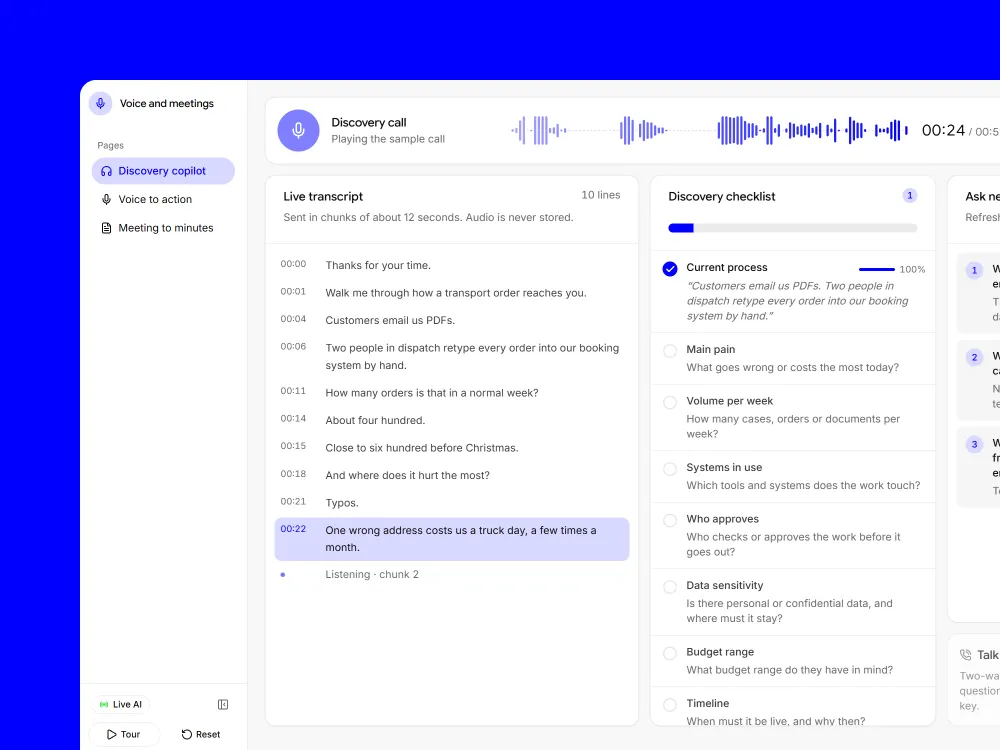
Superstate is one of the partners you can compare against this scorecard. Its approach has four steps. First it maps how the company really works, with a sixty-minute meeting, talks with the people who do the work, and a look at the tools in use. The mapping is free, and the client gets the map and a written offer for the first steps, with a clear scope and price.
Then Superstate builds a Company Brain, one place that knows the company’s clients, documents, rules and decisions, and AI agents that each have one clear job. What matters goes to a person first. Each client’s brain runs on its own server, written in plain pages the client’s people can read, and the client can leave at any time and keep everything. Superstate then stays to fix and improve the system for as long as the client wants. If you are comparing firms that build Company Brains in particular, see who builds company brains.
For where a partner fits in your wider AI plan, start with the AI maturity model for SMBs.
Frequently asked questions
What does an AI transformation partner do?
An AI transformation partner learns how your business works, picks the tasks where AI saves the most, builds the AI systems into your existing tools, and keeps them running. The difference from a traditional consultant is that the partner builds and supports working software, not only a strategy document.
How do we choose an AI transformation partner?
Score each candidate on six points: systems running in production, work that goes from diagnosis to support, a check of your data before any build, clear ownership of data and code, a support model after launch, and handover to your team. Then ask each one to scope a small first step with a fixed price and a measurable goal, and compare the answers.
Should we hire a partner or build an in-house AI team?
It depends on how much custom work you need and whether you can hire and keep AI engineers. Coverage of MIT NANDA’s 2025 research reports that buying from specialized vendors and building partnerships succeeded about 67% of the time, while internal builds succeeded only one-third as often. Our build vs buy guide compares the options in full.
What should a first engagement with an AI partner look like?
A short diagnosis of how your work really runs, followed by one small, clearly scoped first step with a fixed price, a measurable goal and a date. You should own the data, the documentation and the result, and you should be free to stop after the first step.
What are the red flags when choosing an AI partner?
A deliverable that is only a document, no systems in production that you can see, no questions about your data, vague timelines, no answer on who owns the data and code, and contracts that make it hard to leave.

Want to know more about what we do? Visit the Superstate website.