7 Signs Your Business Is Ready for AI Transformation
Discover 7 clear signs your business is ready for AI transformation — from data maturity to leadership buy-in. Assess your AI readiness today.

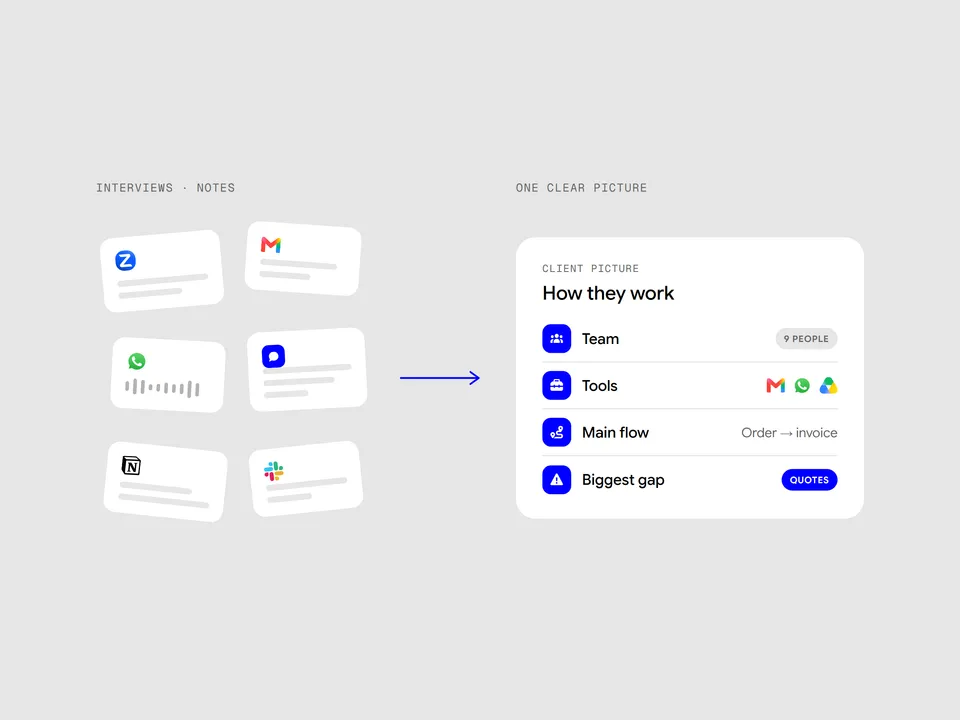
Table of Contents
- 1. Is your data in one place, or do you have a plan to get there?
- 2. Can you map your core workflows on a whiteboard?
- 3. Does your leadership talk about transformation, not tools?
- 4. Do you have repeatable processes that scale poorly?
- 5. Does your team spend more time on process than on product?
- 6. Have you hit the ceiling of off-the-shelf software?
- 7. Are you willing to redesign, not just automate?
- How do you assess your AI readiness today?
- Frequently asked questions
AI readiness is the degree to which a company’s data, processes, people, and leadership can support meaningful AI transformation, beyond surface-level tool adoption. Readiness matters because most AI projects miss their goals: RAND reports that by some estimates, more than 80 percent of AI projects fail, twice the rate of IT projects without AI. Cisco’s AI Readiness Index found that only 15% of organizations have networks fully ready for AI. For the causes behind these failures, read why AI projects fail.
1. Is your data in one place, or do you have a plan to get there?
Think of the typical small business: spreadsheets in Google Drive, customer records in a CRM that half the team does not use, financial data locked in accounting software that talks to nothing else. AI cannot learn from data it cannot reach.
The first sign of readiness is that your company has started consolidating data. At minimum, leadership accepts that data unification is a prerequisite, not a nice-to-have. You do not need perfect data. You need accessible data with a clear path to clean it. The post on AI-ready data shows how.
2. Can you map your core workflows on a whiteboard?
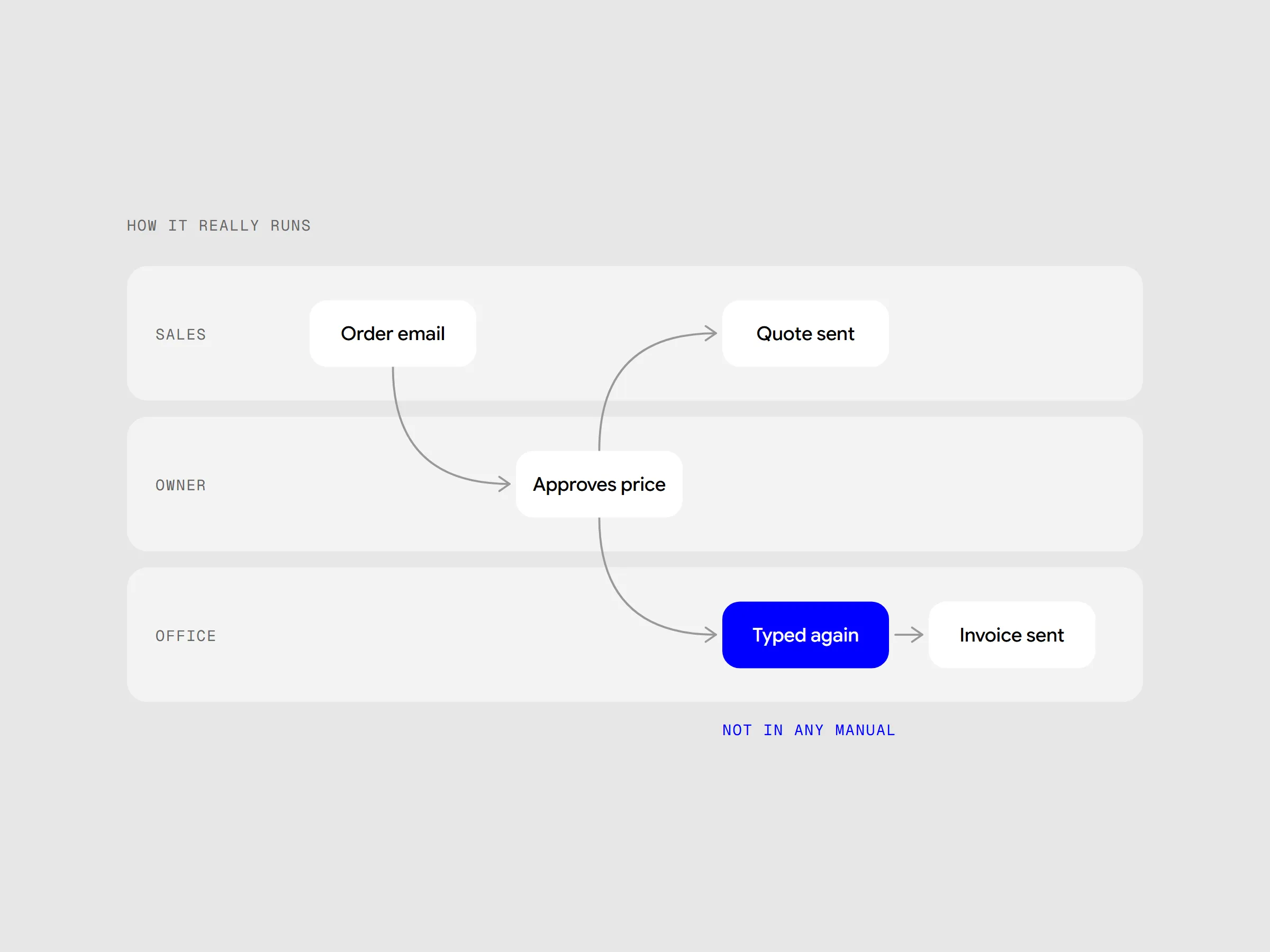
Here is a quick test. Can a senior team member draw the end-to-end flow for how a customer goes from first contact to paid invoice? If the answer is “sort of” or “it depends on who is handling it,” the business has a process problem, not an AI problem.
AI transforms defined workflows. It cannot transform chaos. Ready companies have documented, or at least deeply understood, their core processes. They know where handoffs happen, where bottlenecks sit, and which steps repeat thousands of times a month.
A common mistake is to buy an AI-powered tool for one department without understanding how that department’s work connects to the rest of the business. The tool automates one step. The bottleneck moves to the next step. Nothing changes at the system level.
3. Does your leadership talk about transformation, not tools?
The signal of readiness is whether leadership treats AI as a reason to rebuild how the business works, or as another software purchase. The difference sounds like this:
| Tool mindset | Transformation mindset |
|---|---|
| ”Let’s get an AI chatbot for customer support" | "Let’s redesign how customers get answers" |
| "Can AI write our marketing emails?" | "How should our entire go-to-market motion change with AI?" |
| "We need to automate data entry" | "Why does this data need to be entered manually at all?" |
| "What AI tools are competitors using?" | "What business model would a competitor build from scratch with AI today?” |
Companies ready for transformation have leaders who ask “why” before “how.” Leaders who only optimize existing processes with AI tend to get small gains. HBR calls this the “micro-productivity trap”: task-level gains that never turn into business results.
4. Do you have repeatable processes that scale poorly?
For example, picture a 200-person professional services firm that produces thousands of client reports per quarter. Each report follows the same template, but a person pulls data from four systems, formats it, reviews it, and emails it. Adding headcount scales costs in a straight line, so the firm cannot grow profitably without changing the process.
This is a textbook readiness signal. High-volume, repeatable work with clear inputs and outputs is where AI is easiest to put to use. McKinsey’s State of AI survey found that high performers are nearly three times as likely as others to say they have fundamentally redesigned individual workflows. They redesign work around AI instead of layering AI onto old workflows.
If every employee agrees a process is tedious, time-consuming, and identical every time, you have the raw material for AI transformation. For ranking such candidates, see AI use case prioritization.
5. Does your team spend more time on process than on product?
Track where your team’s hours go for one week. In many small businesses, a large share of time goes to coordination, reporting, data wrangling, and admin instead of the work that creates value for customers.
When operational overhead consumes more energy than the product or service, the business is ready for transformation, and often overdue for it. The tell: managers in spreadsheets instead of with customers, engineers writing status updates instead of shipping code, sales reps copying data between CRM fields instead of closing deals.
Heavy overhead together with accessible data is the best combination. The overhead means there is a clear problem. The accessible data means there is a clear path to solving it.
6. Have you hit the ceiling of off-the-shelf software?
Most companies start with off-the-shelf tools: ChatGPT for drafting emails, Zapier for connecting apps, a handful of AI features inside existing SaaS products. These deliver real value at first. Then they hit a ceiling. Roughly one in four US businesses uses AI at all; the AI adoption gap post has the official figures. Adoption and transformation are different things.
The ceiling looks like this:
- Integration walls. Each tool solves one problem but does not talk to the others. Data stops at tool boundaries.
- Customization limits. The tool fits the generic use case but cannot adapt to your workflow, data structure, or business logic.
- Scaling friction. What worked for 10 users breaks at 100. What worked for one department creates conflicting data when three departments use it.
Hitting this ceiling is a sign of readiness. It means your team has built AI literacy through direct use and has felt the limits of isolated tools. Now you need a layer that connects across the business, not another subscription.
7. Are you willing to redesign, not just automate?
This is the most important sign and the hardest to measure. Readiness is ultimately a mindset.
Many failed AI projects try to automate broken processes instead of redesigning them. Pouring AI into a bad workflow produces a faster bad workflow. Companies that succeed ask uncomfortable questions. Should this department exist in its current form? Should this report exist at all, or can the underlying decision be automated? Is there a fundamentally better way for customers to deal with us?
Readiness means being willing to change the game, not only to speed up the old one.
How do you assess your AI readiness today?
Alexander Kovachev, Project Lead at Superstate, puts it this way: “The companies that come to us already knowing their processes are broken and their data needs work — those are the ones that transform fastest. The hardest conversations are with companies that think they just need to plug in a tool. Readiness starts with honest self-assessment.”
A practical starting point: score your business on the seven signs above, from 1 (not there yet) to 5 (strong). A score of 3 or above is a foundation to build on. A score below 3 is a gap to close before you invest heavily in AI. This is a simple self-check, not a formal benchmark.
If you want help, Superstate maps how your company really works first, then builds on that map. The mapping is free, and you pay only if you say yes to the offer that follows.
Frequently asked questions
How do I know if my business is ready for AI?
A business is ready for AI when it has accessible data, defined repeatable processes, leadership that wants to change how the business works, and a willingness to redesign workflows instead of only automating existing ones. Score yourself on the seven signs in this post.
What percentage of companies are ready for AI?
There is no single number, because “ready” is defined differently in each study. Cisco’s AI Readiness Index found that only 15% of organizations have networks fully ready for AI. RAND reports that by some estimates more than 80 percent of AI projects fail.
What is an AI readiness assessment?
An AI readiness assessment looks at a company’s preparedness for AI across several areas: data quality and access, process maturity, technical infrastructure, skills, leadership alignment, and governance. It shows which gaps to close before AI projects start.
Which sign matters most?
Willingness to redesign work matters most, and it is the hardest to measure. A business with perfect data but no wish to change its processes will only make old workflows faster. Data access is the most common practical blocker.
Should I hire an AI partner or build readiness in-house?
It depends on your internal skills and time. Small teams rarely have spare capacity to map processes and fix data while running the business. Read build, buy or partner for how to decide.

Want to know more about what we do? Visit the Superstate website.