The AI Adoption Gap: How Many Small Businesses Actually Use AI
About one in four US businesses used AI in fall 2026, per the Census Bureau. US and EU data by firm size and sector, and what it means for you.

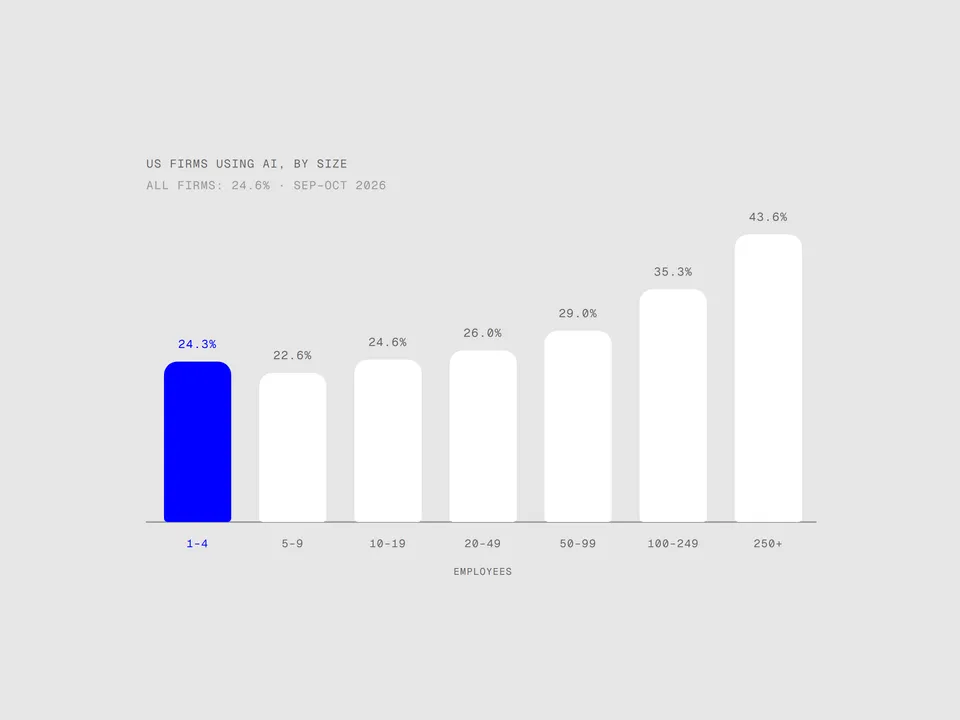
Table of Contents
- How many US businesses use AI right now?
- Is AI use among small businesses growing?
- Do small businesses use AI less than large ones?
- Which industries use AI the most?
- How many small businesses in Europe use AI?
- Why do some surveys say most small businesses use AI?
- Is using AI the same as getting value from it?
- What does this mean for your business?
- Frequently asked questions
So most small businesses still do not use AI in their operations. Use is rising quickly, and it is much higher in large firms and in knowledge-heavy industries. This post sets out the official figures, explains why other surveys show much higher numbers, and closes with what the data means for your business.
How many US businesses use AI right now?
The BTOS is the Census Bureau’s survey of a representative sample of US employer businesses, run every two weeks. It asks: in the last two weeks, did this business use AI in any of its business functions? The examples it gives include AI-powered data analysis, generative AI for marketing or coding, virtual agents for customer service, and AI-powered forecasting.
The latest figures, from the BTOS data downloads:
| Measure (all US employer businesses) | Share |
|---|---|
| Used AI in the last two weeks (Sep 21 – Oct 4, 2026) | 24.6% |
| Did not use AI | 65.8% |
| Did not know | 9.6% |
| Expect to use AI in the next six months | 28.6% |
Is AI use among small businesses growing?
Yes, and faster in 2026 than in 2025. The Census Bureau revised the question in November 2025. The old version asked about AI “in producing goods or services.” The new version asks about AI “in any of its business functions,” which captures more real use. So compare figures within the new series only.
| Survey collected | Businesses using AI |
|---|---|
| Nov 17–30, 2025 | 17.3% |
| Feb 23 – Mar 8, 2026 | 18.2% |
| Apr 20 – May 3, 2026 | 19.8% |
| Jun 15–28, 2026 | 20.6% |
| Aug 10–23, 2026 | 22.4% |
| Oct 5–18, 2026 | 24.6% |
Source: Census Bureau, BTOS national estimates. Each survey asks about the two weeks before collection, so the Oct 5–18 survey is the one that covers Sep 21 – Oct 4.
In May 2026 the Census Bureau reported that use was rising among firms with at least 20 employees, but not significantly among firms with fewer than 20. The later figures in the next table show smaller firms moving up too.
Do small businesses use AI less than large ones?
Yes, but the gap is smaller at the bottom than most people think. The smallest firms are close to the national average. The big jump comes above 50 employees.
| Firm size (employees) | Used AI, Sep 21 – Oct 4, 2026 | Expect to use AI in next six months |
|---|---|---|
| 1–4 | 24.3% | 28.1% |
| 5–9 | 22.6% | 26.7% |
| 10–19 | 24.6% | 28.9% |
| 20–49 | 26.0% | 30.1% |
| 50–99 | 29.0% | 34.5% |
| 100–249 | 35.3% | 41.1% |
| 250 or more | 43.6% | 51.4% |
Source: Census Bureau, BTOS employment size class estimates. Estimates for the largest size class move a lot from one survey period to the next: the previous period showed 36.5% for firms with 250 or more employees.
Which industries use AI the most?
Industry matters more than size. A five-person consultancy is far more likely to use AI than a 200-person restaurant group.
| Sector (NAICS) | Used AI, Sep 21 – Oct 4, 2026 |
|---|---|
| Information | 46.4% |
| Professional, scientific and technical services | 43.8% |
| Finance and insurance | 40.5% |
| Educational services | 33.4% |
| Real estate and rental and leasing | 29.0% |
| Health care and social assistance | 27.6% |
| Manufacturing | 22.9% |
| Administrative and support services | 22.7% |
| Wholesale trade | 21.4% |
| Retail trade | 18.5% |
| Construction | 16.1% |
| Other services | 14.6% |
| Transportation and warehousing | 13.5% |
| Accommodation and food services | 10.7% |
Source: Census Bureau, BTOS sector estimates. Single-period sector figures can shift by a few points between surveys. The May 2026 Census report showed the same order: information (39.7%) and finance and insurance (33.9%) at the top, retail trade at about 14%.
How many small businesses in Europe use AI?
The EU picture is similar. Eurostat found that 20.0% of EU enterprises with 10 or more employees used at least one AI technology in 2025, up from 13.5% in 2024. Eurostat’s survey excludes firms with fewer than 10 employees and the financial sector, so it does not match the US figures one for one.
| EU enterprises, by size (2025) | Used AI |
|---|---|
| Small (10–49 employees) | 17.0% |
| Medium (50–249 employees) | 30.4% |
| Large (250 or more employees) | 55.0% |
| All with 10 or more employees | 20.0% |
Source: Eurostat, Use of artificial intelligence in enterprises, data extracted December 2025.
Eurostat also asked why firms that had considered AI did not use it. The most common reason was a lack of relevant expertise (70.9%). Next came unclear legal consequences (52.5%) and data protection and privacy concerns (48.8%).
Why do some surveys say most small businesses use AI?
You will see figures of 70% or more in the press. They are not wrong. They measure something else. The Federal Reserve compared the main US surveys in April 2026 and found that most of the gap comes from who is sampled and what is counted.
| Survey | Who it asks | Finding |
|---|---|---|
| Census BTOS | Representative sample of US employer businesses | 24.6% of businesses used AI (Sep 21 – Oct 4, 2026) |
| Real-Time Population Survey, via the Federal Reserve | Individual workers | About 41% of the workforce used generative AI for work (Nov 2025) |
| Survey of Business Uncertainty, via the Federal Reserve | Executives, weighted by employment | 78% of the labor force works at firms that have adopted AI |
| Goldman Sachs 10,000 Small Businesses Voices | 1,256 owners in its own program, Jan 27 – Feb 4, 2026 | 76% use AI; only 14% say AI is fully embedded in core operations |
The Fed note gives three reasons for the spread. Large firms use more AI, and some surveys over-represent them. The BTOS question was framed to capture substantial business use, not casual use. And some leaders may over-report AI use because it sounds good. The Fed considers the BTOS the best source for the share of businesses that use AI.
For a business owner, the practical reading is this. Many of your staff probably use AI tools on their own. Far fewer companies have built AI into how the business runs. That unmanaged use has its own risks, covered in our guide to shadow AI.
Is using AI the same as getting value from it?
No. The Goldman Sachs figures make the point: 76% of the owners surveyed use AI, but only 14% say it is fully embedded in core operations. Using a chatbot to draft emails counts as use in most surveys. It does not change how the business works.
The value comes from the second step: connecting AI to your data and your workflows, then changing the work around it. That step is also where most projects stall. Our guide to why AI projects fail covers the causes and how to avoid them.
What does this mean for your business?
Three things follow from the data.
- You are not late, but the window is closing. About three in four US businesses still do not use AI in their operations. But the share rose by more than seven points in under a year, and 28.6% expect to use it within six months.
- Your industry sets the bar, not your size. In information, professional services and finance, more than four in ten firms already use AI. If you compete there, your rivals are likely ahead. In construction, transport or hospitality, early movers can still stand out.
- Adoption is the easy part. Buying a tool counts as “using AI” in most surveys. The gap that matters is between companies that use AI tools and companies that redesign their work around them.
To find out which stage your company is at, and what the next step is, use the AI maturity model. If you want a checklist first, see the signs your business is ready for AI transformation. To choose where to start, see AI use case prioritization.
If you would like an outside view, Superstate maps how your company really works before any AI is built. The mapping is free, and you get a ranked list of the repeated tasks that cost you the most.
Frequently asked questions
How many small businesses use AI?
According to the US Census Bureau’s Business Trends and Outlook Survey, 24.6% of US businesses used AI in at least one business function in the two weeks from September 21 to October 4, 2026. For the smallest firms, with 1 to 4 employees, the figure was 24.3%. For firms with 5 to 9 employees it was 22.6%.
Do larger companies use AI more than small ones?
Yes. In the same Census survey period, use was 26.0% for firms with 20 to 49 employees, 35.3% for 100 to 249 employees and 43.6% for 250 or more. In the EU, Eurostat found that 17.0% of small enterprises (10 to 49 employees) used AI in 2025, against 55.0% of large enterprises.
Why do some surveys say most small businesses use AI?
They measure different things. The Census Bureau asks a representative sample of all employer businesses whether the business used AI in a business function in the last two weeks. Many private surveys ask owners or workers whether they use any AI tool, and some sample only engaged or larger firms. A Goldman Sachs survey of its own program participants found 76% use AI, but only 14% said it is fully embedded in core operations.
Which industries use AI the most?
In the Census survey period that ended October 4, 2026, use was highest in information (46.4%), professional, scientific and technical services (43.8%) and finance and insurance (40.5%). It was lowest in accommodation and food services (10.7%) and transportation and warehousing (13.5%).
Is AI adoption among small businesses growing?
Yes. On the Census Bureau’s current question, the share of US businesses using AI rose from 17.3% in late November 2025 to 24.6% in early October 2026. The share that expects to use AI in the next six months rose to 28.6%.

Want to know more about what we do? Visit the Superstate website.