Why AI Projects Fail, and How to Avoid It
Most AI projects fail for business reasons, not technical ones. The five root causes from RAND's research, the readiness data, and how to avoid each one.

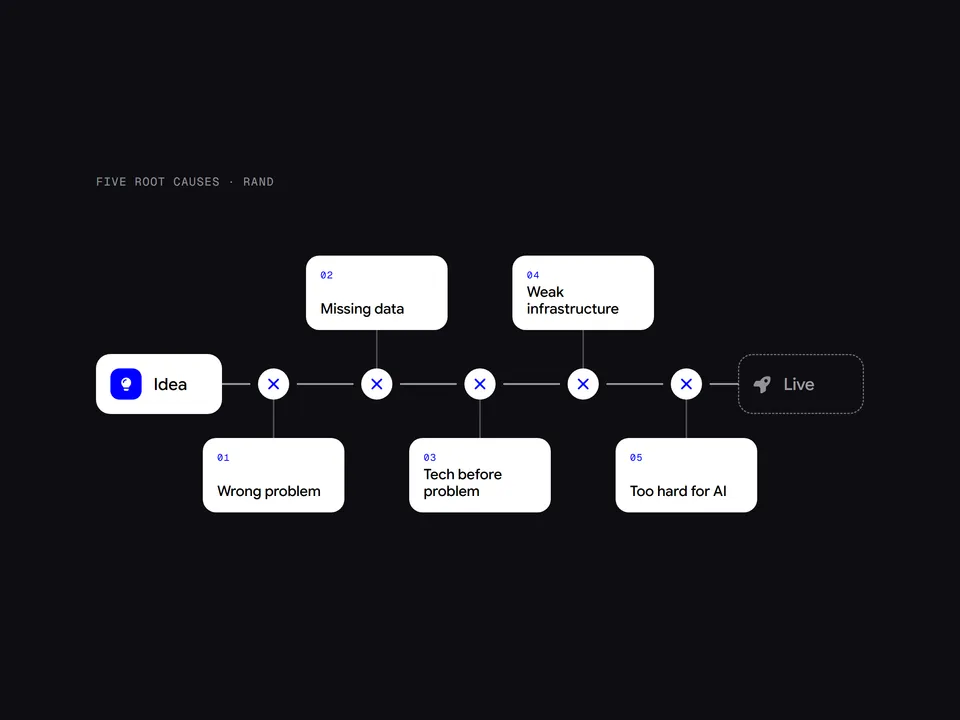
Table of Contents
You avoid most failures with discipline before you build. Define one business problem. Agree the metric. Check the data. Plan for production, not only for the pilot. This guide covers the evidence, the five causes, why pilots stall, and what to do about each one.
How many AI projects actually fail?
The headline figures differ because each study defines “failure” in its own way. Read them together: they all point in the same direction.
| Source | What it measured | Finding |
|---|---|---|
| RAND Corporation (Aug 2024) | AI projects in general, citing published estimates | By some estimates, more than 80% fail, twice the rate of non-AI IT projects |
| Gartner, via The Register (Apr 2026) | 782 infrastructure and operations leaders, surveyed Nov–Dec 2025 | Only 28% of AI use cases fully succeed and meet ROI; one in five fail outright |
| MIT NANDA, via Fortune (Aug 2025) | Generative AI pilots at companies | About 95% are failing |
| Deloitte, State of AI in the Enterprise (2026) | Experiments moved into production | Only 25% of organizations have moved 40% or more of their AI experiments into production |
Some articles quote a precise “80.3%” or “85%” failure rate and attribute it to RAND. RAND’s own report does not give those numbers. It says “more than 80 percent,” and it presents that as an estimate from earlier sources, not as its own measurement.
The Gartner result is useful for a different reason. In the same survey, 57% of leaders said they had suffered at least one AI failure. Gartner’s analyst put the outright failures down mostly to initiatives that were “overly ambitious or poorly scoped.” That is a planning problem, not a model problem.
Why do AI projects fail? The five root causes
RAND’s report is the best primary source on causes. Its authors interviewed 65 data scientists and engineers with at least five years of experience building AI and machine learning models. Five causes came up again and again.
1. Is the team solving the wrong problem?
This is the most common cause. Business leaders misunderstand or miscommunicate what problem AI must solve. The team then trains a model that is optimized for the wrong metric, or one that does not fit the real workflow.
What it looks like: the brief says “use AI in customer support.” Nobody says which number must move. Is it first-response time, cost per ticket, or the share of tickets that never needed a human? Each answer leads to a different project.
The fix: write the outcome in one sentence before any work starts. “Cut invoice processing from five days to one day” is a problem. “Implement AI” is not.
2. Does the data exist?
Many projects fail because the organization does not have the data to train or run an effective model. Sometimes the data does not exist. More often it exists in pieces: customer records in the CRM, orders in spreadsheets, decisions in email and chat.
The fix: list the data the use case needs, where it lives, and who owns it. Do this before you pick a tool. Our guide to AI-ready data shows how to check.
3. Did the technology come before the problem?
Some teams focus on the newest technology instead of the problem their users have. RAND calls chasing the latest advances for their own sake “one of the most frequent pathways to failure.”
What it looks like: a company buys an agent platform because a competitor announced one, then looks for something to point it at.
The fix: pick the problem first, then the simplest technology that solves it. Sometimes that is a rule, a form or a better report, not AI.
4. Can your infrastructure support it?
Organizations often lack the infrastructure to manage their data and deploy finished models. The model works in a notebook. It cannot connect to the systems people use every day.
The fix: budget for data pipelines, access rights, monitoring and deployment from the start. RAND says up-front investment here can substantially reduce the time to complete AI projects.
5. Is the problem too hard for AI?
Some problems are beyond what current AI can do reliably. AI is not, in RAND’s words, “a magic wand.” A task that needs judgment the model cannot learn from your data will not become reliable through more prompting.
The fix: test the hardest part of the problem first, on real cases, before you plan a rollout.
Are companies ready for AI?
Most are not, by their own account. Deloitte asked leaders how prepared their organizations are in each area. The share that rated themselves “highly prepared” is low across the board, and lowest for talent.
| Area | Highly prepared |
|---|---|
| Strategy | 42% |
| Technical infrastructure | 43% |
| Data management | 40% |
| Risk and governance | 30% |
| Talent | 20% |
Source: Deloitte, State of AI in the Enterprise, 2026. Deloitte notes that perceived preparedness for infrastructure, data and talent fell compared with the previous year.
These numbers line up with RAND’s causes. Weak data management is cause 2. Weak infrastructure is cause 4. Low talent readiness makes cause 1 more likely, because few people can translate a business problem into an AI project. If you want to see where your own company stands, start with the AI maturity model.
Why do AI pilots never reach production?

The pilot-to-production gap is where most AI budgets disappear. A pilot works well in a controlled setting: clean data, a small team that wants it to work, and no edge cases. Then it meets the real organization. The data is messy. The people who must use it were not part of the test. Compliance asks questions nobody planned for.
Deloitte’s figures show the size of the gap. Only 25% of organizations have moved 40% or more of their AI experiments into production. Yet 54% expect to reach that level in the next three to six months. That optimism is hard to square with how slowly the first 25% got there.
Three blockers come up again and again.
1. Governance gaps. Nobody decided who owns the AI’s output, how errors are handled, or what data it may see. Deloitte found that only 30% of organizations rate themselves highly prepared on risk and governance. Without those rules, scaling becomes a liability question. Our guide to AI governance for SMBs covers the minimum you need.
2. Infrastructure debt. Older accounting systems, CRMs without modern APIs, and on-premises servers often cannot support AI services. AI does not fix infrastructure debt. It exposes it.
3. No success metric. A pilot is judged on “did it work?” Production is judged on “did it move a business number?” If nobody agreed which number, and by how much, the project stalls in review.
People are the fourth blocker, and the easiest to miss. A team that does not trust the tool will work around it. Workflow-specific training and an early, visible win matter more than any feature. See how to get employees to use AI.
What does a failed AI project look like?
Large companies fail too, and for the same reasons. McDonald’s tested AI voice ordering with IBM at about 100 drive-thrus from 2021. In June 2024 it announced the end of the test. McDonald’s had wanted order accuracy above 95% before a wider rollout.
The lesson is not that voice AI cannot work. The lesson is that the bar for production was clear, and the pilot did not reach it. That is a good outcome for a pilot. It is a bad outcome only when nobody sets the bar in advance and the project drifts on for years.
For a small or midsize company the stakes are higher in relative terms. A failed project that a large company absorbs can take a large share of a small company’s annual budget, and the team’s trust in AI with it.
How do you avoid AI project failure?
RAND turns its five causes into five principles. Here they are, with what each means in practice for a smaller company.
| RAND principle | What it means in practice |
|---|---|
| Make sure the technical team understands the purpose and the business context | Put the person who owns the outcome in the room with the builders, every week |
| Choose problems that will last | Commit to one problem for at least a year. If it is not worth a year, it is probably not worth starting |
| Focus on the problem, not the technology | Write the outcome first. Choose the tool last |
| Invest in infrastructure | Budget for data, access and deployment, not only the model |
| Understand AI’s limits | Test the hardest case first, on real data |
Before you approve your next AI project, answer three questions.
- Can you state the business outcome in one sentence? It must name a number and a target. If you cannot, stop and define it before you spend more.
- Is the data accessible and connected? Name the three data sources the use case needs. If joining them means “we would export a CSV,” the data foundation is not ready.
- Does the owner know the metric and the date? One named person must own the result, not the tool. If nobody does, the project will drift after the kickoff.
Picking the right first project matters as much as running it well. Our guide to AI use case prioritization shows how to score candidates.
Should you build, buy or partner?
The choice of who builds affects the odds. The MIT NANDA research covered by Fortune found that AI tools bought from specialized vendors and partnerships succeeded about 67% of the time. Internal builds succeeded about one third as often.
That does not mean “always buy.” Off-the-shelf tools make you adapt your process to the tool, and five separate tools give you five separate silos. A partner who writes a report and leaves does not close the pilot-to-production gap either. The full cost comparison is in our guide to build vs buy vs partner. If you choose a partner, use our checklist on how to choose an AI transformation partner.
At Superstate we start with a map, not a tool. We meet for sixty minutes, talk to the people who do the work, and follow a few real jobs from start to finish. The mapping is free, and you get a ranked list of the tasks that cost you the most. Then we build a Company Brain, one place that knows your clients, documents, rules and decisions, and agents that use it. We stay to fix and improve them.
Frequently asked questions
What percentage of AI projects fail?
RAND Corporation reports that by some estimates more than 80% of AI projects fail, twice the rate of IT projects that do not involve AI. Other studies measure failure in different ways. A Gartner survey of 782 infrastructure and operations leaders found that only 28% of AI use cases fully succeed and meet ROI expectations, and an MIT NANDA report covered by Fortune found that about 95% of generative AI pilots at companies were failing.
What is the most common reason AI projects fail?
Misunderstanding the problem. In RAND’s interviews with 65 experienced data scientists and engineers, misunderstandings and miscommunication about the purpose of the project were the most common reason for failure. Teams build a model that is optimized for the wrong metric or does not fit the real business workflow.
Why do AI pilots fail to reach production?
A pilot runs on clean data with a small, willing team. Production meets messy data, old systems, unclear ownership and people who were not part of the test. Deloitte found that only 25% of organizations have moved 40% or more of their AI experiments into production. The usual blockers are missing governance, infrastructure that cannot support the AI, and no business metric agreed in advance.
How do you avoid AI project failure?
Start with one business problem you can state in one sentence, and agree the metric before you build. Check that the data exists and that your systems can deliver it. Commit to the problem for at least a year, focus on the problem rather than the newest technology, invest in data and deployment infrastructure, and accept that some problems are too hard for AI today.
Should a small business build AI in-house or work with a partner?
It depends on the use case, your team and your budget. An MIT NANDA report covered by Fortune found that AI tools bought from specialized vendors and partnerships succeeded about 67% of the time, while internal builds succeeded about one third as often. Compare the options with real costs before you commit.

Want to know more about what we do? Visit the Superstate website.