Why Your AI Tools Don't Know Your Business
AI tools give generic answers because your company knowledge is split across six systems no tool sees as one. What is missing, and how to fix it.

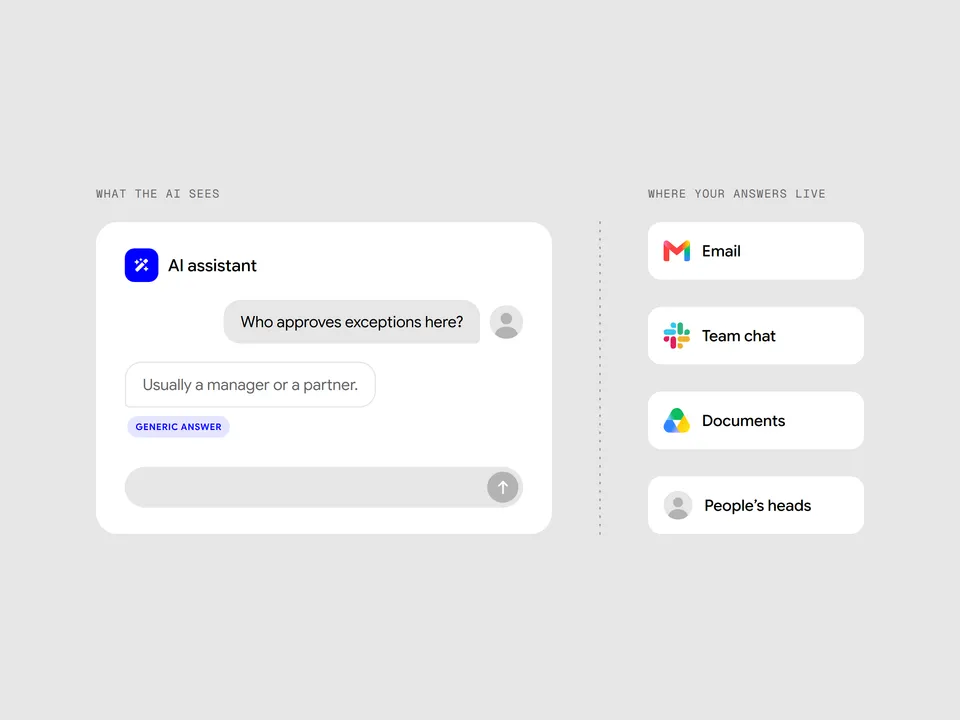
Table of Contents
- What does the generic answer problem look like?
- Why doesn’t ChatGPT know how my company works?
- What does general AI know, and what does it need to know about us?
- Where does our business knowledge actually live?
- Why doesn’t connecting more systems fix it?
- Why doesn’t a longer system prompt fix it?
- What is a Company Brain, and how does it fix generic answers?
- What changes for a sales rep with a Company Brain?
- What does this look like in different industries?
- Where do we start?
- Frequently asked questions
The rest of this article shows where that knowledge lives today, why the usual fixes fail, and what to build instead.
What does the generic answer problem look like?
For example, picture a 40-person accounting firm that gives every employee an AI assistant. In the first week, almost everyone uses it. Three months later, most people have stopped. When the partners ask why, the answers use different words but say the same thing: the AI writes well and knows nothing about how this firm works.
It knows how accountants in general close a quarter. It does not know this firm’s reconciliation sequence, who approves exceptions, or why the review process changed after a difficult client audit. Every answer is correct for some imaginary accounting firm. None of it applies here.
This pattern shows up in the data. In McKinsey’s 2025 State of AI survey, 88% of organizations use AI in at least one business function, but only about 6% are “high performers” that get 5% or more of EBIT from it. In a February 2026 NBER survey of about 6,000 executives in the US, UK, Germany, and Australia, 89% saw no change in productivity from AI over the previous three years.
The tools are in place. People use them. The results are missing. Change management and the wrong use cases explain part of that gap. The most common root cause is simpler: the AI does not know how this business works, so its answers fit any business and help none in particular.
Why doesn’t ChatGPT know how my company works?
ChatGPT, Claude, Gemini, and every other large language model learned from public text: websites, books, and curated datasets. None of that contains your pricing exception policy, your supplier escalation process, or why you reversed a decision last year.
This is not a model defect. A model cannot know what it was never shown. And most of what makes your company different was never written down where an AI can read it. It lives in Slack threads, in email chains, and in the heads of the few people who were in the room.
Stack Overflow put the point plainly in a March 2026 article on enterprise AI: “The difference between AI that impresses people in demos and AI that drives production value is context.” As the leading models get closer to each other in capability, the model you pick matters less. What the model can see matters more.
Most companies are not ready for that. In a March 2026 study by Cloudera and Harvard Business Review Analytic Services, only 7% of enterprises said their data is completely ready for AI. If you want to check your own, read is our data ready for AI?
What does general AI know, and what does it need to know about us?
| Information type | What general AI knows | What your business needs |
|---|---|---|
| Industry processes | General good practice | Your actual workflow and decision rules |
| Pricing | Market norms | Your tiers, exceptions, and approval limits |
| Client relationships | Generic CRM principles | History, preferences, and standing agreements |
| Decision rationale | Standard business frameworks | Why you made specific calls, and what changed |
| Escalation paths | Typical org chart logic | Who really approves what |
| Brand voice | Common style conventions | Your tone, terms, and the words you never use |
| Recent events | Nothing after its training cutoff | Everything that happened since |
Every row is a place where the AI gives an answer that is correct in general and useless in particular. The gap between the two columns is not a model problem. It is a knowledge problem.
Where does our business knowledge actually live?
To fix the gap, name it precisely. In most companies, the knowledge that drives daily decisions is split across six kinds of systems. Each one is run by a different team, and each now has its own AI feature added on top.
| Knowledge source | What AI tools typically see | What they miss |
|---|---|---|
| CRM | Deal history, contacts, pipeline | Informal pricing exceptions, verbal commitments, why a client was onboarded differently |
| Written messages and threads | The decisions inside them, who had authority, what was actually agreed | |
| Chat (Slack, Teams) | Message text, search | The reasoning behind a decision, the informal approval that changed a process |
| Documents and wikis | Formal policies and procedures | The exceptions the team follows instead of the written policy |
| Databases and dashboards | Raw operating numbers | The business logic and thresholds used to read those numbers |
| Meetings and calls | Transcripts, if anyone recorded them | Context, reversals, and the “we agreed never to do that again” moments |
The cost of this split is old and well measured. McKinsey Global Institute found that knowledge workers spend nearly 20% of the workweek looking for internal information or tracking down colleagues who can help. AI was supposed to win that time back. It cannot, because the problem is in how the knowledge is stored, not in the model.
Each AI tool sees only what its own system holds. The CRM assistant knows the deal. It does not know that the CEO agreed to a discount by email six months ago. The document assistant finds the pricing policy. It cannot tell you that the team has overridden that policy many times because the policy no longer fits the market. The tools are not unintelligent. They are blind to each other, and to the context that spans all six systems.
Why doesn’t connecting more systems fix it?
The usual reaction to wrong answers is to give the AI access to more data. Build integrations. Point one assistant at the CRM, the drive, and Slack together.
Connecting sources gives you retrieval, not context. An AI that searches all three systems at once finds mentions. It cannot tell how those pieces relate: which email overrides which policy, which client exception is now a pattern, which Slack thread holds the approval that changed the process. Search finds documents. Context explains how they fit together. We compare the two approaches in Company Brain vs. enterprise search.
This is also why so many AI projects stall. MIT’s NANDA initiative reported that 95% of enterprise organizations got zero return from their generative AI efforts. Its sample was small, but the pattern matches the figures above: capable models running on top of knowledge that nobody organized.
Why doesn’t a longer system prompt fix it?
The next reaction is more instructions. Write a detailed system prompt. Paste in the employee handbook. Brief the AI before every session.
That works for narrow tasks that do not change. It breaks when the context is large, changes often, and must be the same across many people and many tools.
Business knowledge does not stand still. Prices change. Processes get revised. A client negotiates new terms. A decision made in spring is reversed by autumn. A system prompt written in January is wrong by April, and nobody remembers to update all ten copies of it. When the AI keeps answering from an old version of the business, that is context drift, and no prompt prevents it. Only a maintained record does.
What is a Company Brain, and how does it fix generic answers?
A Company Brain is a living, queryable record of how your business actually works, kept current, that every AI tool and every person can read.
Y Combinator put the idea in its Summer 2026 Request for Startups. Partner Tom Blomfield described a system that pulls knowledge out of Slack threads, old emails, support tickets, and people’s heads, structures it, keeps it current, and gives it to AI agents. His examples are the ones in the tables above: how refunds are handled, how pricing exceptions are decided, how engineers respond to incidents.
With a Company Brain in place, the same model gives a different kind of answer:
- The AI that handles an escalation knows this company’s rules: who approves what, the exceptions, and what happened last time.
- The AI that drafts a client email knows the relationship history, the standing agreements, and the tone this client expects.
- The AI that supports an operations decision knows the process as it really runs here, not as a textbook describes it.
The model can be the same. What changes is the layer underneath it. A wiki is not that layer: it holds what someone chose to write down, and it is correct only when someone remembers to update it. We explain the difference in Company Brain vs. wiki.
What changes for a sales rep with a Company Brain?
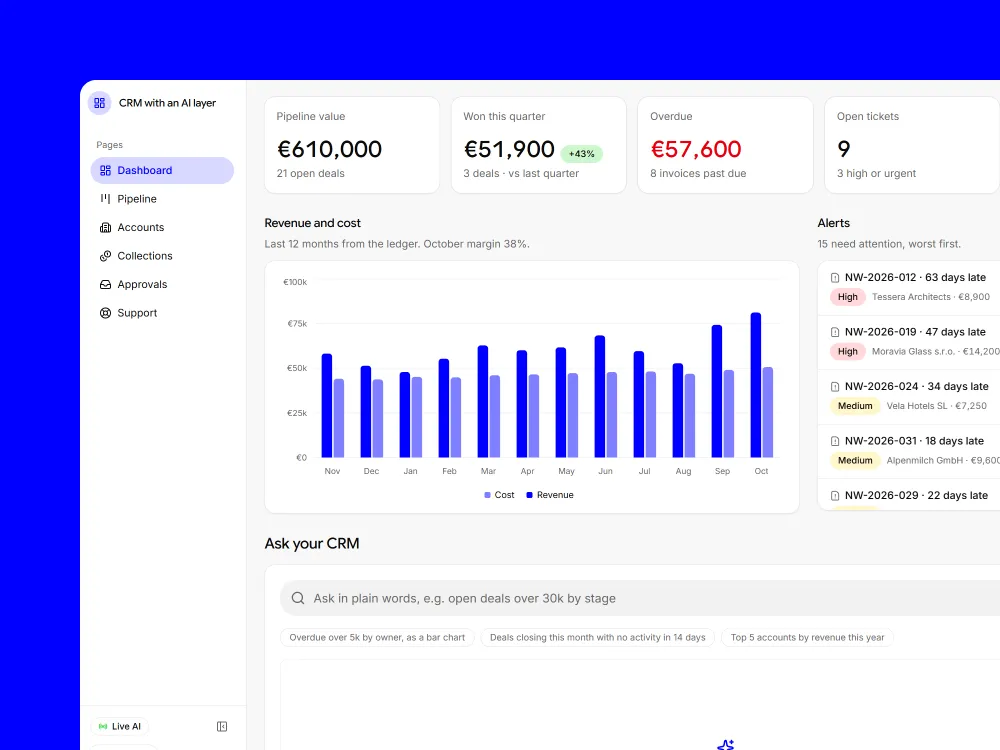
Here is an illustrative example.
Without a Company Brain: A sales rep asks the AI assistant whether the company offers discounts on multi-year contracts. The AI searches the documents, finds the standard pricing policy, and gives a confident answer. The correct answer depends on an exception framework that exists only in an email chain between the CFO and three large accounts. The AI cannot find it, because nobody ever put it where an AI can read it.
With a Company Brain: The same question reaches a record of the company’s real pricing logic: the exception criteria, the approval limits, and who can sign off. The answer is specific and correct, and it names its source. The rep does not need a follow-up meeting.
The same difference shows up in every function: onboarding a new hire, briefing an agent on a client account, or explaining why a process works the way it does. Every time someone has to ask three people, or gets a generic answer, a Company Brain closes the gap.
What does this look like in different industries?
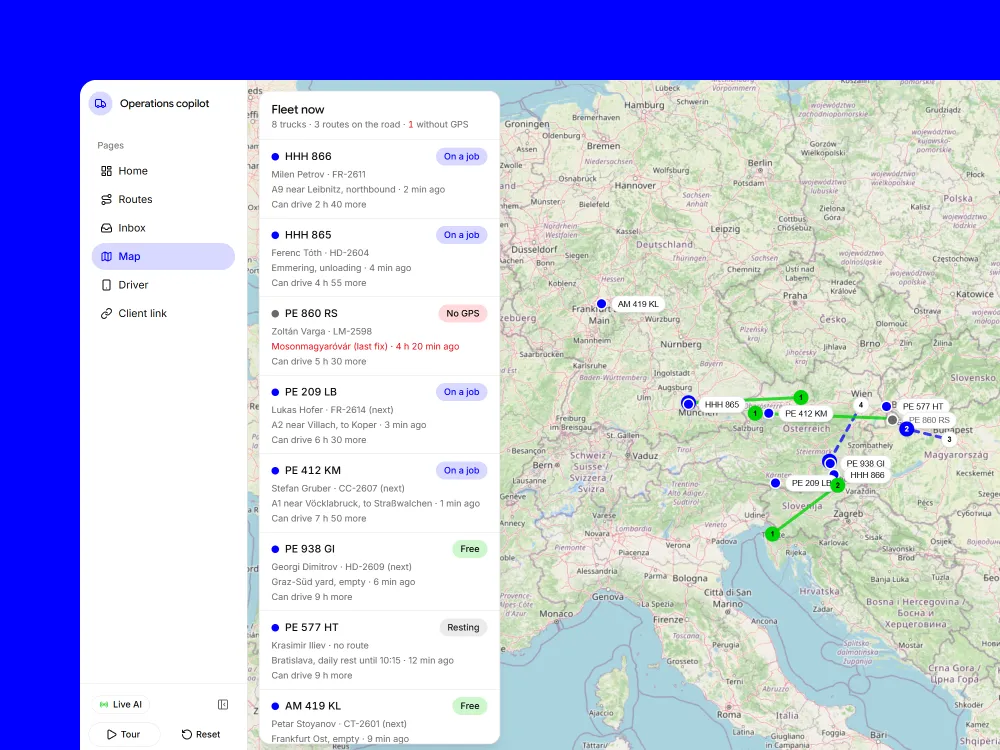
The generic answer problem is the same in every industry. The missing context differs.
- Professional services (law, accounting, advisory): The AI gives textbook answers to client-specific questions. A Company Brain holds the firm’s methods, client history, and the reasons behind past advice.
- Distribution and wholesale: The AI cannot quote prices, apply stock allocation rules, or explain who approves what. A Company Brain holds the pricing exceptions, supplier terms, and escalation paths.
- Agencies: The AI produces on-brand work only if someone briefs it every time. A Company Brain holds the client briefs, creative history, brand rules, and approval patterns, so each task starts from the right context.
In each case, the AI’s capability is not the limit. The information it works from is.
Where do we start?
Switching models or buying another tool treats the symptom. The cause is that the business has no maintained record of how it runs, and every new AI tool starts from that same empty base.
A practical first step takes an afternoon. List the five questions your team asks AI most often. For each one, write down what an accurate answer would need and where that information lives today. The gap between what the AI can see and what those answers need is the shape of the Company Brain you need. For the full method, read how to build a Company Brain.
This is also how Superstate works with clients. We start with a sixty-minute meeting, then talk to the people who do the work and follow a few real jobs from start to finish. On that map we build the Company Brain. It captures what the company already says and writes (meetings, calls, chats, emails, documents), and every answer shows the page it came from. If an answer is wrong, you correct it, and the brain remembers.
The model is not the product. The context is. Generic answers are the symptom, and a maintained record of how your company works is the fix.
Frequently asked questions
Why doesn’t ChatGPT know how my company works?
ChatGPT and other general AI tools were trained on public data, not on your company’s processes, decisions, or clients. They know how businesses in general work, not how yours does. Unless they can read a maintained record of how your company actually runs, generic answers are the only answers they can give.
Why doesn’t connecting AI to more of our systems fix generic answers?
Connecting more systems improves retrieval, not understanding. An AI that searches your CRM, email, and documents at once finds mentions, but it cannot tell which email overrides the written policy or which exception is now the rule. That reasoning has to be organized in one place before any tool can use it.
Can I fix generic AI answers by adding more to the system prompt?
A system prompt works for narrow tasks that do not change. It breaks when the context is large, changes often, or must be the same across many tools and people. Someone has to update every prompt by hand each time a price or policy changes, and prompts have size limits.
What information should a Company Brain hold?
It should hold how the business actually runs: decisions and the reasons behind them, how work really moves, client and supplier history, pricing and approval rules, exceptions, and the tone the company uses with clients. In short, anything an AI needs to answer a question about your company specifically instead of generically.
How do we start fixing generic AI answers?
Start with a map, not a new tool. List the five questions your team asks AI most often, then write down what an accurate answer to each would need and where that information lives today. The gap between what the AI can see and what the answer needs is the first part of your Company Brain.

Want to know more about what we do? Visit the Superstate website.