Company Brain vs Enterprise Search
Enterprise search finds documents. A Company Brain holds how your business actually works. See the difference and which one your AI needs.

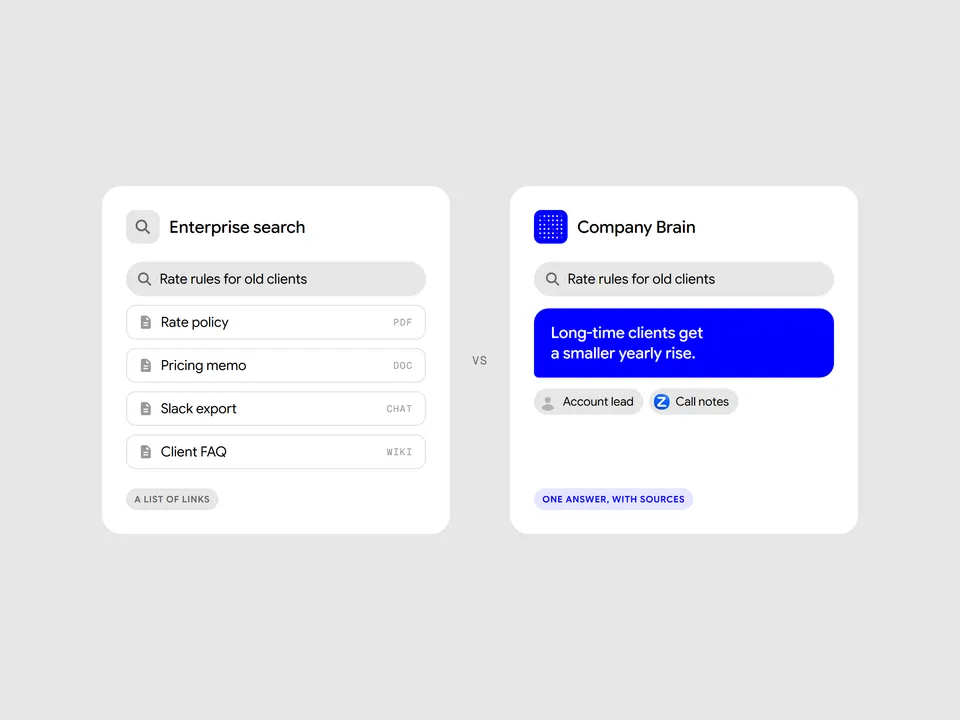
Table of Contents
- What Is the Difference Between Enterprise Search and a Company Brain?
- What Does Enterprise Search Do Well?
- How Much of Company Knowledge Was Never Written Down?
- When Enterprise Search Powers AI Agents, the Gap Becomes a Liability
- What a Company Brain Does That Enterprise Search Cannot
- Do We Need a Company Brain Alongside Enterprise Search?
- Frequently asked questions
For example, picture a 200-person professional services firm that spends six months deploying enterprise search. Every employee can now find any document, email, or wiki page in seconds. Then the firm points an AI assistant at the same index and asks how it handles rate adjustments for long-tenure clients. The AI returns four documents: a 2022 policy, a 2023 pricing memo that partly contradicts it, a Slack export, and an FAQ nobody updated after the restructuring.
The correct answer is in none of them. It lives in the head of one account manager who handled the exceptions for three years and was never asked to write them down. Search retrieved everything documented, and the AI’s answer was still wrong.
What Is the Difference Between Enterprise Search and a Company Brain?
A Company Brain is a living, queryable record of how a business works; the pillar post defines it in full. Enterprise search has a different role: it retrieves what has already been written. Understanding that distinction is the prerequisite for any AI deployment that has to work in production.
What Does Enterprise Search Do Well?
Enterprise search solves a real, painful problem. Once a company grows past a few dozen people, its documents scatter. Google Drive holds the proposals. Confluence holds the product specs. Jira holds the tickets. Email holds the decisions made informally. Notion holds the team runbooks. Slack holds everything else, and finding anything across all of it becomes archaeology.
Tools like Glean unify these sources into a single, permission-aware search interface. Employees stop hunting across tabs. They type a question and get a document in seconds. A knowledge-management statistics roundup reports that employees spend 1.8 hours every day searching for information, nearly 25% of the workday. Enterprise search cuts into that when the information being sought actually exists in a document.
The limitation is structural rather than technical. It sits in the assumption embedded in treating enterprise search as a sufficient AI context layer: that the company’s knowledge lives in its documents.
How Much of Company Knowledge Was Never Written Down?
Much of what a business knows is tacit: the expertise and operational understanding held in people’s heads rather than in company files. Only the explicit part gets documented, meaning the policies, procedures, and decisions someone cared enough to write down. We cover the pattern in The Tribal Knowledge Problem. Estimates of the tacit share vary by source, so this post makes no claim about an exact percentage.
Enterprise search indexes the explicit part. Meticulously. Comprehensively. At scale.
The tacit part — how pricing exceptions actually get decided, which clients receive out-of-policy treatment and why, what the onboarding shortcut is that saves three weeks, why the company parted ways with a particular vendor in 2024 — exists exclusively in the institutional memory of the people who made those calls. It lives in Slack threads that scrolled off the screen months ago, in meetings that were never recorded, in the mental model of the account manager who left eight months ago and took her context with her.
When AI tools run on top of enterprise search, they inherit this gap structurally. The AI can surface every document ever written about the refund policy — and still return an answer that describes how the company handled refunds in 2023, not how it actually handles them today.
When Enterprise Search Powers AI Agents, the Gap Becomes a Liability
This would be a manageable limitation if AI tools were used only for document summarization or keyword retrieval. The stakes change fundamentally when AI agents are being asked to handle consequential work: drafting customer-facing responses, routing complex exceptions, informing pricing decisions, operating autonomously across multi-step workflows. For those tasks, access to only the documented part of company knowledge is a foundation built on a fraction of what the business actually knows.
Most AI pilots fail to deliver. An MIT NANDA study put the share of company generative AI pilots that fail at about 95%, and RAND notes that by some estimates more than 80 percent of AI projects fail, twice the rate of non-AI IT projects. Enterprise search is often present in those failing stacks, and the tool performed exactly as designed. The search layer retrieved documents accurately. The documents were an incomplete representation of how the business actually operated.
Agents acting on information that has become stale or inconsistent is called context drift (see Context Drift in AI Agents). The term “drift” understates something: in many cases, the context was never complete to begin with. The AI worked from partial data — the documented slice of how the business operates, without the undocumented knowledge that determines how decisions actually get made.
The error that makes this so persistent is simple. Leaders see enterprise search delivering document retrieval reliably and assume the same infrastructure provides sufficient grounding for AI to understand the business. Document retrieval and business comprehension are different problems. They require different solutions.
What a Company Brain Does That Enterprise Search Cannot
A Company Brain addresses the structural gap. Where enterprise search asks “what documents exist about X?”, a Company Brain holds the answer to “how does this business actually handle X?” — including the large portion of that answer that was never written into a searchable file.
The comparison clarifies where the two tools diverge:
| Enterprise Search | Company Brain | |
|---|---|---|
| What it accesses | Documents, files, emails, tickets | Decisions, processes, exceptions, undocumented knowledge |
| Knowledge type | Explicit (written and saved) | Tacit + explicit (how work actually happens) |
| Primary question answered | ”Where is the document about X?" | "How does the company handle X?” |
| AI use case | Retrieval and summarization | Contextually accurate decision support |
| Freshness model | Updated when a new document is saved | Updated as business practices evolve |
| Coverage | The documented part | The documented part plus the tacit part |
The distinction shows up in specific scenarios: the exception-handling case where policy documentation and actual practice have diverged; the new-hire onboarding question that the handbook technically answers but doesn’t actually address; the AI agent routing a customer complaint who falls into an undocumented edge case. In each scenario, enterprise search returns the most relevant available document. A Company Brain surfaces how the business actually handles the situation.
Only 7% of enterprises say their data is completely ready for AI, according to a Cloudera and Harvard Business Review Analytic Services report. The gap that number describes isn’t a search problem. Enterprise search can index whatever a company has — the gap is in what the company has available to index.
A Company Brain solves a different problem: it provides the layer that captures what documentation misses — the workarounds, exception-handling routines, and operational knowledge that only surfaces when someone who holds it is specifically asked. That knowledge becomes queryable, shareable, and available to AI agents in the way that tacit knowledge in a person’s head never can be.
Do We Need a Company Brain Alongside Enterprise Search?
Three diagnostic questions help determine whether an AI deployment needs a Company Brain alongside its enterprise search:
First: When the AI returns an answer, does that answer describe how the company formally said it would operate, or how it actually operates today? Wherever those diverge — in pricing, in client handling, in operational exceptions — the search layer is returning accurate documents that describe an incomplete reality.
Second: When a key employee left in the last 18 months, how much of what they knew was captured anywhere the AI can reach? In many companies, the answer is a meaningful share of what actually matters.
Third: When a new hire asks a senior employee how something works, does the answer align with what any document says — or does the senior employee add context, caveats, and “the way we actually do it”? That gap between the document and the explanation is the gap a Company Brain exists to close.
A sixty-minute mapping meeting is a practical starting point: leadership and key operators map how the business actually works, not how the handbook describes it, and the Company Brain is built from there. At Superstate the mapping is free, and every answer the brain gives shows the page it came from. The output is an operational context layer that AI agents can rely on, rather than a search index that retrieves an incomplete picture.
The practical answer is both. Enterprise search handles document retrieval. A Company Brain provides the operational understanding that retrieval alone cannot supply. For the related comparisons, see Company Brain vs RAG and Company Brain vs Wiki.
Frequently asked questions
Is a Company Brain the same as enterprise search?
No. They are different tools solving different problems. Enterprise search retrieves existing documents. A Company Brain captures the operational knowledge and context that was never documented in the first place. A company can and often should use both: search for retrieval, a Company Brain for understanding.
Why do AI tools give wrong answers even when they have access to all company documents?
Because much operational company knowledge was never written into a document. It is held in people’s heads, not in files. Enterprise search indexes the documented part, and AI tools built on top of it can only work with that part.
What’s the difference between a Company Brain and a knowledge base or wiki?
A knowledge base is static. It captures what someone decided to document and relies on human maintenance to stay current. A Company Brain is a living, queryable system that captures how the business actually operates, including decisions and processes no one thought to document, and it updates as practices evolve.
Can enterprise search become a Company Brain with better AI?
Better AI on top of enterprise search improves retrieval quality: it finds and summarizes documents more accurately. The underlying gap remains, which is the knowledge that was never written into a retrievable document. A better search engine over an incomplete corpus still searches an incomplete corpus.

Want to know more about what we do? Visit the Superstate website.