Company Brain vs Second Brain: Key Differences
A second brain stores one person's notes. A Company Brain holds how your business works. See the differences and why companies need both.

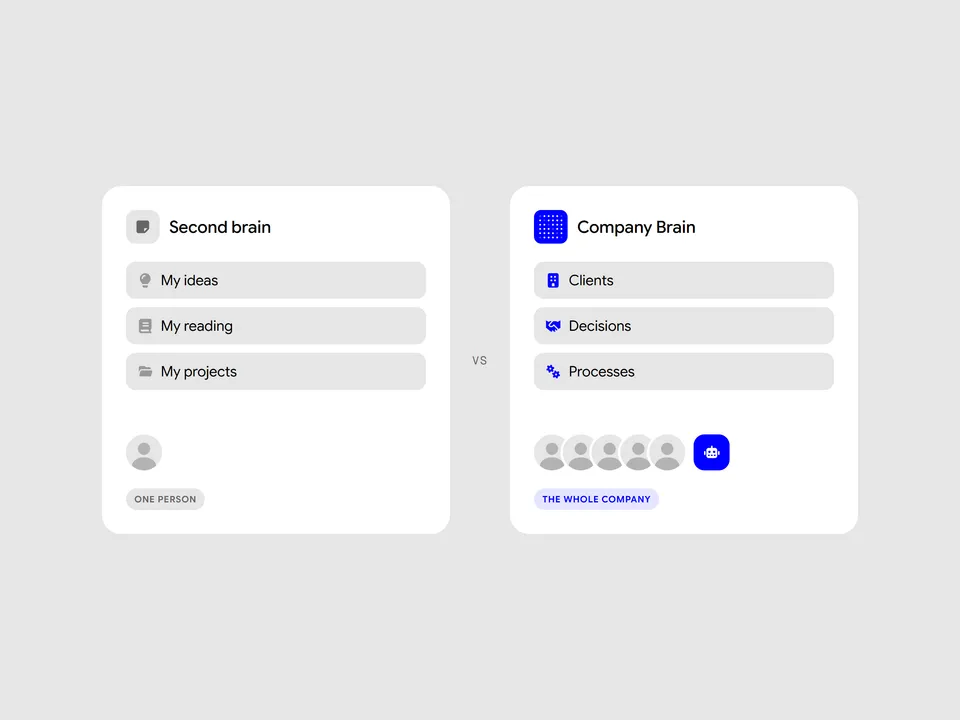
Table of Contents
- What “Second Brain” and “Company Brain” Actually Mean
- Why a Second Brain Can’t Scale to an Entire Company
- Company Brain vs Second Brain: The Core Differences
- Why do companies keep scaling the wrong system?
- What a Company Brain Actually Holds
- Where a Second Brain and a Company Brain Both Belong
- How Organizations Build a Company Brain
- Actionable Takeaway
- Frequently asked questions
Tiago Forte’s Building a Second Brain spawned a whole productivity movement: Obsidian vaults, PARA folders, and Notion templates that many knowledge workers use to organize their thinking. Yet organizations full of people with tidy personal notes still answer “where did that decision get made?” with a shrug. A company of well-organized individuals is still a company without organizational memory. This post covers what makes organizational knowledge different from personal knowledge, and what a business needs that a second brain cannot provide.
What “Second Brain” and “Company Brain” Actually Mean
A second brain is a personal system for capturing, organizing, and retrieving an individual’s own notes, ideas, research, and projects. The term, popularized by Forte’s methodology, encompasses tools like Obsidian, Roam Research, and personal Notion workspaces organized around the PARA framework (Projects, Areas, Resources, Archive). Its defining feature: it belongs to one person, maintained by one person, optimized for how one mind retrieves information.
A Company Brain is the organizational equivalent: a shared, queryable record of how a business works, available to every employee and to the AI tools operating on top of it (the pillar post defines it in full). The first time someone encounters the term, the natural assumption is that it describes a shared second brain — a team Notion workspace, a company wiki, a shared Obsidian vault. That assumption is where most organizations go wrong. A Company Brain and a second brain solve different problems with different architectures, and conflating the two is the source of most organizational knowledge failures.
Why a Second Brain Can’t Scale to an Entire Company
Personal PKM is optimized for retrieval by one person. When an individual builds a second brain, they design the taxonomy, they choose the connections, they know where to look. The system works because it’s theirs — shaped around how one mind thinks and what one person values. That personalization is the feature.
Organizations are the opposite problem. Knowledge at a company is collaborative, contested, and distributed across dozens or hundreds of people simultaneously. A pricing exception gets negotiated in a Slack thread. A refund policy gets revised in a meeting. A vendor relationship carries context spanning three account managers and two years of back-and-forth. None of this belongs in someone’s personal Obsidian vault. The time people lose searching for answers is not a personal productivity failure. It is an organizational memory problem.
The second gap is permanence. Personal knowledge walks out the door when the person does. Institutional knowledge that lives in someone’s personal notes, or someone’s head, evaporates at resignation (see Institutional Knowledge Loss and Employee Turnover). A Company Brain is designed to remain after the person is gone. A second brain, by definition, cannot make that guarantee.
Company Brain vs Second Brain: The Core Differences
The gap between the two systems becomes concrete when mapped side by side:
| Dimension | Second Brain | Company Brain |
|---|---|---|
| Owner | Individual | Organization |
| Updated by | One person | Business-wide (human + AI) |
| Accessible to | One person | Entire team + AI agents |
| Survives employee departure | No | Yes |
| Queryable by AI workflows | Rarely | By design |
| Reflects actual business processes | No | Yes |
| Handles knowledge contradictions | Manually | Structurally |
The right-hand column describes the properties required for AI agents to use organizational knowledge reliably. An AI agent answering “what’s the standard exception for our three largest enterprise clients?” needs access to shared, current, permissioned organizational context — not someone’s personal notebook. The Company Brain is what makes that answer possible. A second brain, however meticulously maintained, cannot.
Why do companies keep scaling the wrong system?
Leaders often try to speed up existing processes with AI, when the underlying architecture needs to change. Nowhere is this gap more visible than in organizational knowledge management.
The most common failure pattern: a company asks its best employees to maintain a shared Notion workspace, treating it as a collective second brain. Some fill it diligently. Most don’t. Within six months, the workspace becomes a graveyard of outdated pages, dead links, and sections marked “TBD.” The organization tried to scale the behavior of personal note-keeping into something organizational. The behavior doesn’t transfer.
Documentation also fragments. Most businesses use several separate tools, and each one captures a slice of organizational knowledge. None captures all of it. AI tools plugged into this fragmented substrate give confident, incomplete answers — because the substrate itself is incomplete. The problem predates AI; AI amplifies it.
What a Company Brain Actually Holds
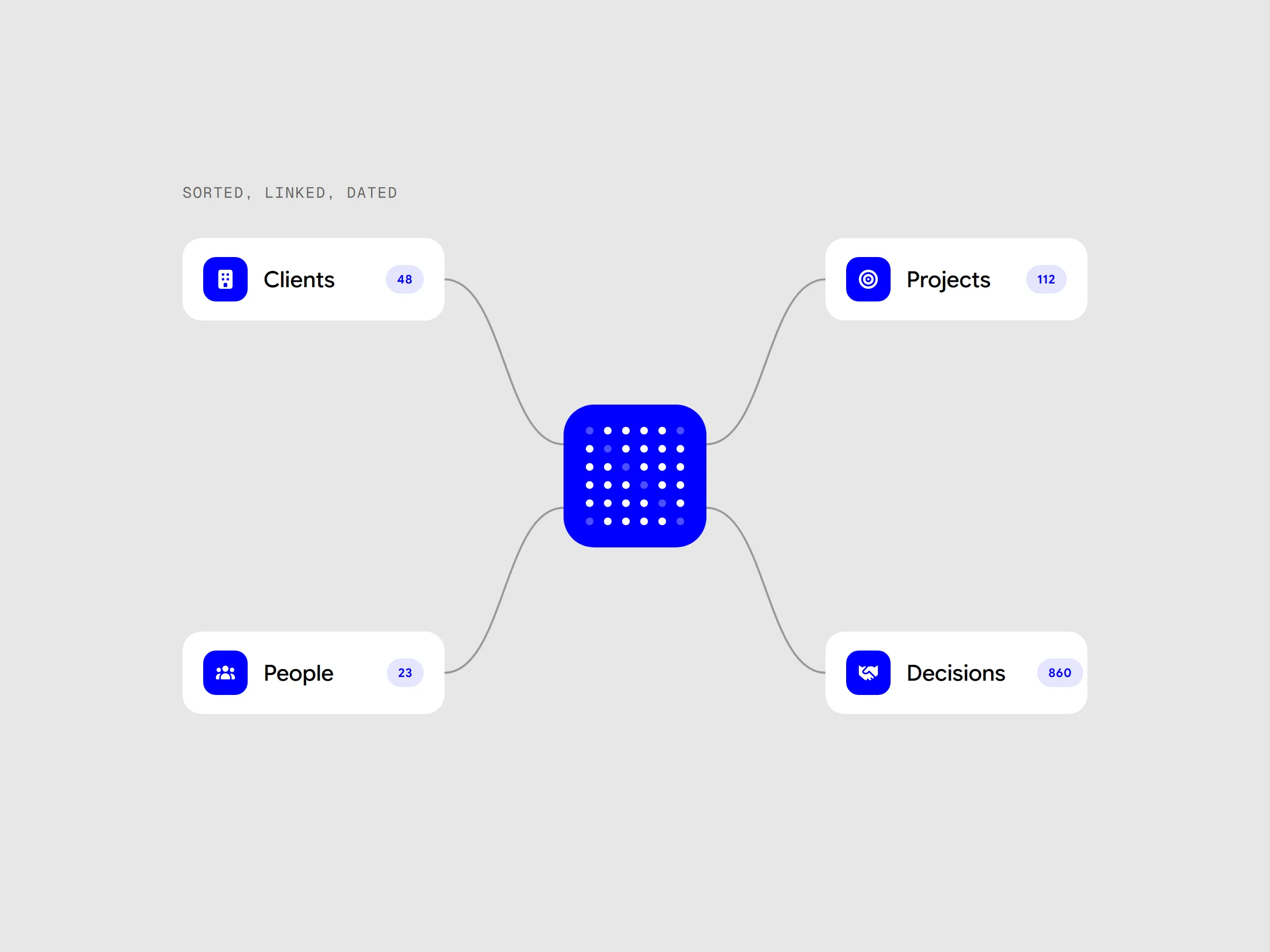
A Company Brain holds what documentation misses.
A Company Brain deliberately goes beyond static documents. It holds the logic, the exceptions, and the institutional reasoning that never make it into a wiki page: how refunds get handled, how pricing exceptions are decided, how the team responds to incidents. Most of that knowledge isn’t written down anywhere. It exists as workarounds, exception-handling routines, and tribal knowledge that only surfaces when something goes wrong (see The Tribal Knowledge Problem). The Company Brain captures that layer, not by asking employees to maintain a wiki, but by building a system that accumulates knowledge from how work actually happens. The meeting where a decision was made. The client call where an exception was negotiated.
This is the architectural distinction a second brain doesn’t address. A personal second brain captures what one person knows. The Company Brain captures what the organization knows but hasn’t yet written down — and makes it available to everyone, including the AI agents doing work on top of it. Individual second brains don’t address context drift, where AI tools act on stale or incomplete organizational context (Context Drift in AI Agents). A maintained Company Brain does.
Where a Second Brain and a Company Brain Both Belong
The two systems aren’t in competition. A company can have both — and arguably should.
High-performing individuals benefit from personal knowledge systems. The discipline of capturing and connecting one’s own ideas (in Obsidian, in Notion, in a physical Zettelkasten) improves individual output. Nothing about a Company Brain changes that calculus. Employees should maintain their own knowledge systems; the business still needs its own.
The organizational layer is what lives above the individual. A Company Brain answers questions that no single employee’s notes could answer: What did the leadership team decide in Q3 planning two years ago? What exception was carved out for the three largest clients? What process broke during the last onboarding cycle and what was the fix? What did the last three account managers each know about the company’s most complex vendor relationship?
The distinction matters for AI deployment specifically. A personal second brain might be queryable by an individual’s personal AI assistant. Organizational AI agents — the ones doing work across the business — need access to a shared, permissioned, current organizational substrate. That’s a different requirement, met by a different architecture.
Both systems can coexist: personal knowledge compounds for the individual, organizational knowledge compounds for the business. The mistake is assuming one substitutes for the other.
How Organizations Build a Company Brain
Building a Company Brain starts with mapping what the business actually knows — not what’s written in the documentation, but the decisions, processes, and context that live in people’s heads and in meeting rooms.
A practical approach starts with a mapping meeting: leadership maps the core of how the business works, and conversations with the people who do the work surface the undocumented knowledge that typically disappears on departure. The mapping session produces the foundation — a living record that reflects actual operations, not an idealized version of them.
From there, the Brain is maintained as an active system that updates as the business evolves: new decisions are captured, outdated processes are revised, exceptions are logged. The delivery model is map, then build, then maintain over time. The goal is an organizational memory layer that AI agents can draw on reliably — so when an agent handles a refund exception, a pricing request, or a client escalation, it operates on current, verified organizational context rather than a three-year-old policy document nobody’s opened since onboarding.
The entry point is low-friction. At Superstate the first step is a free sixty-minute meeting, and you pay only if you say yes to the offer that follows. Our guide to building a Company Brain covers the full path. If you are weighing a shared wiki instead, read Company Brain vs Wiki.
Actionable Takeaway
The second brain movement correctly identified a fundamental problem: human memory is unreliable, and knowledge compounds when externalized into a system. The methodology works — for individuals.
The same logic applies at the organizational level. Employees can and should maintain their own knowledge systems. The business still needs its own. Not a shared wiki that nobody maintains, not a data lake that nobody queries in plain English — a Company Brain: a shared, living record of how the business actually works, queryable by anyone and by any AI tool that needs to act on it.
The question to ask isn’t whether your employees should use Obsidian or Notion. The question is whether the organization has built the layer where what the business knows — not what individual employees know — is stored, maintained, and available. For organizations deploying AI tools, that layer determines whether those tools give useful answers or confidently wrong ones.
Frequently asked questions
What is the difference between a second brain and a Company Brain?
A second brain is a personal system, built by one person for one person, to capture their own notes, ideas, and research. A Company Brain is an organizational system. It is shared across the business, maintained as a living record of how the company actually operates, and queryable by employees and AI agents alike. The two serve different purposes at different scales.
Can a company’s Notion workspace serve as a Company Brain?
Not on its own. A Notion workspace is a documentation tool. Documentation captures what someone chose to write down, while a Company Brain captures how the business actually works, including the exceptions, workarounds, and decisions that never make it into a wiki page. A shared workspace that nobody maintains also goes stale.
Does a Company Brain replace employee second brains?
No. Individual knowledge systems such as Obsidian, Roam, or personal Notion setups compound value for the individual and are worth keeping. A Company Brain works at the organizational level: it holds knowledge that belongs to the business rather than any individual, and it persists after employees leave.
Why do AI tools give generic or wrong answers about my company?
AI tools have broad general knowledge but no access to how your specific business works: its processes, decisions, client exceptions, and history. Without a Company Brain, they answer from generic training data instead of organizational context. The Company Brain is the layer that supplies that context.
What is the first step to building a Company Brain?
Map what the business actually knows, not just what is documented: how decisions get made, how processes really run, and what context lives in team members’ heads. A mapping meeting with leadership, followed by conversations with the people who do the work, surfaces that undocumented layer. It is the foundation the Company Brain is built on.

Want to know more about what we do? Visit the Superstate website.