When Employees Quit, Your Institutional Knowledge Quits Too
Institutional knowledge leaves when employees do. Why documentation fails to stop it, and how a Company Brain keeps it.

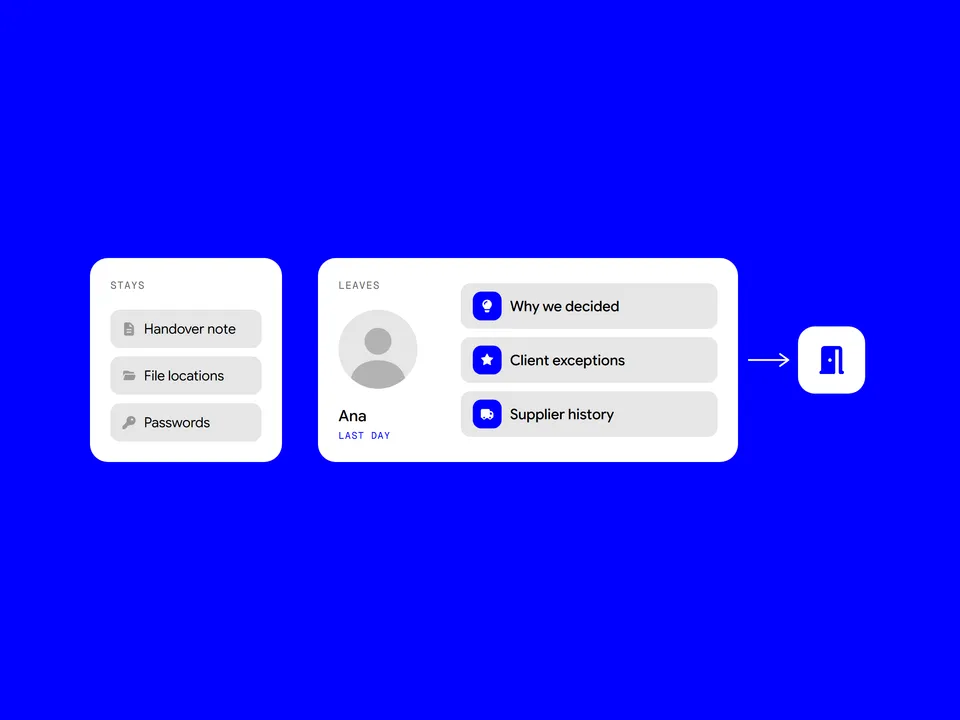
Table of Contents
How much is at stake? Panopto’s Workplace Knowledge and Productivity Report found that 42% of the knowledge needed to do a job is unique to the person doing it and shared with no colleague (HR Dive). Panopto is a vendor, so read it as indicative. This article is about institutional knowledge loss: what disappears when people leave, why the usual fixes fail, and how to close the gap. It is part of our series on organizational memory.
What Actually Leaves When Someone Quits
Most companies think about turnover in terms of the org chart: a seat opens, you hire to fill it. The real loss is harder to see.
When a ten-year employee leaves, you lose the documented stuff - passwords, file locations, a half-finished handover doc. That part is recoverable. What you cannot recover is the undocumented layer: why the biggest client gets billed differently, which supplier to never trust with a rush order, the exact reason the refund policy has that one strange exception. This is the layer that made them valuable, and it is exactly the layer nobody writes down.
The cost is hard to measure, and the numbers come from vendors. The same Panopto study estimates that inefficient knowledge-sharing costs a large U.S. business $47 million a year in lost productivity, and that knowledge workers lose 5.3 hours a week waiting for information or recreating what already exists (HR Dive).
This is the tribal knowledge problem in its purest form. The company runs on memory that lives in people, not systems. It works fine until the people move.
Why “Just Write It Down” Doesn’t Save You
The obvious answer is documentation. Build a wiki. Mandate handover notes. Make everyone update Confluence.
Every company has tried this, and every company has the same graveyard of half-dead pages to show for it. Documentation fails for three reasons that no amount of discipline fixes.
First, it is a snapshot of a moving target. A process documented in January is wrong by March, because the business changed and nobody circled back to the doc. A wiki is only as current as the last time a busy person remembered to maintain it - which is to say, rarely.
Second, people document what they think matters, not what actually matters. The exceptions, the judgment calls, the “we tried that in 2023 and it blew up” - that is the valuable part, and it is the part that never makes it into a clean SOP.
Third, nobody reads it. The onboarding doc that took a week to write gets skimmed once and abandoned, because asking a colleague is faster than searching a stale archive. Documentation is not the same as memory. A filing cabinet stores paper; it does not answer questions.
This is the common blind spot: leaders try to fix a broken process by doing more of it, instead of redesigning it. More documentation is a faster horse. The problem is not that your wiki is too small. The problem is that knowledge belongs in a living system, not a static file someone has to feed by hand.
Why Your New AI Tools Make It Worse, Not Better
Here is the trap most businesses are walking into right now. They lose knowledge to turnover, so they bolt on an AI assistant and expect it to remember what the humans forgot.
It does the opposite. An AI tool that has not been given your company’s context does not know your product, your pricing rules, or the reason behind that odd refund exception. So it does what these tools do when starved of context: it answers confidently and generically. It writes the email a smart stranger would write - polished, plausible, and wrong for your business.
Feed it stale or scattered information and the failure gets worse. The facts changed, but the AI was never told. We cover that in why AI agents give wrong answers over time. Across the market, MIT NANDA found about 95% of generative AI pilots at companies failing (Fortune).
The models are not the problem. The context is. Only 7% of enterprises say their data is completely ready for AI, according to Cloudera and HBR Analytic Services. Bolting intelligence onto a business with no memory produces a genius with amnesia - brilliant in the moment, relearning everything every morning.
What a Company Brain Does Instead
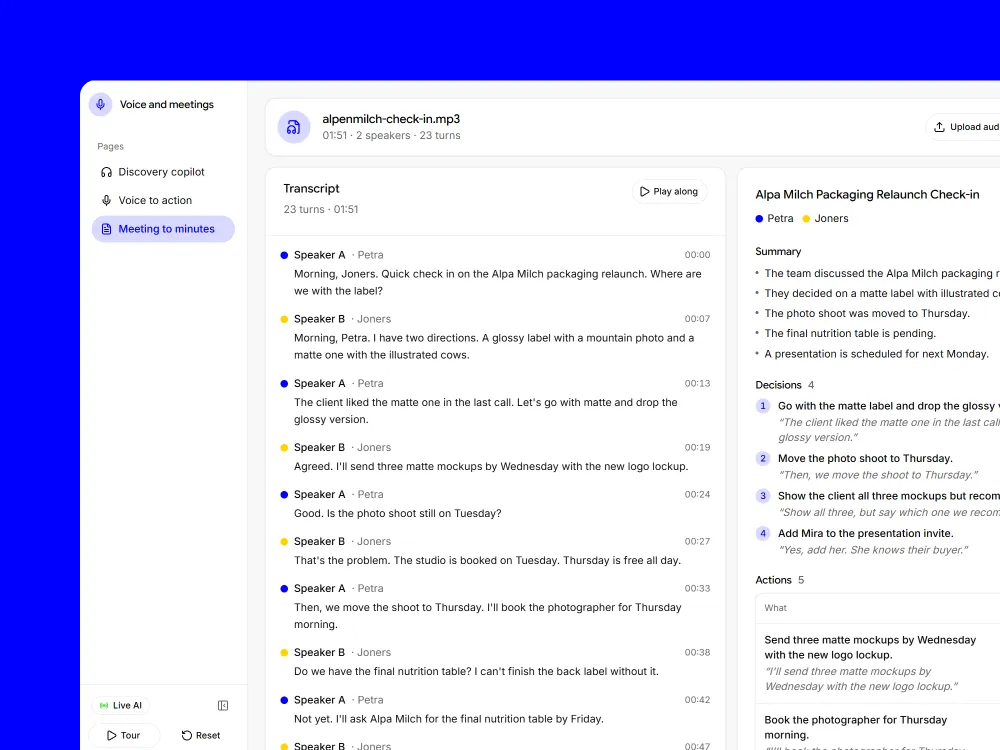
A Company Brain is a living, queryable record of how the business works, which both humans and AI can query in plain language. For how it differs from a wiki, see Company Brain vs wiki.
The distinction matters most exactly when someone quits. A wiki relies on that person having written things down before they left. A Company Brain captures how the business works as work happens, so the knowledge is already out of their head before the resignation letter lands. When the ten-year employee walks, the reasoning behind the odd billing rule is still there to be asked.
Here is how the common approaches compare when an employee leaves:
| Capability | Static Wiki / Notion | Off-the-Shelf AI Tool | Company Brain |
|---|---|---|---|
| Captures undocumented “why” | No - only what’s written | No - starts from zero | Yes - captured as work happens |
| Stays current automatically | No - goes stale | N/A - no memory of you | Yes - living record |
| Survives an employee quitting | Only if they documented it | No | Yes |
| Feeds AI accurate context | No | No - generic answers | Yes - answers know your business |
| Someone must maintain it by hand | Yes | N/A | No |
The difference between an AI tool and a Company Brain is the difference between a smart stranger and a great employee. One knows everything about the world and nothing about you. The other knows how you actually work - and does not quit.
What to Do Tomorrow Morning
Start by naming your single point of failure. Ask one question: if the person who understands [your billing / your biggest account / your production process] gave notice today, how much of what they know exists anywhere but their head? For most businesses the honest answer is “almost none,” and that is the exposure to fix first.
Then map it before you automate anything. The mistake is buying AI tools and hoping they absorb the knowledge by osmosis. Build the foundation first. Superstate starts with a free mapping of how your company works, which begins with a sixty-minute meeting and talks with the people who do the work. You leave with a map of how the business runs. Also read how to get new hires productive faster.
The question is not whether your best people will eventually leave. They will. The question is whether their knowledge leaves with them - or stays behind, working for you, long after they have moved on.
Frequently asked questions
What happens to company knowledge when an employee quits?
The knowledge stored only in their head leaves with them. Panopto found that 42% of the knowledge needed to do a job is unique to the individual, so colleagues cannot easily do that part of the work once the person is gone. Documentation captures a fraction; the reasoning, exceptions, and context usually walk out the door.
What is institutional knowledge loss?
It is the disappearance of a company’s accumulated understanding of how it actually works, including its decisions, processes, and context, when the people who hold it leave or forget. It is invisible on a balance sheet but shows up as repeated mistakes, slow onboarding, and AI tools that give generic answers.
How is a Company Brain different from a wiki?
A wiki is a filing cabinet someone has to fill and maintain, and it goes stale when reality changes. A Company Brain is a living, queryable record of how the business works that stays current and feeds AI tools accurate context, so knowledge does not depend on one person remembering to write it down.
Why do AI tools give outdated or generic answers about my business?
Because they were never given your company’s context: its rules, decisions, and the way you actually do things. Fed stale or scattered information, they produce confident wrong answers. The facts changed, but the AI never learned it.
How do companies prevent institutional knowledge loss?
By moving operational knowledge out of individual heads and into a living system that captures it as work happens. A good start is a mapping of how the business works, with leadership and the people who hold the context, to draft a Company Brain that holds decisions, processes, and context in one queryable place.

Want to know more about what we do? Visit the Superstate website.