Company Brain vs RAG: Why Retrieval Isn't Memory
Company Brain vs RAG: RAG retrieves similar text on every question. A Company Brain remembers how your business works. Learn which one you need first.

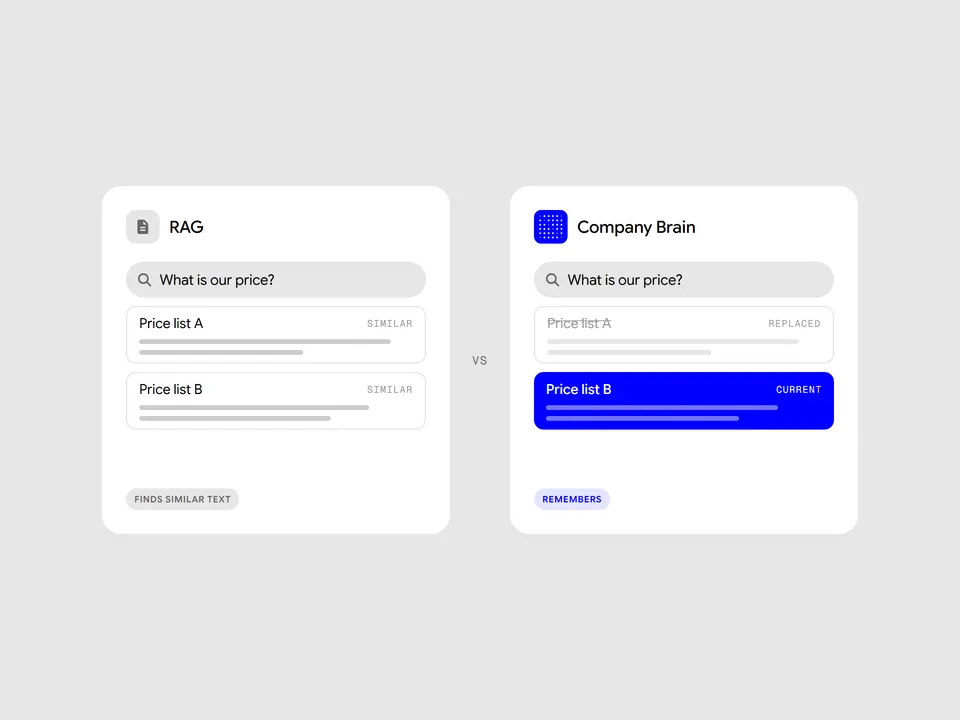
Table of Contents
That gap explains a lot of disappointment. One write-up of vendor estimates says 70% to 80% of enterprise RAG projects never reach production. Buyers were told RAG would make an AI model “know” their business. So why does it keep returning answers that are outdated, incomplete, or flatly wrong?
For a business trying to get reliable work out of AI, the gap between retrieving and remembering is the whole game. This is the core of company brain vs RAG.
What Is RAG, in Plain English?
RAG stands for retrieval-augmented generation. Strip the acronym and it works like this: when someone asks the AI a question, the system runs a quick search across a pile of your documents, grabs the handful of text chunks that look most similar to the question, and staples them onto the prompt before the model answers.
Think of an intern who has never read your files. Every time you ask a question, they sprint to the filing cabinet, pull the three folders whose labels best match your words, skim them, and answer on the spot. Then they forget everything and put the folders back. Next question, they sprint again.
That is retrieval. It is genuinely useful. It is also not the same thing as knowing your business.
What Is a Company Brain?
A Company Brain is a living, queryable record of how a business actually works; the pillar post defines it in full.
The distinction that matters here: a Company Brain is a maintained understanding, not a search index. It has already done the work of deciding what is true, what is current, and how the pieces connect. When a question comes in, it does not re-derive your business from scratch.
RAG is a plumbing technique that might live somewhere inside that system. A Company Brain is the thing that makes the plumbing worth having.
Retrieval Isn’t Memory: The Core Distinction
Here is the failure that RAG-alone cannot escape. Similarity is not truth.
RAG fetches the text that most resembles the question. It has no way of knowing whether that text is the current policy or last year’s, the decision you kept or the one you reversed, the real reason or the after-the-fact rationalization. It grabs what looks close and trusts it. When the underlying pile is stale or contradictory — and every real company’s pile is both — RAG returns confident wrong answers with no error thrown.
That is not a hypothetical. The slow rot of information that falls out of date without anyone noticing is called context drift, and it hits any system that retrieves from a pile nobody maintains. We cover it in Context Drift in AI Agents.
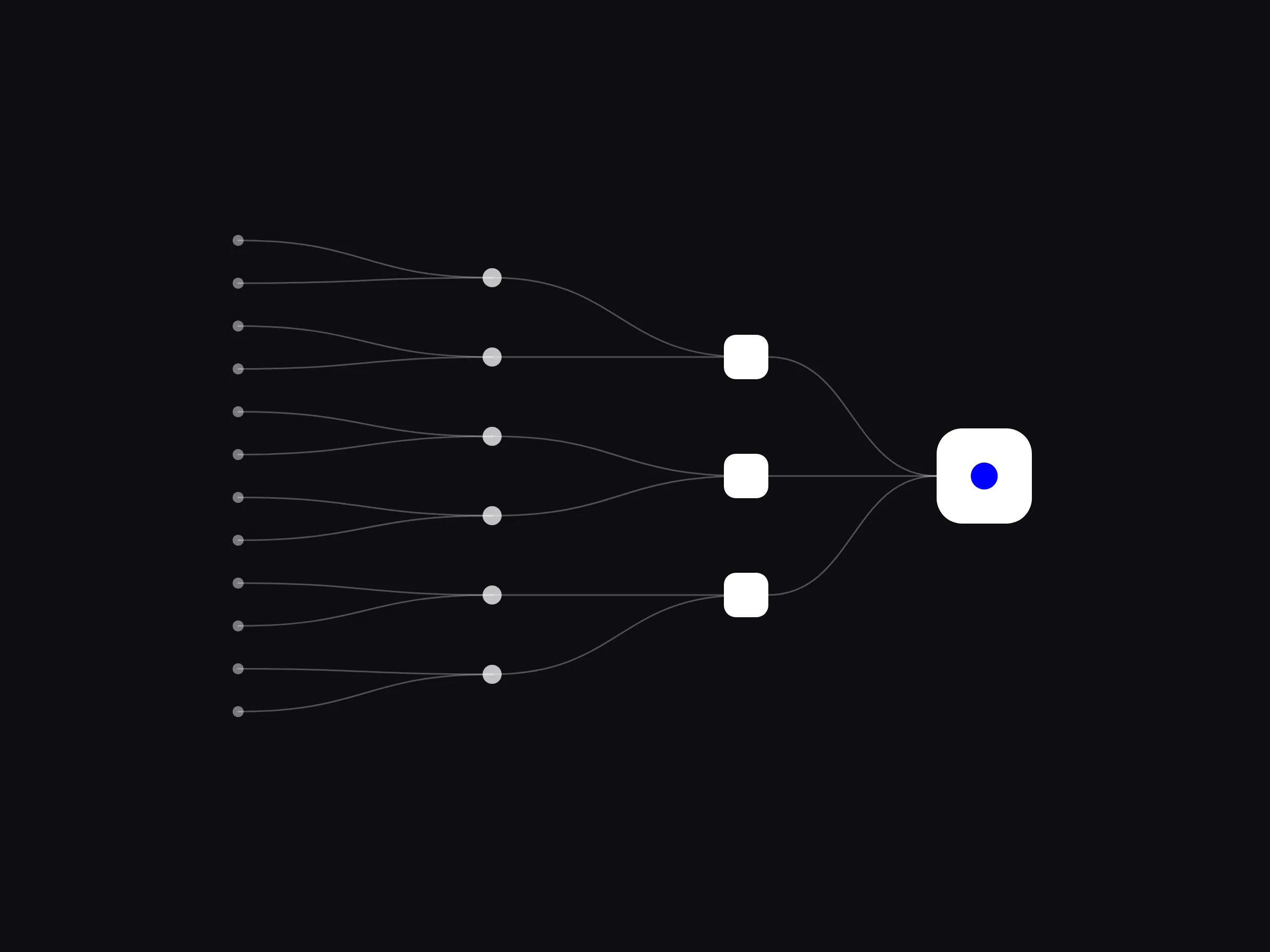
A memory system is built to fight exactly this. It reconciles contradictions instead of retrieving both sides at random. It carries the why behind a decision, not just the document that recorded the what. It stays current as a maintained asset rather than a frozen snapshot indexed once and left to decay.
This is why the pattern is shifting. On June 30, 2026, LangChain’s Harrison Chase published “Wiki Memory” — the idea that an agent should turn raw source data into a compact, persistent knowledge layer, instead of retrieving raw chunks on every query. He wrote that this is “different from basic RAG”: RAG usually retrieves raw chunks at query time, while a wiki precomputes and maintains a higher-level synthesis. The frontier of the field is quietly walking away from “retrieve more” and toward “remember better.”
Company Brain vs RAG: Side by Side
| Dimension | RAG (Retrieval) | Company Brain (Memory) |
|---|---|---|
| What it is | A technique that fetches similar text chunks at query time | A living system that holds how the business actually works |
| When it does the work | On every question, from scratch | Once, then maintained and reused |
| What it returns | Text that resembles the question | A reconciled, current understanding |
| Handles contradictions | No — retrieves both, picks by similarity | Yes — reconciles to what is actually true |
| Carries the “why” | Only if it happens to be in a chunk | Yes — decisions and their reasons are the point |
| Goes stale | Silently, as documents rot | Stays current as a maintained asset |
| Scope | A search layer over documents | The foundation AI and agents operate on |
Read that table one way and the takeaway lands: RAG answers “what does a document say?” A Company Brain answers “how does this business work?” Those are different questions, and only one of them is what a leader actually needs from AI.
Why “Just Add RAG” Fails Without a Foundation
The deeper problem is architectural. Most companies bolt RAG onto a business that has no foundation underneath it — no single, reconciled account of how the work is done. RAG then faithfully retrieves from that mess. Garbage in, confident garbage out.
The numbers around this are stark. Only 7% of enterprises say their data is completely ready for AI, according to a Cloudera and Harvard Business Review Analytic Services report. An MIT NANDA study put the share of company generative AI pilots that fail at about 95%. Neither number points at the models. They point at the foundation — the AI has nothing solid to stand on, so it guesses, and RAG hands it better-sounding material to guess from.
This is a common blind spot: leaders try to make an existing, broken process faster by pointing AI at it, instead of building the layer that would make the AI reliable in the first place. Adding retrieval to a company with no maintained memory is optimizing the sprint to the filing cabinet. The real fix is to stop needing the sprint.
It is also worth being precise about two adjacent tools, because buyers conflate all three:
- RAG is a retrieval technique. It finds text.
- Enterprise search finds documents. It doesn’t understand the business.
- A Company Brain is the understanding itself — the reconciled, current model of how the business runs that the other two can, at best, feed.
How a Business Actually Gets One
The honest answer to “how do we build memory instead of just retrieval?” is not a software download. It starts with mapping what your business actually knows. Our guide to building a Company Brain walks through the steps.
The practical path is a mapping session: a working session where the goal is to capture how the company really operates. How refunds actually get handled. How pricing exceptions really get decided. Why the process is the way it is, including the parts that live only in people’s heads and never made it into any document RAG could retrieve.
From that map, the Company Brain gets built and then kept current as the business changes. That maintenance is the entire point — it is what separates a living memory from a wiki that goes stale the day after it is written. Map, build, run. The retrieval plumbing, if you need it, slots in underneath. It was never the hard part.
The Takeaway
If your AI tools give generic, outdated, or confidently wrong answers, more retrieval will not save you. You can tune the search, add reranking, stack a graph index on top — and the field is doing all of that — but you are still answering “what does a document say?” when the business needs “how do we actually work?”
Tomorrow morning, ask a different question about your AI stack. Not “how good is our retrieval?” but “does anything in our system actually remember how this company operates — or does it re-guess every time someone asks?” If the answer is re-guess, you don’t have a memory problem you can retrieve your way out of. You have a foundation that hasn’t been built yet.
Capable models are now widely available. Context — the reconciled, living record of how your business runs — is the scarce asset. Retrieval finds text. A Company Brain is where that context finally lives.
At Superstate we start with a free sixty-minute mapping meeting, then build the Company Brain on that map. Every answer it gives shows the page it came from. For the other common comparisons, see Company Brain vs Enterprise Search and Company Brain vs Fine-Tuning.
Frequently asked questions
Is a Company Brain the same as RAG?
No. RAG is a technique that fetches similar document chunks and passes them to an AI model at query time. A Company Brain is a living, maintained record of how a business actually works: its decisions, processes, and context. RAG can be one plumbing detail inside a Company Brain, but on its own it retrieves; it does not remember, reconcile, or stay current.
Why does RAG give wrong or outdated answers?
RAG returns whatever text is most similar to the question, whether or not that text is true or current. When the underlying documents are stale or contradictory, which is normal, it confidently returns the wrong thing. The model can be fine; the retrieval step has no way to tell a current policy from an old one.
What’s the difference between retrieval and memory?
Retrieval finds text that looks related to a query and repeats that search on every question. Memory is a maintained, reconciled understanding that persists and improves. It has already decided what is true and current, so it does not re-derive the business from scratch each time.
Can I just improve my RAG pipeline instead of building a Company Brain?
You can make retrieval better with hybrid search, reranking, and graph indexes. But those upgrades still answer “what does a document say,” not “how does this business work.” Without a maintained memory underneath, better retrieval just fetches better-looking material to guess from.
Does a Company Brain replace RAG entirely?
Not necessarily. Retrieval can be a useful component inside a Company Brain. The point is ordering: the reconciled, living understanding of the business comes first, and retrieval serves it, not the other way around.

Want to know more about what we do? Visit the Superstate website.