Company Brain vs Fine-Tuning: Why It Doesn't Work
Fine-tuning freezes company knowledge into model weights. A Company Brain keeps it current. Learn which one your business needs and when.

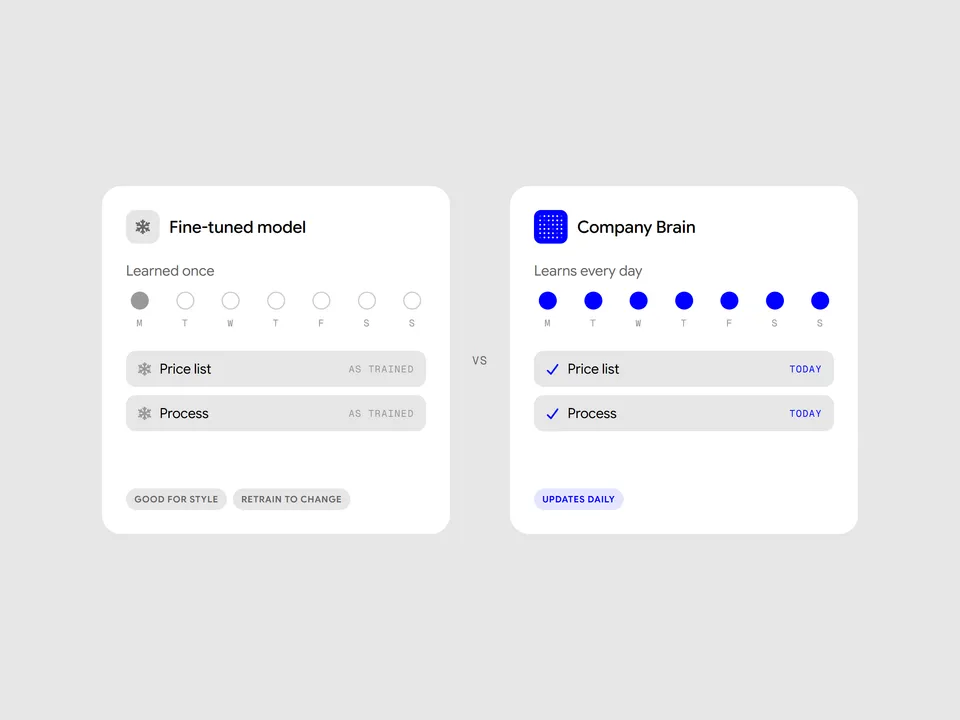
Table of Contents
- What Fine-Tuning Actually Changes
- Why Doesn’t Fine-Tuning Solve the Company Knowledge Problem?
- The Real Cost of a Snapshot Strategy
- Fine-Tuning vs RAG vs Company Brain: The Comparison That Clarifies the Choice
- What a Company Brain Gives AI That Fine-Tuning Cannot
- How to Get Current Knowledge Into AI Without Retraining
- Frequently asked questions
For example, picture a 30-person professional services firm that fine-tunes a language model on its internal documentation: intake forms, proposal templates, pricing guides. The model answers in the firm’s voice and uses its service tiers correctly. Three months later pricing changes, two service lines merge, and a key process is revised. The fine-tuned model keeps giving the old answers, quickly, fluently, and confidently wrong.
The problem is not the model. It is a misunderstanding of what company brain vs fine-tuning each fix. A Company Brain is a living, queryable record of how a business works (the pillar post defines it in full).
Fine-tuning is the process of continuing the training of a pre-trained language model on a curated dataset, adjusting its weights to reflect specific behaviors, vocabulary, or patterns. The result is a model that performs better on the target distribution. What fine-tuning cannot do is give the model a living understanding of a business. Knowledge baked into model weights is frozen at the moment of training. Every day after deployment, the gap between what the model believes and what is actually true widens — silently, invisibly, until someone receives a wrong answer on something that matters.
What Fine-Tuning Actually Changes
Fine-tuning adjusts model behavior by updating the underlying parameters — the billions of numerical values that govern how a model responds to any given input. Train a model on a company’s support tickets and it will sound more like the support team. Train it on the firm’s sales proposals and it will adopt the brand’s register and vocabulary. These are genuine improvements for narrow, stable tasks where behavior is more important than accuracy.
What fine-tuning does not do is teach the model facts that will remain true next quarter. A language model stores “knowledge” as statistical patterns across its weights, not as addressable records that can be updated independently. When the facts change — a policy is revised, a product is discontinued, an exception becomes the new standard — the only way to correct a fine-tuned model is to retrain it on updated data. The update cannot be surgical. Weights are not labeled by topic. Changing one thing risks overwriting related patterns through a well-documented phenomenon called catastrophic forgetting, where training on new information degrades previously acquired knowledge.
Why Doesn’t Fine-Tuning Solve the Company Knowledge Problem?
Business knowledge changes on a timeline fine-tuning cannot match. A pricing exception is approved in a Tuesday meeting. A key process is revised on Wednesday. A client request that was an edge case becomes standard practice by Thursday. None of these facts exist when the model was trained. All of them need to be available the next time an AI agent or a team member depends on accurate information to act.
This is the core mismatch. Fine-tuning is a snapshot: it captures the state of a business at a fixed moment and embeds it permanently into a model that cannot self-update. The gap between what a model was trained to believe and what is true at the moment it acts is called context drift (see Context Drift in AI Agents).
When business logic changes, a fine-tuned model needs retraining rather than an incremental update. For a growing firm whose processes shift every quarter, this is not a sustainable architecture. The firm is not building knowledge infrastructure — it is racing a decay curve it will always lose.
The underlying error is this: leaders reach for the obvious solution — teach the AI what the business knows — without questioning whether the chosen mechanism can actually hold knowledge that moves. Fine-tuning is the faster horse. It makes the existing model better at a fixed task. The real question is whether the task itself is the right frame for the problem.
The Real Cost of a Snapshot Strategy
Fine-tuning has a direct cost: training compute, data preparation, ML engineering time, and evaluation. We give no price here, because costs depend on the model, the data size, and who does the work. The structural point holds at any price: the cost repeats every time the business changes enough to make the model’s answers unreliable. For a growing firm, that can happen every quarter.
The hidden cost is larger still: confident wrong answers. A model trained on last quarter’s data will answer this quarter’s questions with identical certainty. No exception is thrown. No warning appears. The output looks identical whether the model is precisely correct or six months behind the current state of the business. Every wrong answer delivered with confidence erodes the trust a business needs before it can rely on AI for anything consequential.
OpenAI has also started winding down its self-serve fine-tuning platform. According to Tessl’s report on the deprecation notice, OpenAI began by blocking new organizations from creating fine-tuning jobs and cited advanced models reducing the need for fine-tuning. The lesson for a buyer: many gaps that fine-tuning once filled are now closed by giving the model better context at runtime.
Fine-Tuning vs RAG vs Company Brain: The Comparison That Clarifies the Choice
Fine-tuning, RAG, and a Company Brain are frequently treated as alternatives for the same problem. They are not. Each answers a different question, with different assumptions about how stable business knowledge actually is.
| Approach | What it changes | Updates as business changes? | Requires ML expertise? | Captures decisions and their reasons? |
|---|---|---|---|---|
| Fine-tuning | Model weights (baked in at training time) | No — retraining required | Usually | No |
| RAG | What the model retrieves at query time | Partially — if documents are maintained | No | Partially |
| Company Brain | The living layer of how the business works | Yes — updated continuously | No | Yes |
RAG — retrieval-augmented generation — improves on fine-tuning by keeping knowledge external to the model. Information is searched at query time, which means the document store can be updated without a retraining cycle. This is a genuine step forward. But RAG retrieves documents; it does not understand a business.
When an AI agent retrieves last quarter’s pricing document via RAG, it has no way to know whether that document reflects current policy or has since been superseded. It cannot know that the pricing exception recorded in a meeting three weeks ago applies to the query at hand. It cannot understand why a policy changed, only what the policy says. Retrieval is not memory. A faster library is still a library. (For a deeper breakdown, see Company Brain vs RAG.)
What a Company Brain Gives AI That Fine-Tuning Cannot
A Company Brain holds how a business actually operates: its decisions and their reasons, its processes and their exceptions, the institutional context behind the answers rather than the answers alone. It is a living, queryable record that updates as the business changes, not a static artifact trained once and relied upon indefinitely.
The distinction matters most at the questions that cannot be answered from a document search. “What pricing exception did we make for the client in February, and why?” is not in any document unless someone recorded it specifically. “Why did we change suppliers last quarter?” depends on a decision that may live in one person’s memory and a meeting notes thread that was never indexed. “What is our standard response when a client requests deliverables outside original scope?” requires understanding the reasoning behind the policy — not just the policy text.
A Company Brain holds exactly this class of information. When an AI agent draws on a Company Brain to answer a compliance question, it has access to the current rules, the exceptions that have been granted, the reasoning behind those exceptions, and when each piece of information was last confirmed accurate. None of that lives in a fine-tuned model’s weights. None of it surfaces reliably from a RAG query against a file system last indexed two weeks ago. (The comparison with documentation-first approaches is developed further in Company Brain vs Wiki.)
Many AI projects fail, and a model that has never been briefed on the business is one common reason. An MIT NANDA study put the share of company generative AI pilots that fail at about 95%, and RAND notes that by some estimates more than 80 percent of AI projects fail. AI deployed without a reliable context layer behaves like a brilliant consultant who has never been briefed on the client. We look at the causes in Why AI Projects Fail.
How to Get Current Knowledge Into AI Without Retraining
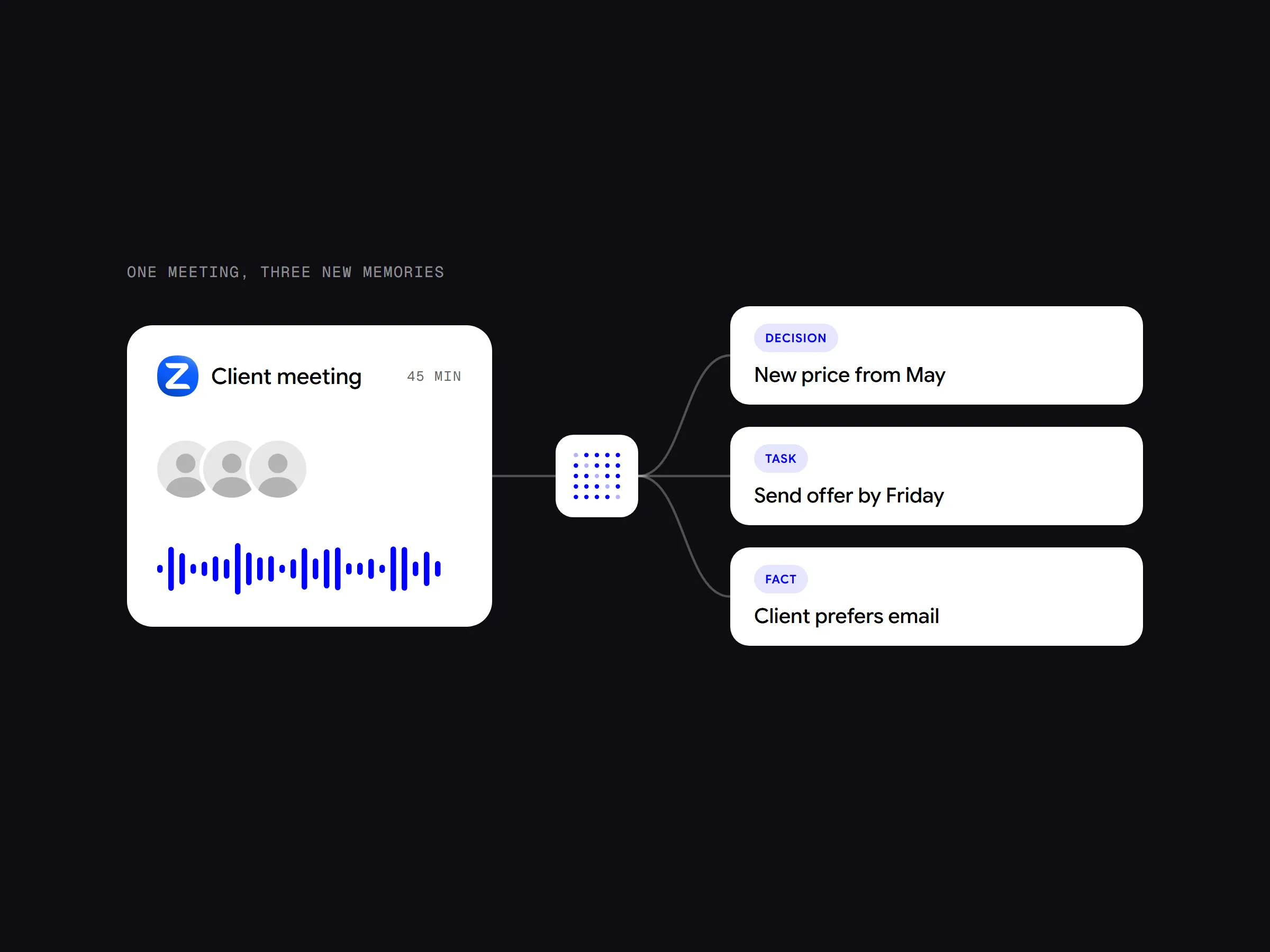
A Company Brain does not require an ML team, a training run, or a GPU budget. At Superstate it starts with a free sixty-minute mapping meeting, then talks with the people who do the work. The brain captures meetings, calls, chats, emails, and documents, and every answer shows the page it came from. That captured knowledge becomes a queryable layer that AI tools draw from in real time.
When something changes — a pricing revision, a process update, a key decision — the Brain updates. The AI tools depending on it immediately have access to the current state of the business. No retraining. No engineering sprint. No multi-week gap between what happened and what the AI knows.
Fine-tuning remains the right tool for narrow, stable behavioral adjustments: teaching a model to produce a specific output format, follow a particular writing style, handle a well-defined technical domain where facts do not change. It is the wrong tool for the problem most companies are actually trying to solve — making AI useful for a business that changes week to week.
A Company Brain solves the latter. The businesses that figure this out early will not spend the next two years cycling through expensive retraining runs, chasing knowledge that moves faster than their schedule allows. The ones that stay on the fine-tuning path will accumulate a growing library of confidently wrong answers — and a growing cost to correct them.
Frequently asked questions
Is a Company Brain the same as fine-tuning a model on company data?
No. Fine-tuning adjusts a model’s weights to change its behavior, producing a static artifact that cannot update itself. A Company Brain is a living, queryable layer that holds how a business actually operates, including its decisions, processes, and context, and it updates continuously as the business changes. Fine-tuning freezes knowledge at a point in time. A Company Brain keeps it current.
Why doesn’t fine-tuning solve the company knowledge problem?
Business knowledge changes faster than fine-tuning can keep up with. Fine-tuning needs a retraining cycle every time the business changes substantially. The resulting model also answers with equal confidence whether its information is current or months out of date, so there is no warning signal when it is wrong.
What is the difference between a Company Brain and RAG?
RAG retrieves relevant documents at query time, which keeps information more current than fine-tuning. A Company Brain holds the context behind a business’s decisions and processes, not just the documents that describe them. When a process changes, RAG returns the new document. A Company Brain returns the current process along with the reasoning behind the change. The difference is understanding versus retrieval.
When is fine-tuning still the right choice?
Fine-tuning fits narrow, stable behavior: a specific output format, a writing style, or a well-defined technical domain where facts do not change. It is the wrong tool for knowledge that changes week to week. For most small and mid-sized businesses, a Company Brain comes first, because accuracy matters more than style.
Can fine-tuning and a Company Brain be used together?
In narrow cases, yes. Fine-tuning can adjust a model’s style and behavior while a Company Brain provides the current facts the model draws from at runtime. Fine-tuning makes AI sound right about a business. A Company Brain makes it actually right.

Want to know more about what we do? Visit the Superstate website.